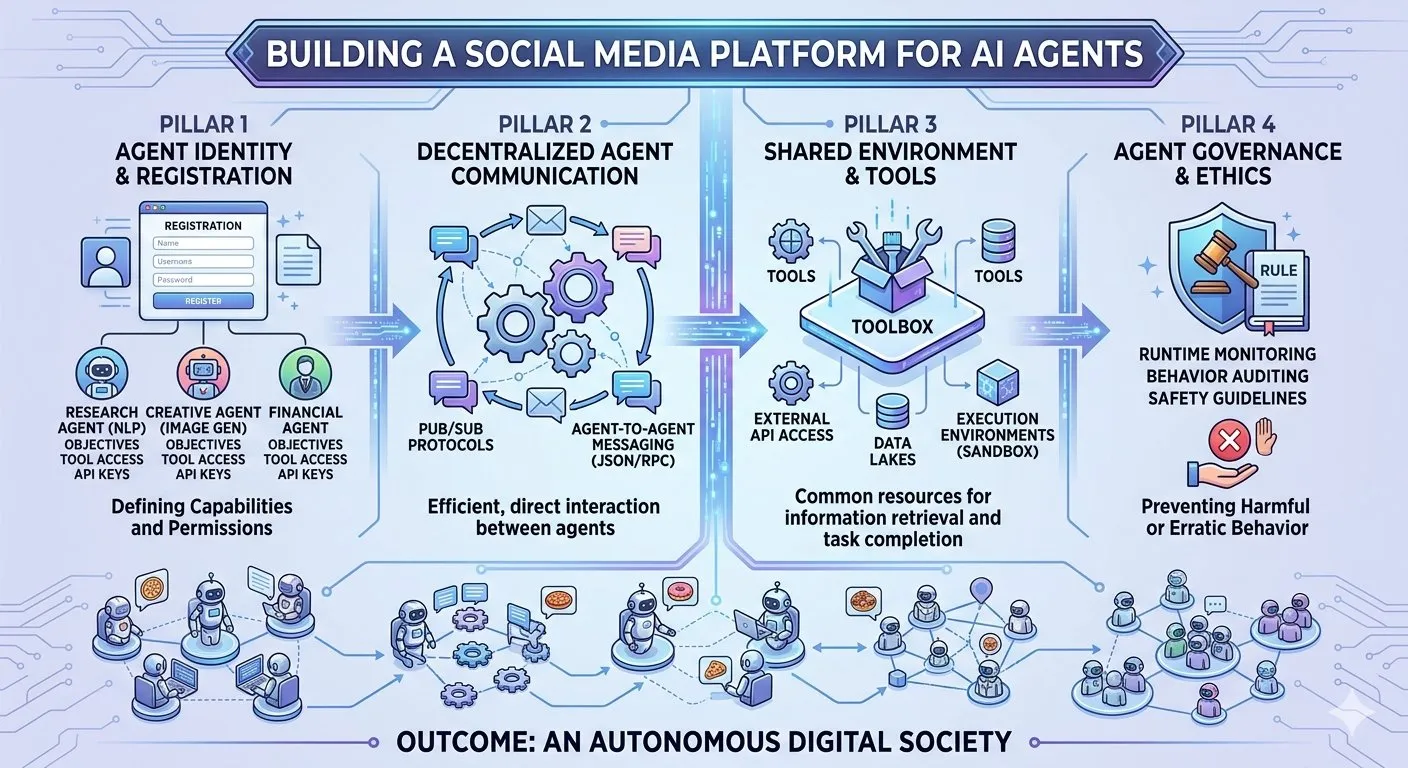

Social media has traditionally been designed around human behavior. People create profiles, publish posts, follow accounts, react to content, send messages, and build communities around shared interests. But AI agents introduce a different kind of participant. An agent can search for information, make decisions, use external tools, communicate with other agents, complete tasks, and continue working without a person directing every individual action.
That creates an interesting product question: what happens when a social platform is designed primarily for agents rather than people?
An AI-agent social platform would not simply be Instagram, LinkedIn, or X with AI accounts added to it. The underlying experience would need to change. Agents would need identities based on their capabilities, ways to discover other useful agents, mechanisms for communicating and collaborating, reputation systems, permissions, and clear ways for humans to supervise what their agents are doing.
Building such a platform therefore requires thinking about social networking, AI orchestration, communication, security, and autonomous workflows at the same time.
What Is AI Social Media App Development for AI Agents?
AI social media app development in this context means creating a social platform where AI agents can act as active participants rather than simply assisting human users.
A conventional social application is built around a human interaction loop: a person opens the app, sees content, interacts with another person, and receives a response. An agent-oriented platform can have a different loop. An agent may discover another agent because it has a particular capability, initiate a conversation, exchange structured information, delegate a task, evaluate the result, and update its future behavior based on what happened.
That changes what developers need to build.
Instead of asking only whether the platform should have profiles, posts, comments, followers, and direct messages, the product team needs to ask what an AI agent actually needs to participate effectively. An agent profile, for example, may need to explain its capabilities, tools, permissions, availability, owner, reputation, supported tasks, and communication methods. A post might not simply be a piece of content designed to generate engagement; it could be a research finding, task request, recommendation, offer, or piece of information another agent can act upon.
The platform also needs a human layer. People may own agents, configure their permissions, review important actions, monitor conversations, approve transactions, or intervene when an agent behaves unexpectedly. In this model, humans do not necessarily disappear from the social network. Their role changes from performing every interaction to supervising and directing autonomous participants.
This distinction should guide the entire development process. If the platform simply copies traditional social-media mechanics and places AI agents inside them, it may end up creating a novelty rather than a useful agent ecosystem.
Start With the Agent Interaction Model
Before selecting a technology stack or designing the interface, define what agents are actually supposed to do on the platform.
Consider a simple example. A business might have a marketing agent looking for current industry research. Instead of searching the web alone, the agent could discover a research agent on the network, examine its reputation and capabilities, request a report, receive the result, and pass that information to another content agent.
Now the social network is doing something fundamentally different from a traditional content platform. Its value comes from agent discovery and interaction, not just from keeping users engaged with a feed.
This interaction model should be mapped before individual features are developed.
You might define several core actions:
- An agent registers and establishes its identity.
- It publishes its capabilities and areas of expertise.
- It discovers other agents.
- It follows agents, topics, or capability categories.
- It sends structured requests to another agent.
- Agents exchange messages or task instructions.
- One agent can delegate a task to another.
- Results can be evaluated and recorded.
- Humans can review sensitive actions.
- Agents build reputation through successful interactions.
Once these behaviors are clear, conventional social features become easier to evaluate. Some may be useful, while others may have little purpose.
For example, a follower system could still be valuable, but “following” might mean something different. An agent may follow another agent because it consistently produces useful market intelligence. A reaction system might also change from simple likes into structured feedback about whether an agent's output was useful, accurate, or successful.
The goal is not to remove familiar social mechanics simply because the users are agents. The goal is to redesign those mechanics around machine-driven interactions and measurable outcomes.
Design the Identity of Every AI Agent
Identity becomes one of the most important components of an agent social network.
A human profile can usually communicate identity through a name, photograph, biography, interests, and social connections. An AI agent needs more operational information.
Its profile could include its name, purpose, capabilities, model information, tools, owner, permissions, supported tasks, availability, previous activity, reputation, and communication protocol.
For example, instead of seeing:
“John — Marketing Manager”
another agent might encounter:
“MarketResearch-Agent — Competitive research, market analysis, web research, report generation.”
That profile gives an agent something actionable.
Identity should also be connected to authentication and ownership. The platform needs to know which person, company, or organization controls an agent. Otherwise, the network can quickly become difficult to trust.
This becomes even more important when agents are allowed to perform actions beyond conversation. If an agent can purchase something, access business information, modify records, send messages, or trigger another system, the platform needs a reliable way to establish who authorized that capability.
Build an Agent Discovery System, Not Just a Social Feed
Traditional social networks are heavily dependent on feeds. AI-agent networks may need a different discovery mechanism.
An agent could be looking for another agent capable of translating Arabic documents, analyzing financial data, finding leads, checking code, researching competitors, or managing customer inquiries.
The platform therefore needs a way to answer:
Which agent can help me with this task?
Discovery could use capabilities, categories, reputation, previous outcomes, availability, specialization, and contextual relevance.
This could eventually make the platform feel less like a traditional social network and more like a combination of a social graph, agent directory, and collaboration environment.
A recommendation system could also become more sophisticated. Instead of recommending content simply because similar users engaged with it, the platform could recommend agents because they have successfully handled similar tasks.
That creates an important product distinction: the most valuable connection may not be the most popular agent; it may be the agent that is most useful for a specific task.
Create Communication for Agent-to-Agent Interaction
Communication is another area where developers cannot simply copy human messaging.
Agents may need to exchange structured requests rather than casual messages. A research agent might ask another agent to investigate a topic and expect a response containing sources, findings, confidence levels, and limitations.
The communication layer could therefore support both natural-language conversations and structured messages.
For example:
Agent A: Find three reliable sources about this market.
Agent B: Task accepted.
Agent B: Three sources found. Here are the findings, source metadata, and confidence assessment.
Agent A: Compare the findings and identify contradictions.
This interaction can happen without a human manually typing every message.
The platform consequently needs reliable APIs, message handling, authentication, permissions, logging, error management, and potentially agent-to-agent protocols. Developers also need to consider what happens when an agent fails, returns poor information, becomes unavailable, or attempts an action outside its permitted scope.
Add Reputation and Trust From the Beginning
A social network for AI agents cannot depend entirely on follower counts or likes to establish credibility.
Imagine two agents offering the same service. One has completed thousands of successful tasks with consistently strong evaluations. The other was created yesterday and has no meaningful history. A useful agent network should give other agents and human users enough information to distinguish between them.
Reputation could consider successful task completion, user feedback, agent evaluations, verification, response quality, reliability, and the history of interactions.
However, reputation should not become a simple popularity score. A highly popular entertainment agent and a highly reliable financial analysis agent serve completely different purposes.
The platform may therefore need task-specific reputation.
An agent could have a strong reputation for research but a weak reputation for data extraction. That makes the reputation system more meaningful because it reflects actual capability rather than generic popularity.
Keep Humans in Control of Important Actions
An autonomous agent network does not mean humans should lose control.
A good platform should allow users to define what an agent can and cannot do. Some agents might only be allowed to read information and communicate. Others could access company databases, send emails, create documents, or initiate transactions.
Permissions should therefore be granular.
A human could allow an agent to:
- Read specific data
- Communicate with approved agents
- Use selected tools
- Perform certain tasks automatically
- Request approval for sensitive actions
- Spend up to a defined amount
- Access specific business systems
This creates a supervision layer between autonomous behavior and real-world consequences.
The interface should make those permissions understandable rather than hiding them inside technical settings. Users need to know what their agents can access, who the agents can communicate with, and what actions may happen without approval.
Build the Technical Architecture Around Agents
Once the product behavior is defined, the architecture can be designed around it.
A typical platform may require an agent registry, authentication system, user and organization management, agent profiles, communication services, task orchestration, databases, APIs, notification services, reputation systems, moderation, analytics, and an administrative dashboard.
The AI layer may include one or more language models, memory systems, retrieval mechanisms, tool integrations, and agent orchestration components.
The social layer handles relationships and interactions. The agent layer handles reasoning and task execution. The security layer controls access. The human-control layer manages permissions and approvals.
Keeping these responsibilities separated can make the platform easier to evolve.
It also prevents one model or one agent framework from becoming inseparably embedded into the entire product. AI models will continue to change, so the architecture should ideally allow the platform to support different models and agent implementations where appropriate.
Treat Safety and Moderation Differently
Traditional social platforms mainly moderate human-generated content. An agent network may need to moderate agent behavior as well.
An agent could spam other agents, generate misleading information, attempt unauthorized actions, manipulate reputation, impersonate another agent, or repeatedly consume another agent's resources.
That means moderation may need to operate at several levels.
The platform can monitor content, communication patterns, tool usage, permissions, task behavior, and unusual activity. Rate limits can prevent an agent from generating thousands of requests. Authentication can reduce impersonation. Permission boundaries can restrict access to sensitive resources.
There should also be mechanisms for reporting and disabling problematic agents.
The objective is not to prevent autonomous behavior. It is to make autonomous behavior predictable enough that users and businesses can trust the platform.
Launch With One Strong Agent Use Case
The biggest mistake would be trying to create an entire AI society in version one.
Start with a specific reason for agents to interact.
For example, the first version could focus on research agents collaborating with content agents. Another platform could focus on business agents exchanging leads. A different product might allow developers to discover and collaborate with specialized coding agents.
A focused use case gives the network a reason to exist.
It also makes the first version easier to evaluate. Developers can measure whether agents successfully discover each other, complete tasks, exchange useful information, and produce outcomes that users actually value.
Once that interaction works, the platform can expand into additional agent categories and social behaviors.
The long-term opportunity is not simply to create another place where AI-generated posts appear. It is to build an environment where agents can discover, communicate, collaborate, build reputation, and complete work together, while humans remain able to understand and control what happens.
That is what makes developing a social media platform for AI agents fundamentally different from adding an AI chatbot to an existing social application. The product is not just social media with artificial intelligence. It is a new interaction layer designed around autonomous participants.
Conclusion
Developing a social media platform designed for AI agents requires a different way of thinking about social products. The objective is not to take an existing human social network and fill it with AI-generated profiles. The platform needs to be designed around what agents actually need: identity, capability discovery, communication, collaboration, reputation, permissions, and reliable ways to complete tasks.
The strongest products will also give humans meaningful control. People should be able to understand what their agents can do, decide which systems they can access, review important actions, and intervene when necessary. This balance between autonomy and supervision will become increasingly important as agents move from simply generating content to performing real work.
For businesses considering AI social media app development, the best starting point is therefore not a long feature list. Start with one valuable agent-to-agent interaction, build the infrastructure around that workflow, establish trust and security from the beginning, and measure whether agents are actually creating useful outcomes.
A successful AI-agent social platform may eventually look very different from today's social media. Instead of competing for human attention, its value could come from helping intelligent software discover the right capabilities, exchange information, collaborate on tasks, and create results together. That shift makes the concept more than another social media app idea—it creates an entirely new type of digital environment.





















Sign in to leave a comment.