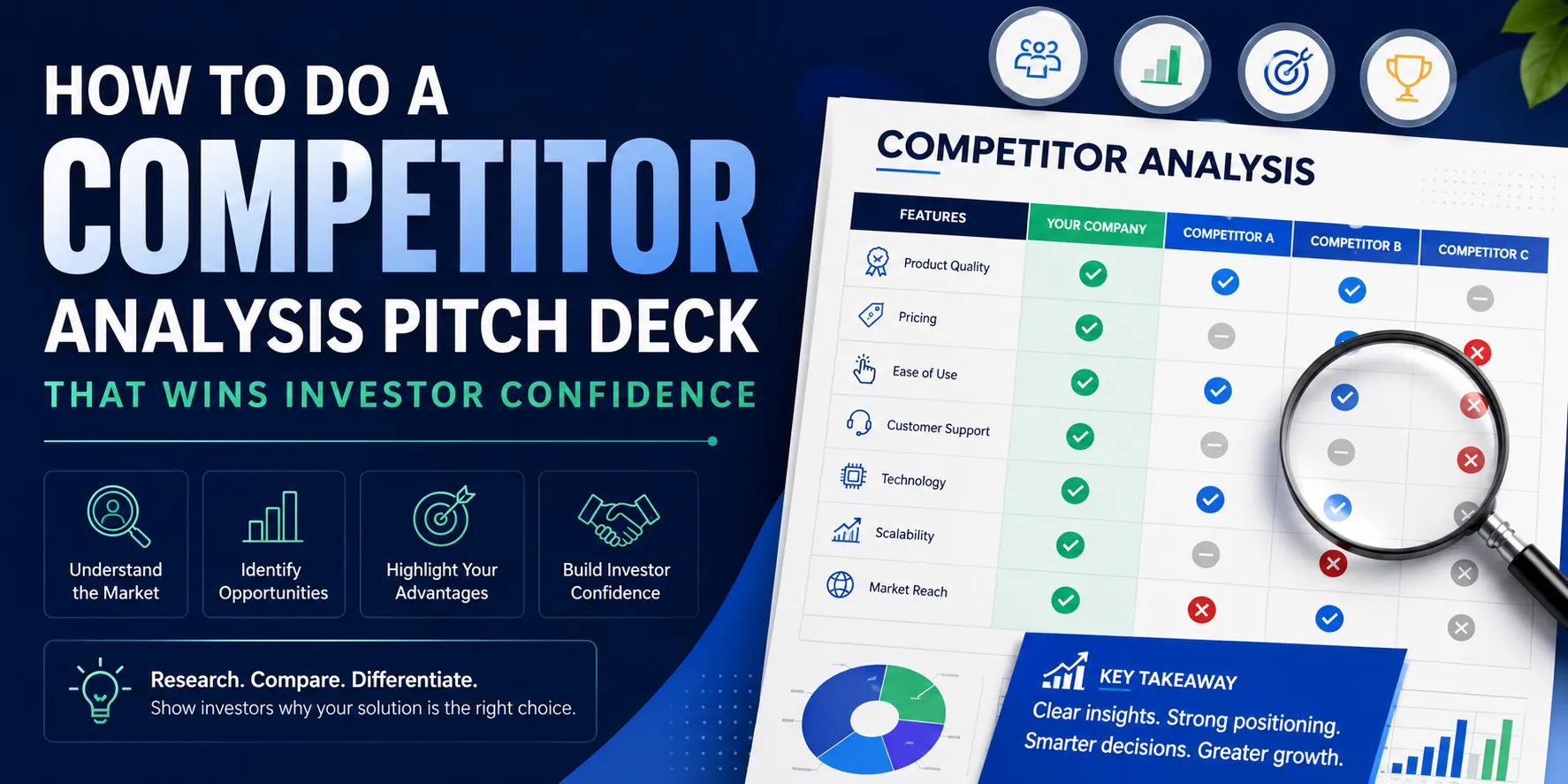

When pitching your business to investors, it's not enough to present a great idea. Investors also want to know how well you understand your market and the companies competing in it. That's why learning how to do a competitor analysis pitch deck is an important part of preparing a successful investor presentation.
A well-structured competitor analysis pitch deck helps investors see that you've researched the market, identified opportunities, and developed a strategy to stand out. It also demonstrates that your business decisions are based on facts rather than assumptions.
In this guide, you'll learn the essential steps to create a competitor analysis that strengthens your pitch and increases investor confidence.
What Is a Competitor Analysis Pitch Deck?
A competitor analysis pitch deck is a section of your presentation that compares your business with other companies offering similar products or services. Its purpose is to show where your business fits in the market and why customers would choose your solution.
Rather than focusing on competitors' weaknesses, this section should highlight your unique strengths while providing an honest comparison. Investors appreciate transparency and realistic market analysis because it reflects thoughtful planning.
Why Competitive Analysis Matters to Investors
Before making an investment, investors evaluate whether your business can compete successfully in the market. They want to know if you've identified your competitors, understand customer needs, and have a clear plan for long-term growth.
A strong competitive analysis helps answer questions such as:
- Who are your biggest competitors?
- What makes your solution different?
- Why will customers choose your business?
- What market opportunity are you targeting?
- How can your company maintain a competitive advantage?
Providing clear answers to these questions makes your presentation more convincing.
How to Do a Competitor Analysis Pitch Deck Step by Step
Understanding how to do a competitor analysis pitch deck starts with gathering accurate information and presenting it in a way that's easy for investors to understand.
1. Identify Your Main Competitors
Begin by listing businesses that operate in the same industry or solve similar customer problems.
You should consider:
- Direct competitors offering similar products or services
- Indirect competitors providing alternative solutions
- Emerging startups entering the market
Including different types of competitors gives investors a complete picture of your industry.
2. Research Each Competitor
Once you've identified competitors, collect reliable information about their business.
Look for details such as:
- Products or services
- Pricing models
- Target audience
- Customer reviews
- Market presence
- Business strengths
- Areas where they could improve
Use trusted sources like company websites, industry reports, customer feedback, and market research to ensure your information is accurate.
3. Compare Important Business Factors
An effective competitor analysis pitch deck doesn't overwhelm investors with excessive data. Instead, it focuses on meaningful comparisons that support your business strategy.
You can compare factors like:
- Product features
- Pricing
- Customer support
- Technology
- Ease of use
- Scalability
- Security
- Distribution channels
Keeping comparisons relevant makes the information easier to understand.
4. Explain Your Unique Value Proposition
The goal of competitive analysis isn't to prove competitors are weak. Instead, explain why your solution offers additional value.
Your competitive advantage could include:
- Innovative technology
- Better customer experience
- Faster implementation
- Lower operating costs
- Specialized expertise
- Flexible pricing
- Industry-specific solutions
Connect these strengths directly to customer needs so investors can clearly see your market position.
5. Present Information Visually
Investors often review many presentations in a short period. Simple visuals help communicate information more effectively than large blocks of text.
Consider using:
- Comparison tables
- Feature matrices
- Positioning charts
- Market maps
- SWOT summaries
Well-designed visuals improve readability and make your presentation more memorable.
6. Highlight Market Opportunities
Competitive analysis should do more than compare companies. It should also identify opportunities your business can pursue.
For example, you can highlight:
- Underserved customer segments
- New technology trends
- Changing consumer preferences
- Geographic expansion opportunities
- Industry gaps
Showing market opportunities demonstrates your growth potential.
7. Support Your Claims with Data
Investors trust evidence more than opinions.
Whenever possible, support your analysis with:
- Industry statistics
- Customer research
- Market reports
- User feedback
- Growth projections
- Performance metrics
Accurate data strengthens your credibility and reduces uncertainty.
Common Mistakes to Avoid
Even strong business ideas can lose investor confidence if the competitive analysis is poorly prepared.
Some common mistakes include:
Claiming There Is No Competition
Every business competes with something, even if it's an alternative solution. Acknowledging competitors shows market awareness.
Using Outdated Information
Competitor strategies change over time. Review and update your research before every investor presentation.
Including Too Much Information
Investors don't need every detail. Focus on the comparisons that directly support your business strategy.
Making Unsupported Statements
Avoid broad claims like "We're the best in the market." Instead, explain exactly what makes your business different using facts and measurable results.
Best Practices for a Strong Competitor Analysis
To make your presentation more effective:
- Research competitors regularly.
- Keep comparisons objective and balanced.
- Use clear visuals instead of crowded slides.
- Focus on customer value rather than criticizing competitors.
- Present only the most relevant information.
- Back important points with reliable data.
- Align your analysis with your overall business strategy.
These practices help investors understand both your market knowledge and your long-term vision.
Final Thoughts
Knowing how to do a competitor analysis pitch deck allows you to present your business with confidence and credibility. Investors want evidence that you've studied the market, understand your competitors, and have a practical strategy for growth.
A well-prepared competitor analysis pitch deck combines research, clear comparisons, and meaningful insights to demonstrate why your business is positioned for success. By presenting accurate information in a simple and visual format, you make it easier for investors to recognize the value of your opportunity.
If you're looking to create an investor-ready presentation with clear messaging and professional design, Pitch Deck Partners can help transform your competitive research into a compelling pitch deck that leaves a lasting impression.

















![Best Cloud Computing Courses & Certificates [2026]](/data/post/1865935/a3146442e219da996ed3b2fd.webp)









Sign in to leave a comment.