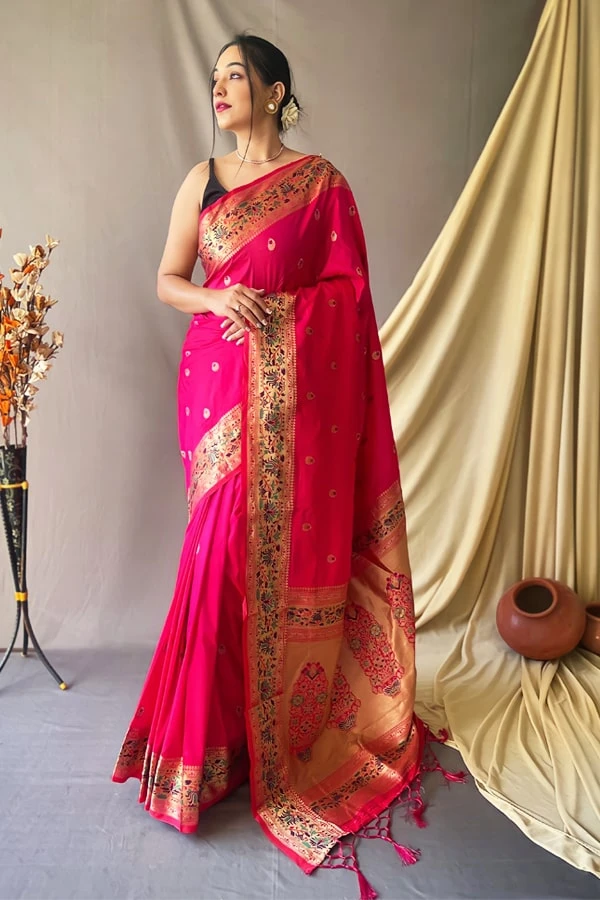

Every dress code can be easily accommodated by the classic saree, whether it is worn on regular days or on special occasions. Even worse than this isn't even that! What always boggles our brains is the variety of this silhouette of Indian heritage. Nearly every state, from the North to the South, has its own, equally stunning variation of the drape. One of the many beautiful varieties will be the subject of this blog post: the Paithani. There are many different styles of paithani saree, but one thing is always the same: they are all exquisite and have a significant cultural value in Maharashtrian society.
A Yeola Paithani sarees, which has its origins in Aurangabad, Maharashtra, is stunning, as is the woman sporting one. This masterwork was adored by the brides as well as the Paithani royal families! It has acquired the same cultural significance over time and is sometimes referred to as the Queen of Sarees. It is a brocade saree that is entirely created with traditional tapestry techniques using pure silk threads and silver zari. Although it is more expensive than average, it is totally worth it! Let's investigate the causes of it.
What makes a paithani saree unique?
The Paithani, once a code for "royalty," now plays a significant part in every Maharashtrian wedding. You may be confident that the Maharashtrian bride-to-be or the bride's mother will give you a soul-satisfying explanation of the Paithani's importance. Being a treasure to possess and admire, Paithani is passed down from one generation to the next in order to preserve its legacy. The nicest thing about sorts of Paithani sarees is that they sparkle in the sun or under a spotlight and are nearly identical on both sides. This finely woven saree is characteristic of Maharashtrian tradition and makes the wearer look utterly brilliant thanks to its gorgeous colour scheme and bubbly charm.
How do we recognise genuine Paithani?
While genuine Paithani is made from fine silk and zari, the growing demand for affordable sarees has also given rise to imitative alternatives that look like this masterpiece but are in fact very different. While some salespeople are very upfront about this, others might even attempt to trick a first-time Paithani buyer. For this reason, before you go out and buy a drape for yourself, you need to know how to spot a fake one.
Knowing the design components is the key to recognising a pure Paithani from a blended one. A handwoven silk saree called a paethani features elaborate Zari threadwork in either gold or silver along the pallu and borders. The distinctive weaving method used to create the many types of Paithani sarees makes them stand out from the competition. In India, skilled artisans complete the entire process by hand, from dyeing the yarn to weaving. The primary structure of the saree is woven on a handloom. These sarees are made from really delicate and fine silk.
The procedure for producing the design and motif is equally unusual. They are created by weaving the vibrant threads together and tying them to the warp. As we previously noted, the fabric's reverse side and designer are very similar to them other. These patterns genuinely give the impression of being woven into the fabric.
Every Paithani saree is unique. Since they are handmade, they are similar but not identical. There is still room for important variations. Contrary to popular belief, fake Paithani patterns are identical since they are mass-produced. Examining the pallu on the reverse side of a handloom saree can help you tell a real one from a fake. The original one's reverse side and top side have the exact same appearance.
A genuine Paithani saree is extremely heavy and needs to be handled with extra care and caution because it uses natural dyes and hues in addition to silver and gold zari threads. the less expensive, manufactured options? Not really.
Genuine Paithani sarees can take months or even a year to make, but mass-produced versions can be made in less than 15 days, depending on the design.
What shade of Paithani is the best?
A Paithani saree is renowned for its distinctive combination of hues and patterns. People travel to India from all over the world to purchase exquisite Paithani drapes as souvenirs. If you're one among them, you should be aware of the prevalent colours for this saree. The most notable colours are Shirodak (pure white), Raghu (parrot green), and Kali Chandrakala (jet black saree with a red border).





Sign in to leave a comment.