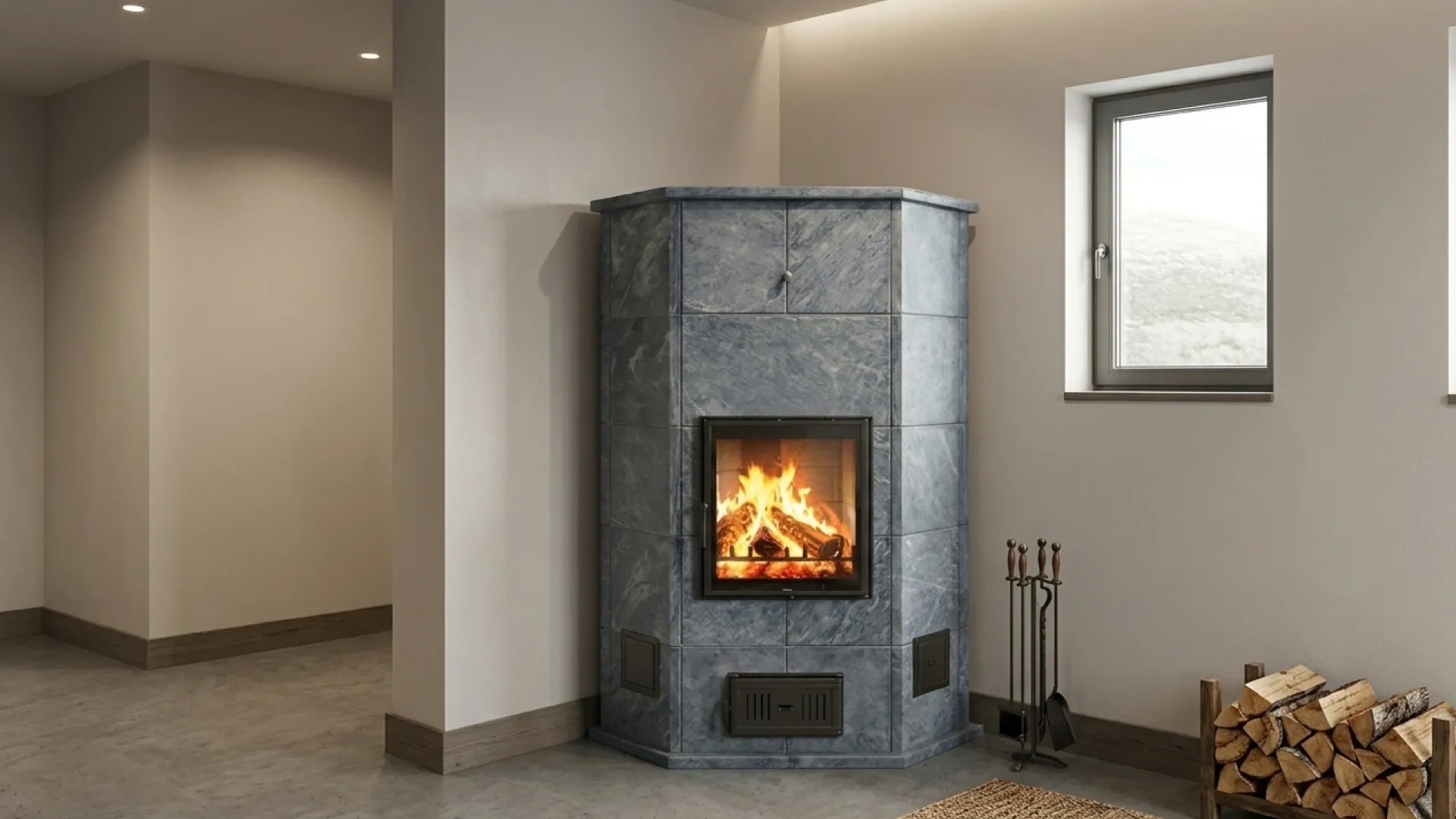

A soapstone masonry heater that is performing at its best is a remarkably self-sufficient system. You load the firebox, light the fire, activate the contraflow at the right moment, and the heater does the rest — storing heat in its stone mass and releasing it gently and evenly into your living space for the next 12 to 18 hours. When everything is working correctly, the process feels almost effortless.
But how do you know when everything is working correctly? How do you distinguish between a heater performing at its best and one that is quietly underperforming — consuming more wood than necessary, delivering less heat than it should, or developing a condition that will become a maintenance problem if left unaddressed?
The answer is monitoring — not with complex instruments or specialist knowledge, but with the systematic observation of a handful of straightforward indicators that together give you a clear picture of how your heater is performing relative to its potential. This guide covers what to monitor, how to monitor it, what the readings mean, and how to respond when something tells you the heater is not performing at its best.
Why Monitoring Matters
The case for active monitoring comes down to one simple truth: problems that are caught early are almost always cheaper and easier to fix than problems caught late. A masonry heater does not typically fail dramatically or suddenly. It degrades — quietly, incrementally, and often invisibly — until a small inefficiency has become a significant problem.
Increased wood consumption is one of the earliest and most reliable indicators that something in the system has changed. A heater that suddenly requires 20 percent more wood to maintain the same indoor temperature is telling you something. So is a fire that takes longer than usual to establish, a surface that feels cooler than expected at peak output, or a draft that feels sluggish where it previously felt strong.
These signals are only useful if you have a baseline to compare them against. Monitoring creates that baseline — a record of how your heater performs when it is operating correctly, against which any future deviation can be measured. Without that baseline, you are guessing. With it, you are managing.
Indicator 1 — Surface Temperature
The surface temperature of your heater's soapstone shell is the most direct measure of how much heat the stone mass has stored and is currently releasing. A correctly loaded and operated Greenstone heater reaches a peak surface temperature of approximately 150 to 180°F during and shortly after a full burn cycle. At this temperature, the stone radiates strongly and the living space heats efficiently. As the stone discharges over the following hours, the surface temperature drops gradually — reaching roughly room temperature 12 to 18 hours after the fire has ended.
Monitoring surface temperature gives you two useful data points. First, it tells you whether the current fire has charged the stone adequately — a peak surface temperature significantly below the expected range suggests the fire burned at lower intensity than intended, possibly due to wet wood, an undersized load, or a draft problem. Second, it tells you how much heat remains in the stone at any given time, which helps you decide whether another fire is needed and what size load is appropriate.
A non-contact infrared thermometer is the right tool for this. These are inexpensive, widely available, and take readings in seconds without contact with the hot surface. Point it at a flat soapstone face at approximately the mid-height of the heater — this gives you a representative reading of the overall surface temperature rather than a hot spot near the firebox or a cooler area near the base.
Record the peak surface temperature after each fire and the approximate temperature at the time of the next fire. Over a few weeks, you will develop a clear sense of the normal temperature range for your heater under various conditions — outdoor temperature, fuel load, wood species — and deviations from that range will become immediately apparent.
Indicator 2 — Draft Strength and Quality
The draft is the engine that drives combustion in your masonry heater. Strong, consistent draft pulls combustion air through the firebox, carries combustion gases through the heat exchange channels, and expels them cleanly through the flue. Weak or inconsistent draft compromises every stage of this process — reducing combustion temperature, increasing incomplete burning, and ultimately reducing the amount of heat transferred into the stone mass.
Monitoring draft does not require instruments. It requires attention to a few observable characteristics each time you light a fire. Before lighting, hold your hand near the open firebox door and feel for the direction of airflow. With the bypass open, you should feel a gentle inward pull — air moving from the room into the firebox. This confirms that positive draft exists before the fire is lit.
After lighting, observe the behavior of the smoke and flame in the first few minutes. A well-drafting fire draws cleanly, with flame and smoke moving steadily upward and no tendency to spill into the room. The fire establishes quickly and builds in intensity within the first ten minutes.
When you activate the contraflow, observe the transition. A heater with good draft handles the transition smoothly — the fire may momentarily slow slightly as the gases are rerouted through the channel system, but it recovers quickly and continues to burn strongly. A heater with marginal draft may struggle noticeably when the contraflow is activated, with the fire slowing significantly or producing brief puffs of smoke at the door.
Note any changes in draft behavior from one season to the next or from one firing to the next under similar conditions. Gradually weakening draft is an early warning of a developing problem — as detailed in our guide on masonry heater mistakes to avoid, catching these signals early prevents small issues from becoming serious ones.
Indicator 3 — Combustion Quality
The quality of combustion during each fire is one of the most information-rich indicators available to a masonry heater owner, and it is observable directly through the firebox glass or at the door opening during the early stages of a burn.
A correctly burning fire in a masonry heater has several visible characteristics. The flame is active, well-defined, and predominantly yellow-orange, indicating complete combustion at high temperature. The smoke at the chimney top — observable from outside, particularly on cold days when the exhaust is visible against the sky — is light grey to nearly invisible. Heavy, dark, or white billowing smoke indicates incomplete combustion and should prompt a review of wood moisture content and firing technique.
Inside the firebox, the fire should be burning across the full width of the fuel load rather than concentrated in one area. A fire that burns unevenly — intensely in one area and poorly in another — suggests the fuel load was not stacked correctly, with insufficient airspace between pieces, or that the grate is partially blocked restricting airflow from below.
The sound of a well-burning masonry heater is also informative. A strong fire produces a steady, moderate roar — the sound of active combustion and good draft working together. A fire that sounds hollow or intermittent may be struggling with draft or airflow. A fire that sounds excessively loud and intense may be overfired or drawing more air than intended through a gap in the door seal.
Monitor combustion quality consistently and note any fires that behave differently from the established norm. A single unusual fire is often explained by a one-time variable — slightly wetter wood, an unusual wind condition, a cold flue that was not pre-warmed. A pattern of unusual combustion across multiple fires points to a systemic issue worth investigating. Understanding how masonry heaters work gives you the context to interpret what you are seeing and respond correctly.
Indicator 4 — Wood Consumption Rate
Your seasonal wood consumption is one of the most objective long-term performance indicators available. It integrates all of the other variables — combustion efficiency, heat capture efficiency, heater maintenance condition, wood quality, and firing habits — into a single measurable outcome. A heater consuming more wood for the same heat output is less efficient than it was, and that efficiency loss has a cause that is worth finding.
Tracking wood consumption requires only that you measure your wood use consistently. The simplest method is to weigh individual loads using a bathroom scale — weigh yourself without and then with an armload of wood, and the difference is the load weight. Log the load weight for each fire and total it at the end of each month or season.
Compare your consumption figures year over year. An increase of 15 to 20 percent or more in wood consumed per heating degree day compared to a previous season is a meaningful signal that something has changed in the system. The most common causes are soot accumulation in the heat exchange channels, a failing door gasket, a partially blocked flue, or a shift toward wetter or lower-density wood. Each of these is diagnosable and correctable — but only if you are tracking consumption closely enough to notice the change.
Indicator 5 — Heat Exchange Channel Condition
The heat exchange channels are not directly observable during normal operation, but their condition can be assessed indirectly through the indicators above — and directly during the annual cleaning process. When you open the clean-out ports and look into the channels with a flashlight, you are getting the most direct available evidence of how efficiently the channels have been functioning.
Light, dry, fine soot in the channels is normal and expected after a season of correct operation. Heavy, dense soot accumulation — particularly if it has a greasy or tar-like character — indicates that combustion temperatures have been lower than optimal, probably due to wet wood, dampened-down fires, or insufficient firing frequency. This type of deposit reduces heat transfer efficiency significantly and requires more thorough cleaning than the standard annual brush-through.
After cleaning, note how much material was removed and its character. This record tells you whether your firing habits from the previous season were consistent with efficient operation. A season that produced light, dry soot reflects good habits. A season that produced heavy, sticky deposits should prompt a review of wood moisture content and firing technique before the next season begins. Your masonry heater maintenance tips guide covers the correct cleaning process in full detail.
Indicator 6 — Room Temperature Consistency
The most practical measure of your heater's heat output is the simplest: how comfortable is your home? A heater performing at its best maintains a consistent, comfortable temperature throughout the living space between fires — warming gradually during and after a burn and cooling slowly and evenly through the discharging phase.
Deviations from this pattern are worth noting. A home that warms less than expected after a full fire, or that cools to uncomfortable temperatures before the next scheduled fire, may indicate that the heater is underperforming relative to its potential. This could reflect a maintenance issue, a change in wood quality, an unusually cold period that exceeds the heater's design capacity, or a change in the home's thermal envelope.
A simple indoor thermometer placed in the main living area — not immediately adjacent to the heater — gives you a consistent reference point. Log the temperature at the time of each fire and at regular intervals through the day. Over time this log reveals the normal temperature arc produced by your firing schedule and highlights any deviations from that arc.
If the arc is flatter than expected — the room is not warming as much as it should after a full fire — the heater is likely underperforming. If the arc drops more steeply than expected — the room cools faster than usual between fires — the heater may be losing heat output capacity or the home's heat loss rate has changed. Either observation is worth investigating.
Building Your Monitoring Routine
Effective monitoring does not require hours of attention each day. It requires consistent observation of a few key indicators, recorded in a format that allows comparison over time. A simple firing log — a notebook or a notes app on your phone — is all the infrastructure you need.
For each fire, note the date and time, outdoor temperature, fuel load weight and species, peak surface temperature after the burn, any observations about draft quality and combustion behavior, and room temperature at firing time and at regular intervals through the day. Add a brief note about anything unusual — a sluggish draft, an unusually smoky start, a surface temperature higher or lower than expected.
This log takes two to three minutes to update after each fire. Over a full heating season it becomes an extraordinarily useful record — one that lets you spot trends, diagnose problems early, and demonstrate to a professional inspector exactly what the heater has been doing over time. Combine this daily log with the structured seasonal tasks covered in our guide on long-term maintenance planning and you have a complete monitoring system that protects your heater's performance without requiring specialist knowledge or expensive equipment.
When Monitoring Reveals a Problem
The value of monitoring is that it tells you when to act — and gives you enough information to act intelligently rather than reactively. When your log reveals a pattern of declining surface temperatures, increasing wood consumption, weakening draft, or deteriorating combustion quality, you have the data to diagnose the likely cause and choose the appropriate response.
Many performance issues are self-correctable with firing technique adjustments or owner-performed maintenance. A switch to drier, denser wood resolves consumption and combustion quality issues caused by fuel quality. A mid-season channel cleaning restores heat capture efficiency lost to soot accumulation. A door gasket replacement resolves the uncontrolled air infiltration that disrupts combustion balance. These are owner-level interventions that your monitoring data will point you toward directly.
Others require professional attention — a chimney assessment for persistent draft problems, a firebox inspection for concerning crack development, or a flue liner evaluation for smoke behavior that does not respond to operational adjustments. In these cases, the monitoring data you bring to the professional makes the diagnosis faster and more accurate than a professional working from a cold start with no history to reference.
Final Thoughts
Monitoring your masonry heater for optimal heat output is ultimately about developing a relationship with the system — understanding what it looks, sounds, and feels like when it is performing at its best, and noticing when something has shifted. That awareness does not come from instruments or checklists alone. It comes from consistent, attentive observation over time, recorded in a format that lets you see patterns that no single inspection can reveal.
The heater you understand is the heater you can manage confidently — adjusting your habits in response to what it tells you, catching problems before they become serious, and maintaining the efficient, comfortable performance that a well-operated soapstone masonry heater delivers season after season.
Have Questions About Your Heater's Performance?
Our team is happy to help you interpret what your heater is telling you and advise on the right response — whether it is a simple technique adjustment or something that needs a closer look.
Contact Greenstone Today — call us at 855-826-9246 or email [email protected].
























Sign in to leave a comment.