

Enterprises continue to expand their cloud footprint to accelerate digital transformation, cut infrastructure costs, and scale globally. Yet this shift introduces new and constantly evolving security and compliance exposure points. It gives CISOs and IT leaders the clarity they need to understand their exposure and take action before an incident disrupts operations or triggers a regulatory failure.
Ampcus Cyber supports global enterprises across the US, Middle East, and India with advanced cloud security assessments that combine governance, threat intelligence, and compliance expertise. This guide outlines how security leaders can approach cloud risk assessments with clarity, rigour, and enterprise-grade discipline.
What Is a Cloud Risk Assessment?
A cloud risk assessment is a detailed examination of the threats, weaknesses, and configuration gaps across your cloud platforms. It looks at how your data moves, who can access it, how your resources are configured, and whether your current controls align with frameworks such as NIST, ISO 27001, PCI DSS, and CIS Benchmarks.
Put simply: it helps you understand where the risks are, how serious they are, and what you must do to address them.
Why a Cloud Risk Assessment Is Critical
A structured cloud risk assessment helps enterprises:
- Identify misconfigurations and security gaps before attackers exploit them
- Validate alignment with frameworks like NIST, ISO 27001, CIS Benchmarks, and PCI DSS
- Reduce the risk of data loss, unauthorized access, and account compromise
- Strengthen multi-cloud governance and continuous compliance
- Build confidence during cloud migrations and hybrid expansio
Cloud environments evolve rapidly. Without proactive assessment, organizations operate blindly, exposing themselves to avoidable risks and costly audit failures.
Common Cloud Security Risks to Watch
Every organization faces different risks, but some patterns repeat across industries:
- Incorrectly configured storage, databases, or security groups
- Over-privileged IAM users and service accounts
- Unencrypted data or weak key management practices
- Lack of controls for serverless functions, APIs, and containers
- Inconsistent patching across workloads
- Shadow IT and unsanctioned cloud services
- Limited monitoring and alerting in production environments
A strong cloud infrastructure security assessment uncovers these problems early, before attackers do.
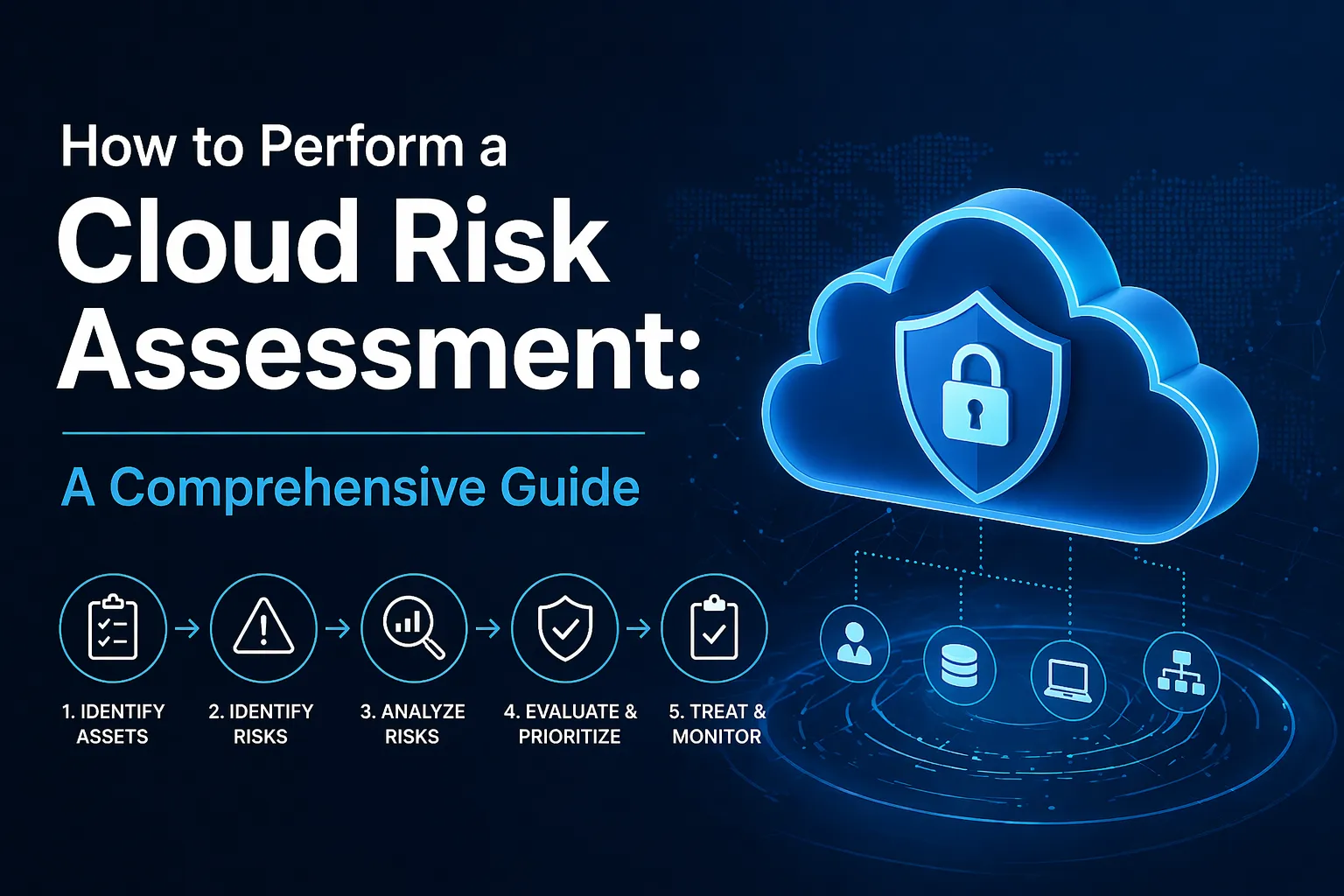
How to Perform a Cloud Risk Assessment: Key Steps
1. Establish Scope and Identify Cloud Environments
Map your cloud footprint—providers, workloads, data flows, integrations, and compliance obligations. This step ensures you assess the right assets.
2. Identify and Classify Cloud Assets
Catalog resources such as virtual machines, storage buckets, container clusters, databases, and APIs. Categorize data based on sensitivity—PCI cardholder data, PII, PHI, confidential business information, and more.
3. Analyze Threats and Vulnerabilities
Review risks ranging from credential compromise to insecure APIs. Evaluate misconfigurations, architectural gaps, and known platform-specific vulnerabilities.
4. Assess Security Controls and Cloud Architecture
Evaluate IAM, encryption standards, logging, network segmentation, key management, workload protection, and governance policies. This step highlights strengths and exposes control gaps.
5. Understand the Cloud Shared Responsibility Model
Different cloud providers split responsibilities in different ways. Most breaches occur when organizations misunderstand which controls they manage versus what the provider manages.
6. Prioritize Risks and Recommend Remediation
Determine the likelihood and impact, then create clear, actionable mitigation plans—such as patching, policy refinement, configuration hardening, or redesigning insecure components.
7. Formalize Reporting and Implement Continuous Monitoring
Document findings and build dashboards to track compliance and risk posture continuously.
Tools and Technologies That Strengthen Cloud Risk Assessments
Enterprises improve cloud visibility and accelerate remediation through:
- Cloud Security Posture Management (CSPM)
- Cloud Workload Protection Platforms (CWPP)
- CIEM and IAM governance tools
- Container and Kubernetes security scanners
- Zero Trust access and micro-segmentation technologies
- Automated compliance mapping tools
Ampcus Cyber’s threat & vulnerability radar integrates these capabilities into a unified assessment engine—helping organizations detect misconfigurations, validate controls, and achieve continuous compliance across complex multi-cloud ecosystems.
Best Practices for Cloud Security Risk Assessments
- Enforce Zero Trust security principles across cloud workloads
- Apply least-privilege access to IAM roles and service accounts
- Automate configuration audits and policy enforcement
- Encrypt all sensitive data and rotate keys regularly
- Maintain real-time visibility across all cloud instances
- Align cloud governance with PCI DSS, NIST CSF, and ISO 27001
Conduct recurring cloud security assessments during major cloud changes
Strengthen Your Cloud Security with Ampcus Cyber
A well-executed cloud security risk assessment empowers organizations to manage risk confidently, secure mission-critical workloads, and maintain continuous compliance. Ampcus Cyber brings deep expertise, advanced threat intelligence, and certified PCI DSS capabilities to help enterprises build resilient, audit-ready cloud environments.
If you’re looking to strengthen cloud governance or prepare for your next PCI DSS or compliance review, our cloud security experts are ready to support you.


























Sign in to leave a comment.