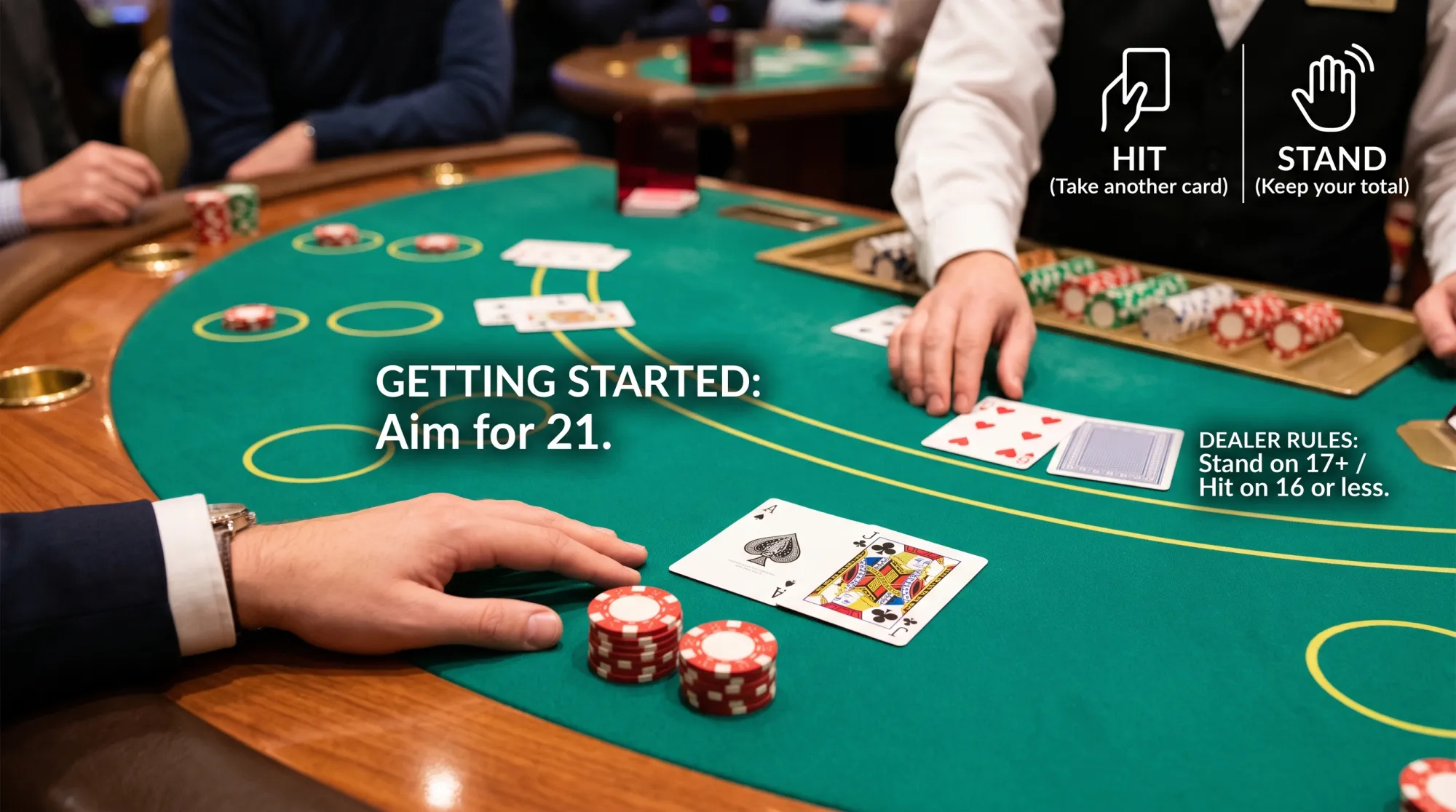

Blackjack is one of the most popular card games for beginners because the rules are simple and the gameplay is easy to understand. The game is based on comparing card totals and making basic decisions during each round. Many people enjoy blackjack because it combines simple math, quick thinking, and strategy.
If you want to learn how to play blackjack game step by step, understanding card values, player actions, and game flow is the best place to begin. Whether you are learning for entertainment, practice, or general card game knowledge, knowing the basics can help you understand how the game works.
What Is Blackjack?
Blackjack is a card game where players compare their hand totals against the dealer’s hand. The main objective is to reach a value closer to 21 without going over that number.
Each player receives cards and chooses whether to take another card, keep the current total, or use special actions such as splitting or doubling. At the end of the round, the hands are compared to determine the result.
Unlike poker, blackjack is not played against other players at the table. Every round is played against the dealer.
Why Blackjack Is Popular Among Beginners
Blackjack is considered beginner-friendly because it has simple rules and fast gameplay. Most players can understand the basics after a few rounds.
Reasons why beginners enjoy blackjack:
- Simple card values
- Easy game structure
- Quick rounds
- Simple decision-making
- Strategy-based gameplay
Many players also like blackjack because skill and decision-making can influence gameplay more than in many other card games.
Blackjack Card Values Explained
Understanding card values is the first step in learning blackjack. Every action in the game depends on your hand total.
Number Cards
Cards numbered 2 through 10 keep their normal face value.
Examples:
- 2 = 2 points
- 5 = 5 points
- 10 = 10 points
If a player receives a 7 and a 4, the total becomes 11.
H3: Face Cards
Face cards all count as 10 points.
- King = 10
- Queen = 10
- Jack = 10
For example, a Queen and a 9 create a total of 19.
Ace Card Rules
The Ace is unique because it can count as either 1 or 11 depending on the situation.
Examples:
- Ace + 7 = 18
- Ace + 9 + 8 = 18
The game automatically uses the Ace value that helps the hand most.
Blackjack Hand Value Table
Cards — Total Value
- 10 + 8 = 18
- King + 9 = 19
- Ace + King = 21
- 5 + 6 + 7 = 18
- Ace + 6 = 17
Main Goal of the Blackjack Game
The goal in blackjack is to finish with a hand value closer to 21 than the dealer without going over 21.
A player does not need exactly 21 to succeed. The hand simply needs to be stronger than the dealer’s total.
How Players Win
Players can succeed in blackjack in several ways:
- Having a higher hand than the dealer
- Reaching 21 with the first two cards
- Dealer going above 21
- Dealer having a lower total
What Happens When You Bust
If a hand goes over 21, it is called a bust. Once this happens, the round ends for that player.
For example, if a hand reaches 22 after taking another card, it is considered a bust.
What Is a Push in Blackjack?
A push happens when both the player and dealer have the same total.
Example:
- Player = 19
- Dealer = 19
In this situation, the round ends in a tie.
H2: How to Play Blackjack Game Step by Step
Blackjack follows a simple sequence during every round.
Step 1 – Place Your Bet
Before cards are dealt, players choose the amount they want to use for the round.
Many beginners start with smaller amounts while learning the rules and gameplay.
Step 2 – Dealer Distributes Cards
Each player receives two cards. The dealer also receives two cards.
- Players usually see both of their cards
- One dealer card is visible
- One dealer card remains hidden
The visible dealer card helps players decide their next move.
Step 3 – Check Your Hand Total
Players add the values of their cards to calculate the total.
Examples:
- 10 + 7 = 17
- Ace + 8 = 19
- 5 + 5 = 10
The total helps determine the next action.
Step 4 – Choose Your Blackjack Action
Players decide how to continue their hand.
Hit
A hit means taking another card.
Players often choose this when the current total is low.
Stand
Standing means keeping the current hand and ending the turn.
Players usually stand on stronger totals.
HDouble Down
This action allows the player to double the original amount and receive one additional card.
Split
If the first two cards are identical, they can be separated into two hands.
Example:
- 8 + 8 can become two separate hands
Surrender (Optional Rule)
Some blackjack versions allow players to leave the round early with part of the original amount returned.
Not all versions include this rule.
Step 5 – Dealer Plays Their Hand
After all player turns finish, the dealer reveals the hidden card and follows standard game rules.
Common dealer rules include:
- Draw another card on 16 or lower
- Stop on 17 or higher
Step 6 – Determine the Winner
The dealer compares all hand totals at the end of the round.
- Higher total under 21 wins
- Equal totals result in a tie
- Hands over 21 lose automatically
Basic Blackjack Rules Every Beginner Should Know
Although blackjack is simple overall, beginners should understand a few important rules before playing.
Dealer Must Hit or Stand Rules
Some blackjack versions use slightly different dealer rules.
Common examples include:
- Dealer hits on soft 17
- Dealer stands on hard 17
These rules can slightly change gameplay.
Minimum and Maximum Bets
Every table or game version may use different minimum and maximum limits.
Beginners often benefit from starting small while learning the game.
Blackjack Payout Rules
A natural blackjack usually receives a higher reward than a normal winning hand.
Examples:
- 3:2 payout
- 6:5 payout
Different game versions may use different payout structures.
Common Blackjack Terms Explained
H3: Important Blackjack Terms
- Blackjack = Ace plus a 10-value card
- Bust = Going over 21
- Push = Tie between player and dealer
- Shoe = Device holding multiple card decks
- Soft Hand = Hand with Ace counted as 11
- Hard Hand = Hand without flexible Ace value
- Insurance = Optional side option in some versions
- House Edge = Built-in mathematical advantage in the game
Beginner Blackjack Strategy Tips
Blackjack strategy focuses on making smarter decisions based on card totals and probability.
best Beginner Decisions in Blackjack
Helpful beginner tips include:
- Stand on strong totals
- Avoid unnecessary risks
- Watch the dealer’s visible card
- Start with smaller amounts
- Practice before advanced strategies
Why Basic Strategy Matters
Blackjack includes both luck and decision-making. Basic strategy helps players reduce mistakes and understand common situations more clearly.
While strategy improves decisions, it does not guarantee outcomes.
ractice Before Playing With Real Money
Many online card game platforms offer practice versions of blackjack. These versions help beginners:
- Learn game flow
- Understand hand totals
- Practice decision-making
- Improve confidence
Practice mode is useful before moving to advanced play.
Common Mistakes Beginners Make in Blackjack
Taking Too Many Hits
Beginners sometimes continue taking cards even when holding strong totals.
For example, taking another card on 19 creates unnecessary risk.
Ignoring Dealer’s Upcard
The dealer’s visible card provides useful information about the round.
Weak dealer cards may influence safer decisions.
Betting Too Much Too Early
New players sometimes increase amounts too quickly before understanding the game fully.
Starting small helps players learn more comfortably.
Playing Emotionally After Losses
Making rushed decisions after losing rounds often creates additional mistakes.
Staying calm and focused improves overall decision-making.
Online Blackjack vs Live Table Blackjack
Players can learn blackjack online or at physical tables.
Online Blackjack Benefits
- Easy access
- Practice modes available
- Faster gameplay
- Beginner-friendly learning environment
- Multiple game variations
Live Table Blackjack Experience
Live table blackjack creates a more social atmosphere with real dealers and physical cards.
Rounds usually move at a slower pace.
Which Option Is Better for Beginners?
Online blackjack is often easier for beginners because practice modes and learning tools are widely available.
However, some players prefer live tables because they enjoy face-to-face interaction and real card handling.
Is Blackjack a Game of Luck or Skill?
Blackjack combines both luck and strategy.
The cards dealt are random, but player decisions can influence gameplay. Understanding probability, hand totals, and strategy helps players make better choices over time.
Even experienced players can lose individual rounds because randomness always remains part of the game.
Final Thoughts on How to Play Blackjack Game
Learning how to play blackjack game starts with understanding the basic rules, card values, and player actions. Blackjack remains popular because it is simple to learn while still offering strategic depth.
Beginners should focus on learning the fundamentals, practicing regularly, and understanding how different game situations work. Over time, experience and practice can improve confidence and decision-making.
FAQs
How do beginners play blackjack?
Beginners play blackjack by receiving cards, calculating hand totals, and choosing actions such as hit or stand to reach a stronger hand than the dealer.
What is the goal of blackjack?
The goal is to finish with a hand closer to 21 than the dealer without going over 21.
Can strategy improve blackjack decisions?
Yes. Strategy helps players make more informed decisions, although outcomes still involve randomness.
What happens if both player and dealer get the same total?
The round usually ends as a tie, commonly called a push.
Is blackjack easy to learn?
Yes. Blackjack is widely considered beginner-friendly because the rules and card values are simple to understand.























Sign in to leave a comment.