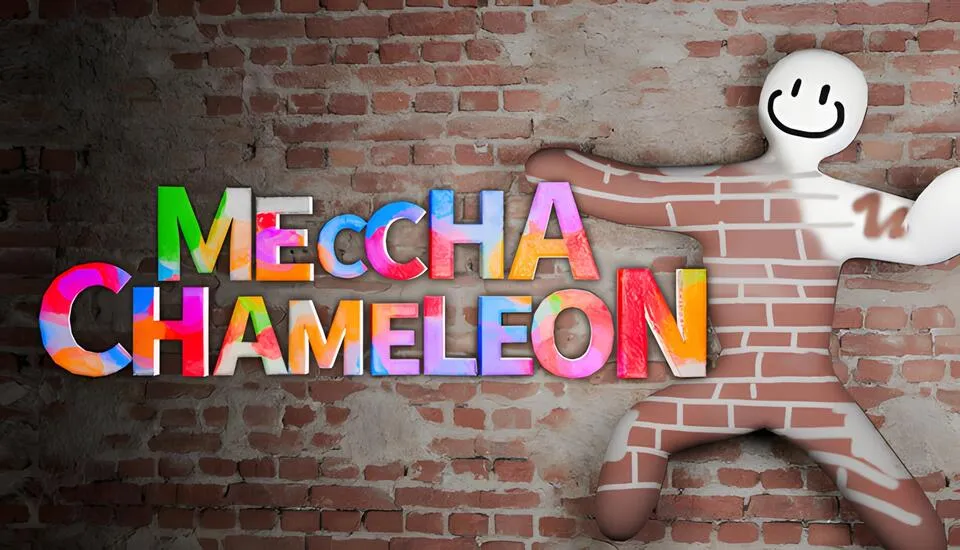

You crouch into the corner of a cluttered storage room, eyedropper already pulled up, and sample the exact grey of the crate beside you. Three seconds later a Seeker's footsteps stop just outside the doorway. You don't move. You don't breathe. That held-breath moment, repeated every single round, is the whole appeal of Meccha Chameleon, and it's the kind of tension that's hard to explain to someone who's only watched a clip without actually sweating through a round themselves.
| Genre | Multiplayer hide-and-seek party game |
| Platform | Windows PC (Steam) |
| Players per lobby | 2 to 10 recommended, up to 24 possible |
| Core roles | Hiders (Chameleons) and Seekers |
The premise sounds almost silly until you actually load into a match. Every player spawns as a plain white figure, and the Hiders have to paint that body to match the walls, floors, and props around them before the Seeker comes looking. There's no list of preset disguises to pick from, which is exactly what separates this game from older prop-hunt clones where you simply snapped into a barrel or a lamp model and hoped nobody checked too closely.
What makes the loop addictive isn't just the painting itself, it's the social layer sitting underneath it. Voice chat groups end up laughing as much over a terrible disguise as a brilliant one, and that mix of genuine skill expression and constant low-stakes comedy is a big reason lobbies tend to refill themselves round after round without anyone suggesting a different game. Players who come in expecting a simple party distraction are usually surprised by how quickly the underlying mechanics start to matter.
The Paint Tool in Meccha Chameleon
Opening the paint menu drops you into something closer to an art program than a typical game UI. The eyedropper is the tool that matters most, because it samples a colour directly from the surface you're standing against rather than making you guess at a shade. Players in community Discords repeat this advice constantly: sample the actual wall you'll lean on, not a similar one across the room, because lighting shifts colour more than most beginners expect, and a torch-lit corridor wall can read several shades darker than an identical wall just a few steps into open light.
Once the base colour is locked, the HSV sliders let you nudge the shade toward shadow or highlight. A surprising number of new players skip the metallic and roughness sliders entirely, then can't figure out why their otherwise perfect colour still gets them tagged. A glossy body catches light differently than a matte wall, and that mismatch is one of the most common reasons a "good" disguise still fails, especially once a Seeker's flashlight or movement shifts the angle of reflected light across your model.
Players who main Hider often describe the paint phase using community shorthand like "blending" rather than "painting," a small distinction but one that signals how seriously the community treats colour accuracy as a craft rather than a cosmetic afterthought. Spend a session purely on the eyedropper and slider combination, ignoring pose entirely, and the improvement in how convincing your base colour reads is usually obvious within just a handful of rounds.
- Match the surface's exact hue with the eyedropper before adjusting anything else, since starting from an accurate base saves you from chasing a moving target with the sliders later.
- Brighten the side of your body facing the room's main light source, because an evenly lit body reads as flat and artificial against a wall that clearly has its own shadow gradient.
- Darken the opposite side so your shape reads with depth, not as a flat sticker, which matters even more on curved or textured surfaces where real shadow naturally falls unevenly.
- Check your roughness setting against glossy versus matte surfaces, since a shiny finish on a chalky plaster wall is one of the fastest tells an attentive Seeker will catch.
Picking a Pose That Survives the Hunt
Colour only solves half the problem. A human-shaped silhouette pressed flat against a wall still reads as a person even when the paint job is flawless, which is why pose selection gets just as much attention from serious players as colour matching does. Crouching, lying flat, curling into a corner, or angling against an object all break up the obvious outline that gives Hiders away in the opening seconds of a hunt, and the right pose can make even a slightly imperfect colour match hold up under a quick glance.
Competitive-minded players treat the prep phase as a checklist rather than a scramble. Pick the spot first. Walk to it. Sample it. Set a pose that fits the geometry around you. Rushing this sequence is the single biggest reason beginners get caught early, and it's a habit that's easy to break once you've lost a few rounds to it. Newer players in particular tend to open the paint menu before they've even chosen a final hiding spot, which wastes valuable prep time matching colours they'll never actually need.
Slower, methodical players tend to favour tight, awkward poses near low furniture, where a crouched silhouette reads naturally as part of the clutter, while players who prefer a faster, riskier playstyle often go for bold standing poses against busier walls, betting that visual noise alone will be enough cover. Both approaches show up constantly in ranked-feeling matches, and neither is objectively wrong once your colour work is solid enough to support it.
Reading the Room as a Seeker
Seekers in Meccha Chameleon aren't just clicking randomly on walls. The strongest hunters slow down deliberately, scan shadows and corners before open spaces, and look for shapes rather than colours, since an experienced Hider's colour work is usually close to perfect by the time you reach your fifth or sixth match. What gives people away is almost always the silhouette: a gap between limbs, a patch that's slightly too bright, or a pose that doesn't match the object it's supposed to be.
Casual players tend to favour Normal mode for its straightforward win condition, while players chasing a faster pace gravitate toward Double, where the round turns into more of a speed hunt. Either way, the underlying skill being tested is the same, and Seekers who switch between modes regularly often say the skill transfers cleanly even though the pacing feels completely different.
One detail only regular Seekers tend to notice is how often Hiders forget to account for sound. Footsteps on certain floor types carry further than players expect, and a perfectly disguised Hider who shuffles their pose mid-hunt can give themselves away through audio alone before a Seeker ever lays eyes on them.
What beginners get wrong early on
The most common rookie mistake is choosing an open, brightly lit area to hide in. A flat colour match means nothing if there's no shadow or surrounding clutter to break up the visual transition between your body and the wall. Favouring shadowed corners over open walls in your first few rounds will save you far more rounds than chasing a perfect colour ever will, and it buys you time to get comfortable with the eyedropper without the added pressure of an exposed position.
How can you tell if your disguise actually works?
Rotate the camera fully around your character before the hunt phase begins. What looks convincing from your own first-person view can look completely obvious from the angle a Seeker will actually approach from, and small details like exposed white elbows are invisible to you but glaring to anyone walking past. Doing this check every single round, even once it feels repetitive, is one of the clearest habits separating consistent survivors from players who get tagged early on a fluke.
Frequently Asked Questions
How many players can join one match of Meccha Chameleon?
Lobbies are recommended for 2 to 10 players for the best pacing, though the maximum can run higher depending on the host's network. Most experienced groups settle around 6 to 8 players for matches that feel neither rushed nor empty, since smaller groups make the Seeker's job too easy and larger ones can stretch prep time thin.
What's the difference between Normal and Double mode?
Normal mode runs the classic format where Hiders try to survive until the timer ends, giving Hiders a longer, calmer prep window to fine-tune their disguise. Double mode compresses the pace into more of a speed hunt, rewarding quick, confident colour choices over the slow, detailed disguises that work well in a longer Normal round.
Why do I keep getting caught even with a good colour match?
Colour is only half the disguise. Seekers are trained by repetition to spot human silhouettes, so a flawless hue against a wall still fails if your pose doesn't break up your outline or if you're hiding somewhere with no shadow to support the colour. Sound, particularly footsteps right before the hunt phase locks in, is another overlooked factor that catches out otherwise well-disguised Hiders.
Meccha Chameleon rewards the kind of patience that doesn't show up on a scoreboard until you've already lost a few rounds learning it. Spend a session focused only on the paint tool, then another on pose work in a spot like the Mansion map, and the gap between getting tagged in ten seconds and surviving the full timer starts to close fast.




























Sign in to leave a comment.