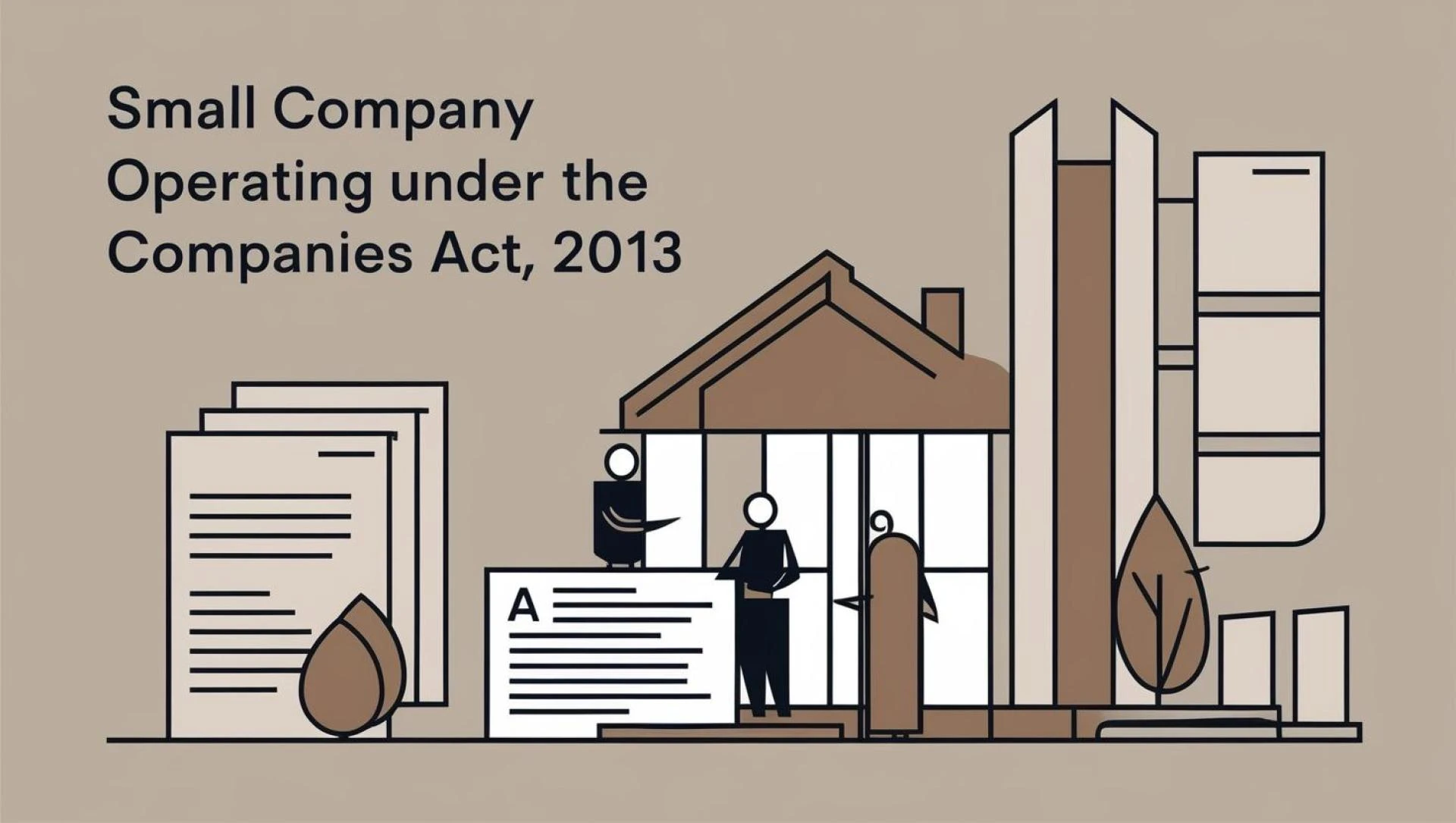

Running a business in India? Then you should absolutely know about Small Company in india status under the Companies Act, 2013. It’s like having a VIP pass to simplified compliance, lower costs, and less red tape. Think of it as the government’s way of saying, “We see you, small business owners—and we’ve got your back.”
In this article, we’ll break down how to qualify as a Small Company, what perks come with the title, and why this status might be the boost your business needs.
📖 Understanding the Definition of a Small Company
Legal Meaning as per Section 2(85)
According to Section 2(85) of the Companies Act, 2013, a "Small Company" is a private company that satisfies both of these conditions:
- Paid-up share capital does not exceed ₹4 crore.
- Turnover does not exceed ₹40 crore (as per the most recent profit and loss statement).
What Makes a Company ‘Small’
It’s not about headcount, market presence, or whether you’re a startup. It’s strictly based on financial limits.
📊 Core Qualification Criteria
1. Paid-Up Share Capital Limit
This refers to the actual money invested by shareholders. To qualify, your company must have paid-up capital of ₹4 crore or less.
2. Turnover Limit
Turnover is the total revenue from operations during a financial year. This must be ₹40 crore or less.
3. Both Conditions Must Be Met
Even if you meet only one of the limits, you won’t qualify. Both thresholds are mandatory.
🚫 Entities That Cannot Qualify
Certain types of companies are explicitly excluded, no matter how small their capital or turnover is:
- Public companies
- Holding or subsidiary companies
- Section 8 companies (non-profit)
- Companies governed under any special Acts
So, even if a Section 8 company has only ₹10,000 capital and zero revenue—it still can't be classified as a Small Company.
📈 Recent Amendments That Expanded the Scope
2021 Revisions
The Ministry of Corporate Affairs (MCA) revised the limits in 2021 to:
- Capital: ₹2 crore
- Turnover: ₹20 crore
2023 Revisions
In a major boost for MSMEs, the thresholds were further doubled in 2023:
- Capital: ₹4 crore
- Turnover: ₹40 crore
More companies are now able to enjoy the benefits.
🪜 Step-by-Step Process to Check Qualification
Step 1: Evaluate Paid-Up Capital
Refer to your company’s balance sheet to check the total paid-up capital.
Step 2: Calculate Turnover
Use your latest profit and loss account to find your turnover.
Step 3: Confirm Non-Eligibility Factors
Make sure your company is not a public, holding, subsidiary, or Section 8 company.
🎁 Benefits of Being a Small Company
🧾 Reduced Regulatory Burden
- Less paperwork
- Relaxed board meeting requirements
- Simpler filings
💸 Cost Savings on Filing Fees
- Lower fees for filing forms with ROC
- Reduced penalties for late filings
📉 Fewer Board Meetings
Only two board meetings a year are required, instead of four.
📂 Annual Return Simplification
Form MGT-7A
Small Companies use a simplified version of the annual return form: MGT-7A, which is much easier to fill.
Signature and Certification
You don’t need a Company Secretary to sign it if your company doesn't have one. A Director’s signature alone is sufficient.
📄 Financial Statement Filing
AOC-4
Small Companies file financial statements using Form AOC-4—a standard filing form.
No Cash Flow Statement Required
Yep, that’s right! Small Companies are exempt from preparing a cash flow statement, making compliance even easier.
🧑⚖️ Audit and Secretarial Exemptions
No Auditor Rotation
Small Companies are exempt from mandatory auditor rotation, saving time and effort.
Relaxation from Secretarial Standards
Compliance with SS-1 and SS-2 (Board and General Meetings) is not mandatory for Small Companies.
🧾 ROC Filing Made Easy
Forms to File
- MGT-7A: Annual Return
- AOC-4: Financials
Penalties Are Lower
Missed a deadline? Don’t panic. Small Companies pay much lower late fees compared to larger entities.
🏢 Difference Between Small Company and Private Limited Company
Aspect
Private Limited
Small Company
Paid-Up Capital
No limit
≤ ₹4 crore
Turnover
No limit
≤ ₹40 crore
Audit Rotation
Required
Not required
Annual Return
MGT-7
MGT-7A
Meetings
4/yr
2/yr
All Small Companies are Private Limited, but not all Private Limited Companies are Small Companies.
❗ Misconceptions About Small Company Status
“It’s Just Another Business Type”
No, it's a legal classification with specific advantages, not a different kind of business.
“Once Small, Always Small”
Wrong. It’s not permanent. You must check eligibility annually.
🔄 Losing and Regaining Small Company Status
Annual Assessment
Every year, check if your company still fits the paid-up capital and turnover limits.
If You Exceed Limits
You lose Small Company status in the following financial year. But you can regain it if your numbers fall back below the thresholds.
📝 Do You Need to Apply for Small Company Status?
Automatic Qualification
There’s no separate registration process. If your company meets the criteria, it’s automatically treated as a Small Company.
MCA Recognition
The Registrar of Companies (ROC) recognizes your status based on your filed documents.
✅ Conclusion
Small Company status under the Companies Act, 2013, is a massive relief package wrapped in legal language. It simplifies compliance, slashes costs, and gives your small business more breathing room to grow. No need for a formal application—just stay within the limits, and enjoy the benefits.
If your business checks the boxes, you’re not just small—you’re smart.


























Sign in to leave a comment.