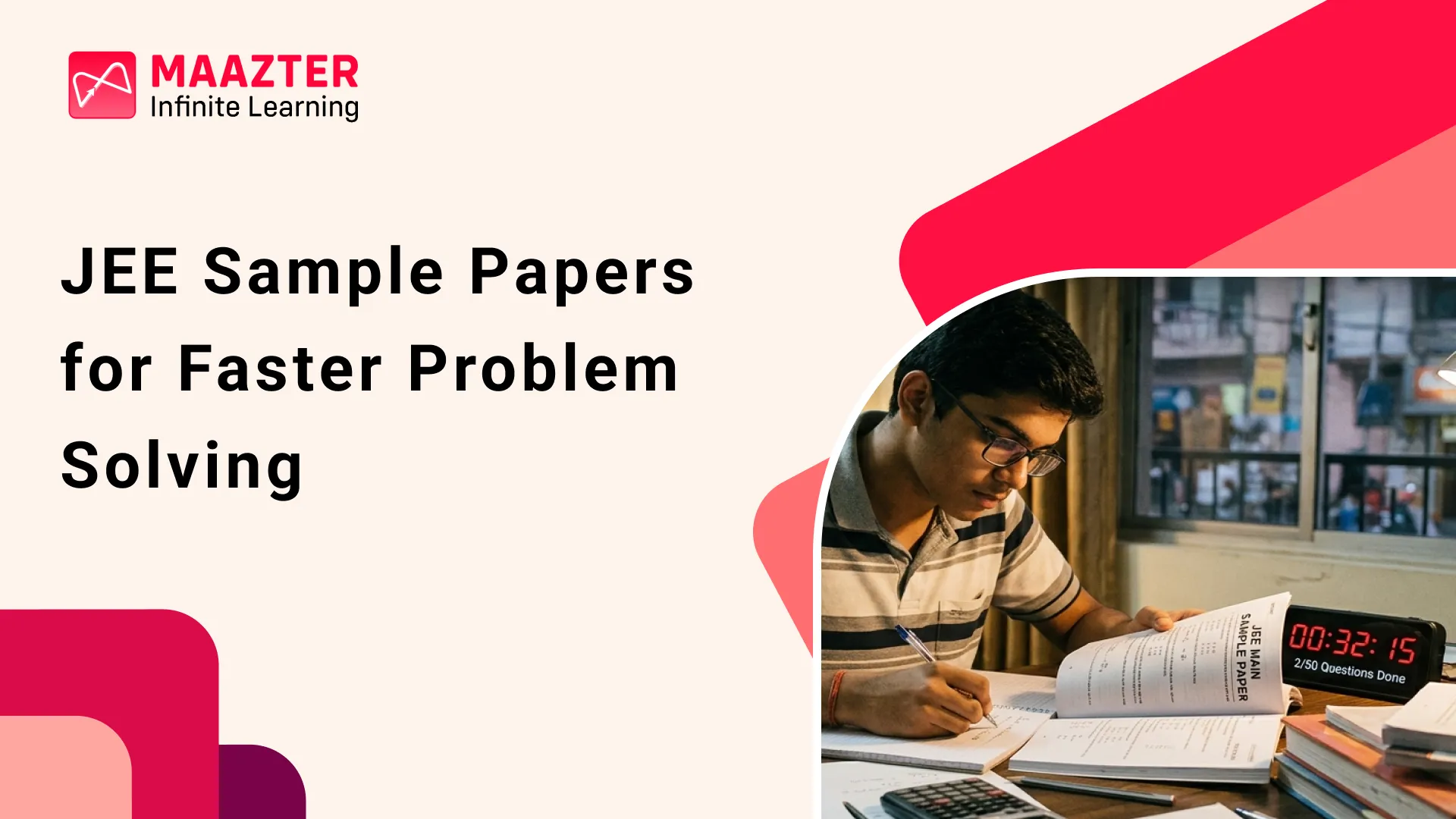


Mastering JEE Sample Papers Effectively
A question that feels easy at home can suddenly cost ten minutes inside a timed JEE sample papers test, and that time loss is the real problem most aspirants face. It isn't a lack of knowledge - it's the gap between understanding a concept and applying it fast enough when the clock is running. This is exactly the gap that regular, timed practice is designed to close, and it's why sample papers deserve a bigger role in daily preparation than most students realise.
Why JEE Sample Papers Build Real Speed
Solving more questions isn't automatically the answer. What actually moves the needle is how a student practises with a timer running, under exam-like conditions, and with honest review afterward. This is where JEE sample papers, and consistent JEE practice papers in general, start doing more than chapter-end exercises ever can.
When Concepts Are Clear But Speed Isn't
Many students can explain a formula perfectly in a doubt-clearing session but still stall when the same concept appears as question number 14 in a 60-question paper. That's because conceptual clarity and problem-solving speed are two different skills. One comes from understanding; the other comes from repetition under pressure. A student who has solved a type of Mechanics problem only three or four times will naturally take longer than one who has seen it fifteen times across different papers, even if both understand the theory equally well.
How Timed Practice Reveals Real Weaknesses
There's a difference between solving a paper and learning from one. A student who finishes a paper and only checks the final score has solved it. A student who notes exactly which Chemistry questions took four minutes instead of ninety seconds, and asks why, is learning from it. Timed JEE papers work like a diagnostic tool, they show which chapters are genuinely strong, which ones only feel strong, and where calculation speed quietly breaks down under a ticking clock.
A Simple Routine Using Sample Question Papers
A practice routine doesn't need to be elaborate to be effective. It just needs to be consistent and followed with discipline, especially in the weeks when full-length papers start replacing single-chapter revision.
Steps To Follow During Practice
A workable routine can look like this, and can be adjusted depending on preparation level:
- Choose a topic, chapter, or a full paper to attempt
- Set a realistic, exam-like time limit before starting
- Solve without checking answers midway
- Mark any question that took noticeably longer than expected
- Check incorrect answers only after finishing
- Identify the specific reason behind each mistake
- Reattempt the questions that were marked difficult
- Note down speed and accuracy for that attempt
- Repeat with a different paper the next day
This isn't a rigid timetable, a student early in preparation might only manage chapter-wise practice sets for JEE preparation, while someone closer to the exam can move to full three-hour attempts.
Reviewing Mistakes After Every Attempt
Checking a score tells a student what went wrong; a mistake log tells them why. Splitting errors into categories - concept error, calculation error, reading error, time-management error, and careless mistake turns a vague "I need to improve" into something specific and fixable. A student who realises three of their last five mistakes were reading errors, not concept gaps, can fix that in a week. Without this breakdown, the same mistakes tend to repeat paper after paper.
Choosing Questions Wisely Under Time Pressure
Good question selection often matters more than raw problem-solving ability. Many aspirants lose time by attempting a difficult question early simply because it appears first, leaving too little time for three or four easier questions later in the paper.
Learning When To Skip A Question
Knowing when to move on is a skill that only develops through practice, not instruction. A student attempting an engineering entrance practice paper for the tenth time starts recognising, almost instinctively, when a question is going to take longer than it's worth. For example, a student who once spent four minutes on a single Mathematics problem, leaving too little time for the questions after it eventually learns, through repeated timed attempts, to flag such questions and return to them only if time remains.
Balancing Easy, Moderate And Difficult Questions
Sorting questions into easy, moderate, and time-consuming categories within the first few minutes of a paper protects overall performance. Attempting every easy and moderate question first, before touching anything genuinely difficult, tends to secure more marks in less time. This is a strategy that's hard to internalise through theory alone, it becomes natural only after enough JEE preparation papers have been attempted under real time constraints.
How Structured Exam Question Papers Help
Once a student understands what to practise, the next question is usually where to find well-structured material at different levels. This is where a resource like Maazter fits in not as a replacement for concept study, but as a way to move from isolated chapter practice toward full paper attempts.
Moving From Chapter Tests To Full Papers
Maazter's structure follows a natural progression: Daily Practice Problem (50), Chapter Test (20), Module Test (8), and Grand Test (10) for NEET and JEE preparation. For foundation-level learners, it offers Chapter Test (25) and Grand Test (3), helping students strengthen individual topics before attempting broader papers. Students preparing through foundation course question papers can build this habit early, so that full-length testing feels familiar rather than overwhelming by the time JEE preparation intensifies.
Building Familiarity With Real Exam Formats
Beyond subject-wise testing, Maazter also offers academic-level exam question papers - Unit & Monthly Tests, Pre Mid-Term and Full Portion exams, and One Mark Tests, which reinforce school-level concepts that later support competitive exam preparation. Its 10-set Exam Rehearsal Series (Concept Builder I & II, Exam Ready I & II, Confidence Booster, Centum Challenger I & II, and One-Mark Mastery in Easy, Medium and Advanced levels) is designed to move students gradually from concept understanding toward full exam readiness. For students specifically looking to practise with real exam-style formats, Maazter's Previous Year Question Papers page offers a mix of foundation course question papers, sample question papers, and subject-wise material that reflects actual paper patterns rather than isolated practice questions.
Bringing It All Together
Improvement in JEE preparation rarely comes from solving more papers alone, it comes from solving with attention, reviewing honestly, and gradually building speed, accuracy, and better question selection over time. JEE sample papers work best when they're treated as a feedback tool, not just a box to check off in a study plan. If you're looking for structured, level-wise practice material to support this process, Maazter's Question Papers is a useful place to start building that habit consistently.


























Sign in to leave a comment.