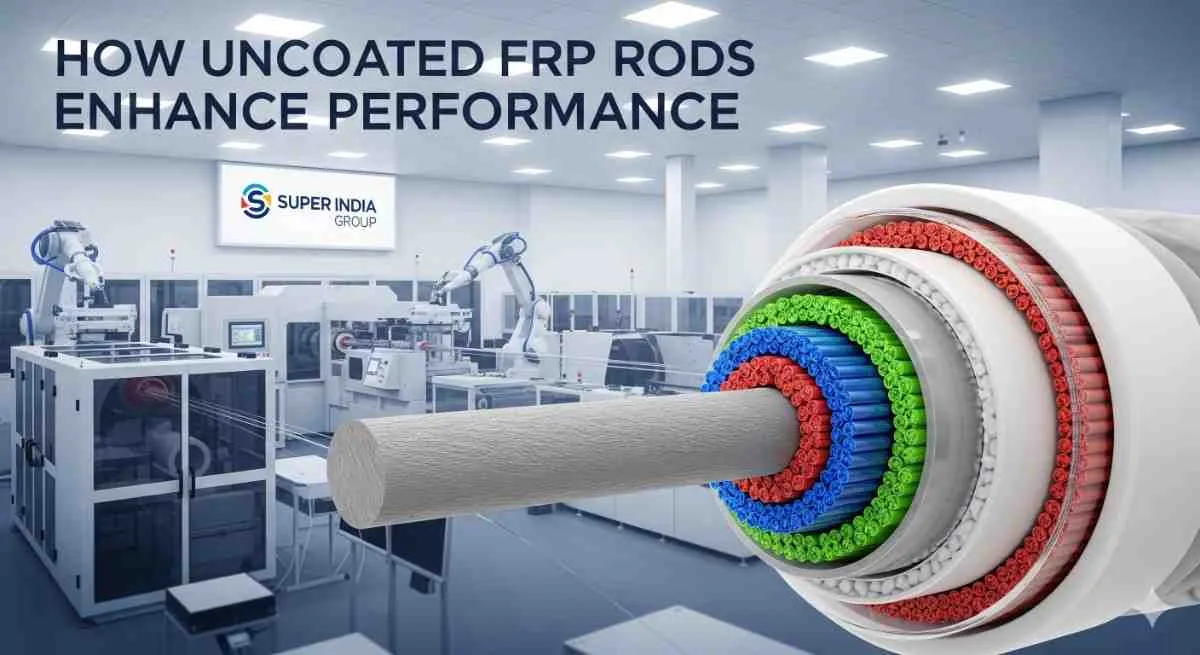

India’s fibre optic network continues to expand rapidly. BharatNet has connected over 2.15 lakh gram panchayats, with total optical fibre deployment crossing 42 lakh route kilometres by early 2026. Cable manufacturers face constant pressure to produce reliable cables faster, at competitive costs, while ensuring they survive India’s tough weather and long installation runs.
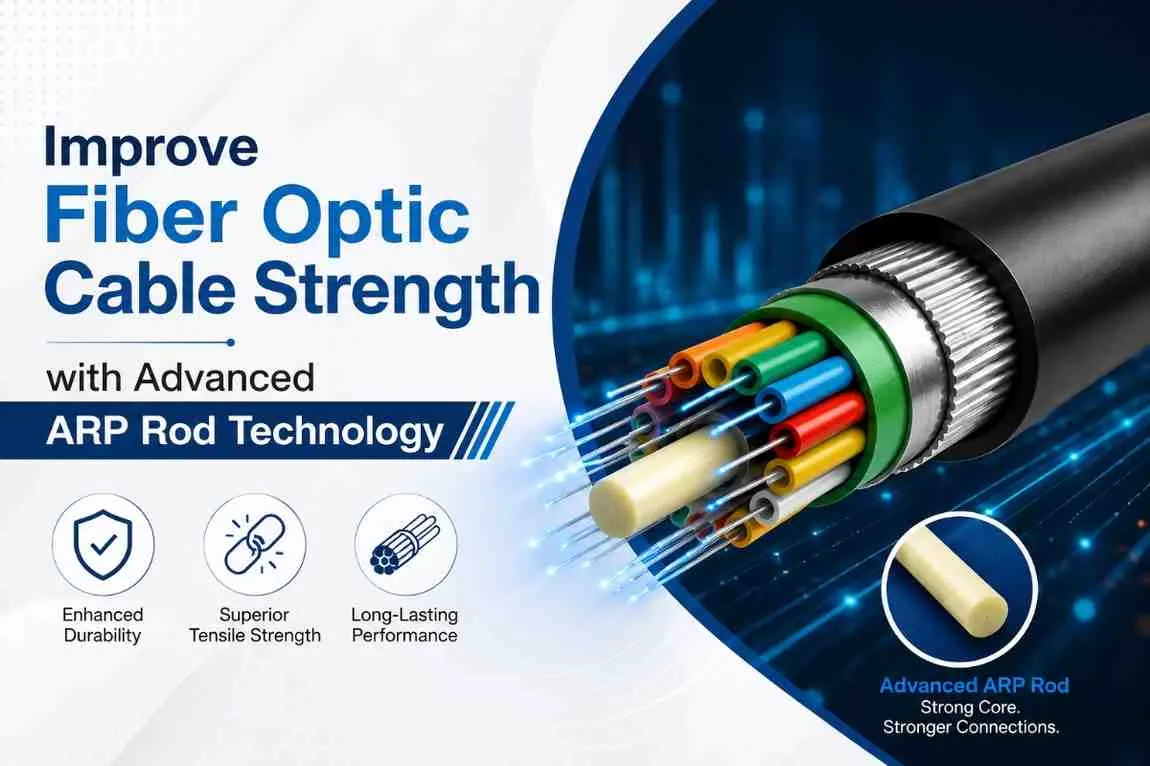
An uncoated FRP rod for fiber optic cable plays a quiet but powerful role here. These bare pultruded rods serve as the central strength member in many all-dielectric designs. They deliver the mechanical backbone cables need without adding unnecessary layers or cost. Here’s how they improve manufacturing performance and final cable quality.
What Makes an Uncoated FRP Rod Different?
Manufacturers create uncoated FRP rods by pulling continuous E-glass fibres through a resin bath and curing them into a solid, rigid rod. The “uncoated” version keeps its natural smooth surface straight from the pultrusion process—no extra polymer coating applied.
Cable makers place these rods at the centre of loose-tube, uni-tube, slotted-core, or ribbon cables. The rod’s main job is simple: provide high tensile strength during pulling and laying, prevent buckling or sagging, and keep the delicate optical fibres protected for 20–30 years.
Because it has no coating, the uncoated FRP rod stays cost-effective and integrates cleanly in designs where strong adhesion to the outer jacket isn’t critical.
Superior Strength-to-Weight Ratio
One of the biggest advantages shows up right on the factory floor and during installation.
An uncoated FRP rod offers tensile strength often exceeding 1500 N/mm² while weighing roughly one-fourth that of steel. This light weight reduces overall cable weight significantly. Manufacturers can produce longer continuous lengths on stranding lines with less strain on equipment. Installers pull cables more easily over longer distances—whether in ducts or aerial routes—without excessive tension on the fibres.
The result? Faster production cycles, lower transportation costs, and smoother on-site deployment, especially in rural BharatNet projects where teams cover vast distances.
Excellent Dimensional Stability and Anti-Buckling Performance
Temperature swings and mechanical stress can cause cables to buckle or deform, damaging the optical fibres inside.
Uncoated FRP rods provide outstanding dimensional stability. They stay rigid enough to maintain cable shape under load but offer enough controlled flexibility during bending. This anti-buckling support keeps the cable straight and stable, even when temperatures rise or fall sharply.
In manufacturing, this stability means more consistent quality across long production runs. Fewer defects occur during jacketing and stranding. In the field, cables resist sagging in aerial installations and handle ground movement or wind loads better.
Non-Conductive and Corrosion-Resistant Properties
India’s diverse environments test cables hard—coastal salt air, heavy monsoons, high humidity, and dust.
Unlike steel, an uncoated FRP rod is fully dielectric and non-metallic. It eliminates risks from electromagnetic interference and lightning strikes, which matter in areas with mixed power and telecom infrastructure.
It also resists corrosion, moisture, and chemicals extremely well. No rust forms over time, and no harmful reactions occur with cable filling compounds. This keeps transmission performance stable for decades and cuts long-term maintenance costs for operators.
Boosts Manufacturing Productivity
Long, splice-free lengths are a practical win for cable factories. Uncoated rods come in continuous spools that let production lines run smoothly with minimal stops. Tight diameter tolerances (often ±0.05 mm) ensure even stranding and uniform cable construction.
The smooth natural surface reduces friction during processing, lowering the chance of surface damage or defects. Manufacturers achieve higher output rates while maintaining consistent quality—important when supplying massive nationwide projects.
Because the rod needs no extra coating step for central strength applications, production stays simpler and more cost-efficient.
Better Overall Cable Performance
Cables built with uncoated FRP rods as the central strength member deliver real-world benefits:
- Lighter weight improves handling and reduces strain on poles in aerial setups.
- Lower installation tension protects the optical fibres, reducing attenuation issues.
- Superior environmental resistance means cables perform reliably in harsh conditions without frequent repairs.
- All-dielectric construction meets safety standards for many indoor and outdoor applications.
These improvements help cable makers deliver products that not only meet specifications but also lower the total cost of ownership for network operators.
When Uncoated FRP Rods Make the Most Sense
Uncoated versions work best as central strength members where the rod doesn’t require strong bonding to the outer jacket. For designs needing better adhesion or peripheral reinforcement, coated rods may suit better. However, for standard all-dielectric fibre optic cables, the uncoated option often strikes the right balance of performance and economy.
Reputable Indian manufacturers now produce these rods with advanced quality controls, including precise fibre alignment and resin systems tailored for telecom use. This local capability supports fast delivery and helps the industry scale up to meet growing demand.
Looking Ahead in Indian Telecom
As India pushes fibre deeper into villages and prepares for future technologies, cable performance becomes even more critical. Uncoated FRP rods help manufacturers build lighter, stronger, more durable cables without inflating costs.
They reduce weight, resist harsh environments, prevent buckling, and streamline production—all while protecting the heart of the cable: the optical fibres.
For cable producers aiming to deliver reliable, high-quality fibre optic cables at scale, choosing the right strength member makes a measurable difference.
Conclusion
An uncoated FRP rod for fiber optic cable quietly enhances every stage—from manufacturing efficiency to long-term network reliability. Its combination of high tensile strength, low weight, corrosion resistance, and dimensional stability makes it a smart choice for modern all-dielectric designs.
As India’s fibre rollout continues at full speed, these simple composite rods help build infrastructure that lasts. The right reinforcement today means fewer problems tomorrow.
Frequently Asked Questions
What is the main role of an uncoated FRP rod in fibre optic cables?
It acts as the central strength member, providing tensile strength during installation and preventing buckling while protecting the optical fibres over the cable’s lifetime.
How does an uncoated FRP rod compare in weight to steel?
It weighs about one-fourth as much as steel but delivers comparable or higher tensile strength, making cables lighter and easier to handle.
Why do manufacturers prefer uncoated over coated FRP rods for some designs? Uncoated rods cost less and work perfectly as central strength members when strong jacket adhesion isn’t needed. They simplify production while delivering excellent performance.
Can uncoated FRP rods handle India’s climate conditions?
Yes. They resist moisture, salt, heat, and corrosion far better than metal, making them ideal for both aerial and underground installations across diverse regions.
Are uncoated FRP rods suitable for all fibre optic cable types?
They suit loose-tube, uni-tube, slotted-core, and ribbon designs well, especially in all-dielectric constructions focused on central reinforcement.


























Sign in to leave a comment.