
According to sources, small and medium businesses benefit the most from cloud services, as they spend 36% less money on IT. Cloud-based solutions/services are used widely in all the business sectors. Manufacturing, BFSI, government, and various enterprises use cloud solutions for automating the manual work process and ease of work.
Cloud solutions have helped various businesses to grow regardless of the business size, infrastructure, and finance. Cloud is not just the future, but it is the present! Choosing cloud solutions is your only choice. Basically, cloud computing is a collection of servers whose resources are accessible to you through the Internet. To access the cloud services/resources, you need a cloud service provider who offers you services according to the requirement of your business.
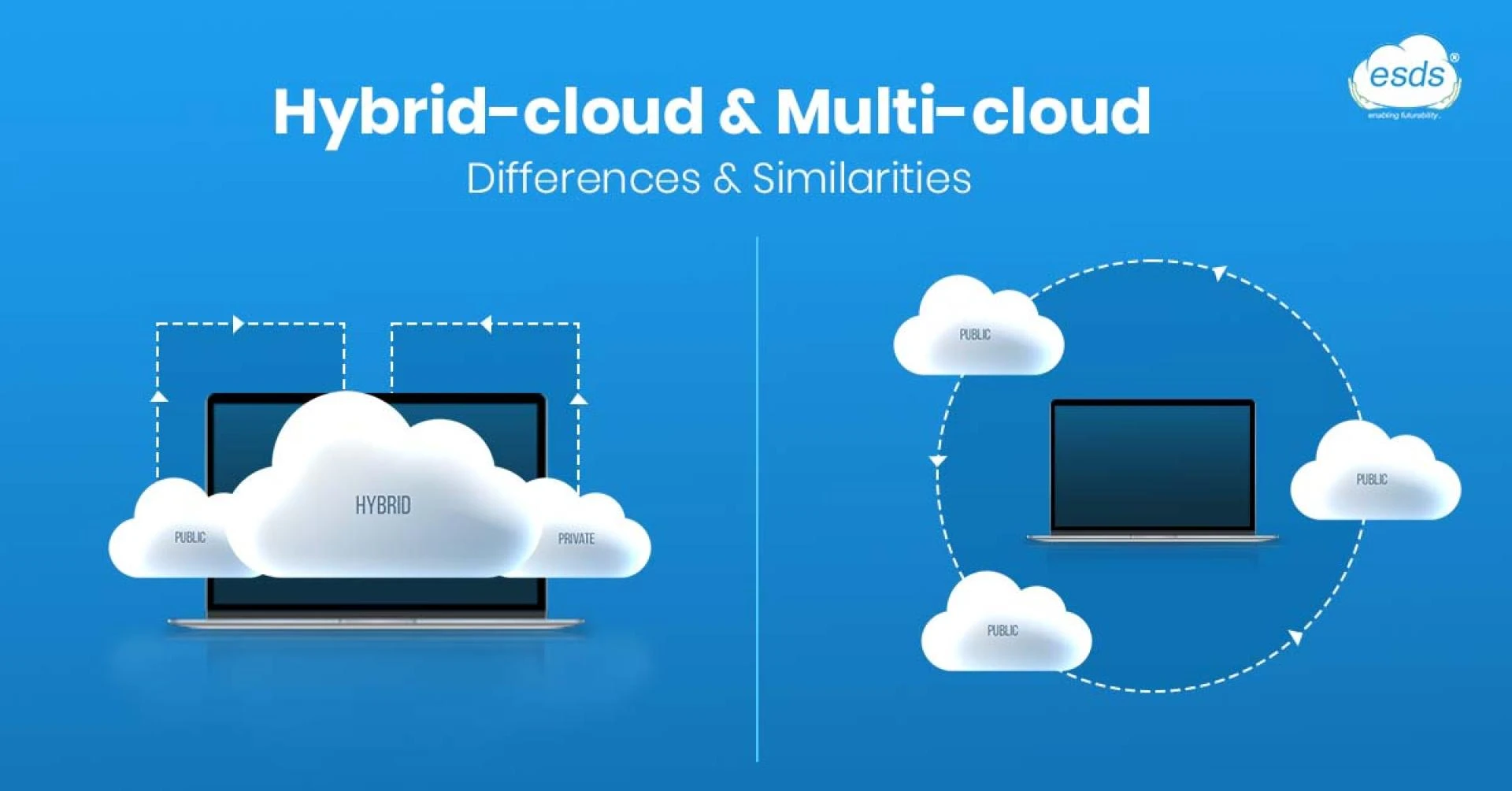
Hybrid clouds and multi-clouds are the two most popular types of cloud computing.
Find out what multi-cloud and hybrid cloud are and how they can help you!
What is Multi-Cloud?
Multi-cloud refers to the use of multiple public clouds. Multi-cloud deployment is when a company uses various public clouds from different cloud service providers. For cloud hosting, storage, and the entire application stack, a company uses services from multiple service providers.
Multi-cloud deployments have a variety of applications. Multiple IaaS (Infrastructure-as-a-Service) providers can be used in a multi-cloud deployment, or a single vendor can provide IaaS, PaaS (Platform-as-a-Service), and SaaS (Software-as-a-Service) services. Multi-cloud can be used solely for redundancy and system backup, or it might include many cloud vendors for various services.
Benefits of Multi-Cloud
1. Reliability and redundancy
If one cloud goes down, customers will still be able to access some functionality via the other installed clouds. A public cloud can be used as a backup for another cloud.
2. Reduced vendor lock-in
Moving to the cloud necessitates relying on third-party cloud providers, and as firms become more reliant on these vendors, it can be harder to break free. A multi-cloud model distributes systems and storage among multiple vendors.
3. Potential cost savings
If a company doesn’t want to commit to using one cloud vendor for all of its infrastructure needs, it can pick and select the most cost-effective services from other vendors.










Sign in to leave a comment.