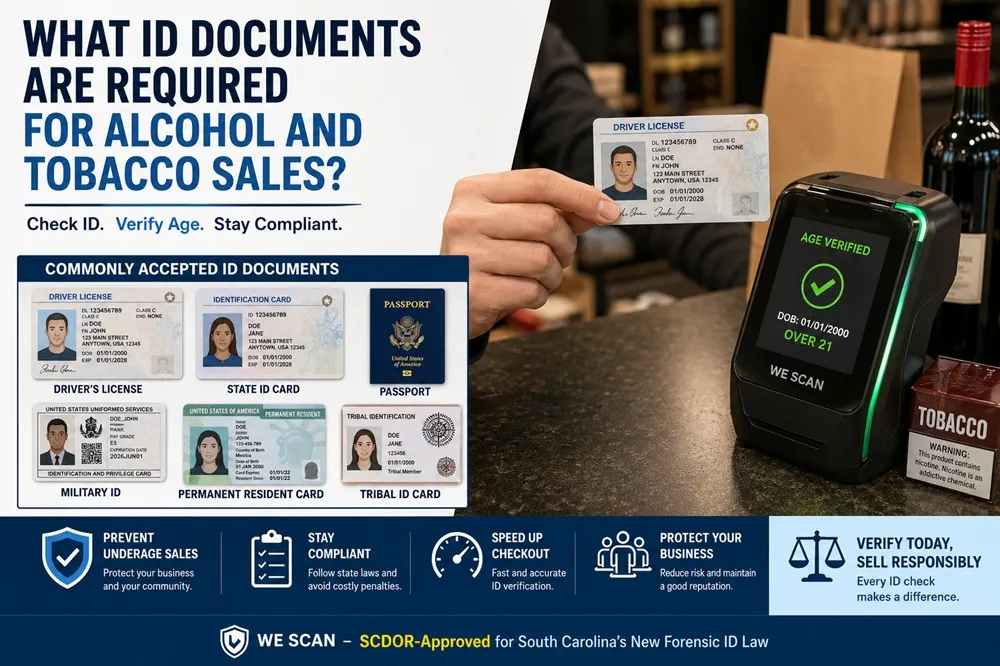
Selling alcohol and tobacco comes with legal responsibilities. Every retailer must verify a customer’s age before completing a sale. Using the correct identification documents helps prevent underage sales, reduces the risk of fines, and keeps your business compliant with state laws.
The ID Documents required for alcohol and tobacco sales can vary by state, but most retailers accept government issued photo identification such as driver’s licenses, passports, military IDs, and state identification cards. Many businesses now use ID scanners to improve accuracy and reduce human error. This guide explains which documents are commonly accepted, how to verify them, and why modern ID scanning technology has become an important part of retail compliance.
Why Age Verification Matters
Alcohol and tobacco are age restricted products. Selling these products to minors can result in:
- Heavy financial penalties
- License suspension or revocation
- Legal action
- Damage to your business reputation
According to the Centers for Disease Control and Prevention, preventing youth access to tobacco products is one of the most effective ways to reduce tobacco use among young people. Retailers play a major role in this effort.
Many states also conduct compliance inspections to ensure businesses check IDs before every sale.
ID Documents Required for Alcohol and Tobacco Sales
Retailers should only accept valid, government issued identification that clearly shows the customer’s:
- Full name
- Date of birth
- Photograph
- Expiration date, where applicable
- Security features
The most commonly accepted documents include:
Driver’s License
- Accepted for age verification: Yes
- Notes: Most commonly used government issued photo ID.
State Identification Card
- Accepted for age verification: Yes
- Notes: Valid government issued photo ID for individuals without a driver’s license.
Passport
- Accepted for age verification: Yes
- Notes: Accepted for both domestic and international customers.
Military Identification Card
- Accepted for age verification: Yes
- Notes: Accepted in many states for verifying legal age.
Permanent Resident Card
- Accepted for age verification: Depends on local regulations
- Notes: Always check your state’s specific requirements before accepting it.
Tribal Identification Card
- Accepted for age verification: Accepted in many states
- Notes: Must meet applicable state and local legal requirements.
Always follow your state’s regulations because accepted documents may vary.
How Retailers Should Check an ID
Checking an ID should take only a few seconds, but every step matters.
Check the Photo
Make sure the photo matches the customer standing in front of you.
Verify the Date of Birth
Confirm the customer meets the legal age requirement before completing the sale.
Look for Signs of Tampering
Watch for:
- Peeling laminate
- Missing security features
- Different fonts
- Blurry printing
- Scratches near the birth date
Check the Expiration Date
Expired IDs may not be accepted depending on state regulations.
Use an ID Scanner
Modern ID scanners automatically read barcode data and verify information within seconds. This reduces mistakes and speeds up customer service.
Why ID Scanners Help Retailers
Manual ID checks can lead to errors, especially during busy hours.
An ID scanner provides several benefits:
- Faster age verification
- Better accuracy
- Reduced human error
- Electronic verification of barcode data
- Improved compliance records
- Easier employee training
Retail stores, liquor stores, convenience stores, grocery stores, bars, restaurants, casinos, and vape shops increasingly rely on ID scanning technology for daily operations.
South Carolina’s New Forensic ID Law
Retailers in South Carolina should stay informed about recent compliance updates.
WE SCAN is now SCDOR Approved for South Carolina’s new forensic ID law.
This approval helps businesses meet the state’s updated identification verification requirements while improving customer safety and reducing compliance risks.
Businesses operating in South Carolina should review the latest guidance to ensure they follow all legal requirements during alcohol and tobacco sales.
Common Mistakes Retailers Should Avoid
Many compliance issues happen because of simple mistakes.
Avoid these common problems:
- Accepting expired identification
- Relying only on appearance
- Ignoring damaged IDs
- Skipping ID checks during busy periods
- Failing to train new employees
- Not using available verification technology
Consistent procedures help reduce these risks.
Best Practices for Retail Compliance
Follow these simple practices every day:
- Check every customer’s ID when required by law.
- Train employees regularly.
- Keep ID scanning equipment updated.
- Stay informed about state regulations.
- Document compliance procedures.
- Review company policies often.
A clear verification process protects both customers and your business.
Helpful Statistics
Recent studies continue to show the importance of strong age verification practices.
Nearly 9 out of 10 adults who smoke cigarettes started before the age of 18.
- Source: Centers for Disease Control and Prevention (CDC)
Retail compliance checks help reduce illegal sales of alcohol and tobacco products to underage buyers.
- Source: U.S. Food and Drug Administration (FDA)
These findings show why proper ID verification remains an important responsibility for every retailer.
Frequently Asked Questions
What ID documents are accepted for alcohol and tobacco sales?
Most retailers accept driver’s licenses, state ID cards, passports, military IDs, and other valid government issued photo identification, depending on state regulations.
Can an expired ID be accepted?
Many states do not allow expired identification for age verification. Always follow your local laws.
Is a digital copy of an ID acceptable?
Some states allow digital identification, while others require a physical government issued ID. Check your state’s current rules before accepting digital IDs.
Why should retailers use an ID scanner?
An ID scanner improves accuracy, verifies barcode information, reduces manual errors, and helps businesses comply with age verification laws.
Are ID requirements the same in every state?
No. Each state may have different rules regarding accepted identification documents and age verification procedures.
Conclusion
Checking the correct ID Documents required for alcohol and tobacco sales is one of the most important steps in responsible retailing. A consistent verification process helps prevent underage sales, protects your business, and supports compliance with state regulations. Using modern ID scanning technology also improves speed, accuracy, and confidence at the point of sale.
Businesses looking to strengthen their age verification process can rely on WE SCAN, now SCDOR Approved for South Carolina’s new forensic ID law, to help meet compliance requirements while providing fast and reliable ID verification solutions.
Source:- https://tinyurl.com/4yuevzz9




























Sign in to leave a comment.