
Retirement planning is one of the most important financial decisions that you need to make on time to have a fruitful and secure financial future. The National Pension System (NPS) takes the centre stage when it comes to choosing the best plan for retirement years. It helps build a steady fund when you reach 60 years of age. However, many people overlook a key element in their retirement calculations - annuity rates. Read this blog to get clarity on the impact of annuity rate in NPS with an NPS calculator, as it will help you make smart decisions when investing in an NPS account.
What is an Annuity in NPS?
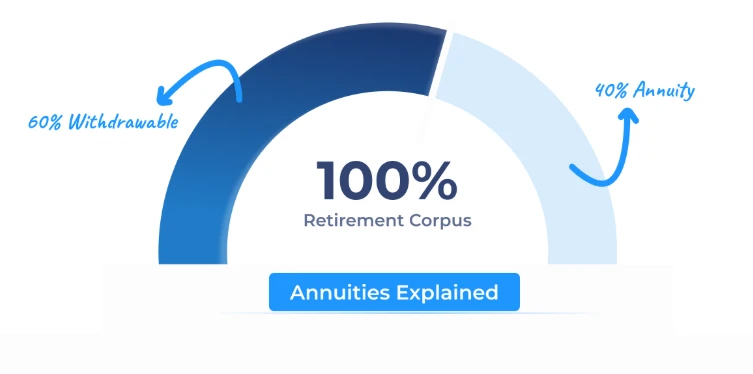
An annuity in NPS can be defined as a financial product that pays you a fixed monthly income for life after retirement. Once you exit from the NPS, you are required to use at least 40% of your accumulated corpus to buy an annuity. It ensures you continue to receive a regular income, even after your working years are over. An annuity rate in NPS determines how much monthly pension you will receive based on your corpus invested in annuity.
Understanding the NPS Calculator
The NPS calculator is an online tool that helps you estimate:
Here’s what you enter in an NPS calculator:
By adjusting these values, especially the annuity rate, you can see how your pension amount changes.
What is the Annuity Rate in NPS?
The annuity rate in NPS is the rate at which your annuity provider offers to convert your invested amount into a monthly pension. For example, if you start investing ₹5000 per month in NPS at an interest rate of 10% p.a., from the age of 28 years. Then at 60 years, your total retirement corpus will be ₹1,40,41,677 approx. The 40% of the maturity amount invested in annuity at the interest rate of 6% p.a. comes to be ₹56,16,671 approx, and you will get ₹28,083 approx per month as pension.
Disclaimer: Estimates based on the ICICI Bank NPS Calculator, actual returns may vary.
The annuity rate depends on various factors like:
Impact of Annuity Rates in the NPS Calculator
Annuity rates have a direct impact on your monthly pension after retirement. When you use the NPS calculator, one of the most important inputs is the annuity rate. It helps you estimate how much fixed monthly income you will receive based on the portion of your NPS corpus used to buy an annuity.
Let us take the above example to understand the concept better. You retire with ₹1,40,41,677 approx and decide to use ₹56,16,671 approx (40%) for annuity purchase, the pension amount will depend on the annuity rate:
Disclaimer: Estimates based on the ICICI Bank NPS Calculator, actual returns may vary.
So, even a 1% change in annuity rate can lead to a noticeable difference in your pension income. This is why it's essential to use an updated NPS calculator with realistic annuity rates before making decisions
How to Choose the Right Annuity Plan?
There are five types of annuity plans you can choose under NPS:
The subscriber receives a lifetime annuity. After the death of the subscriber, payments stop, and 100% of the purchase price is returned to the nominee.
The subscriber gets a lifetime annuity. After the death of the subscriber, their spouse receives it for life. Then, the full purchase price is returned to the nominee after the spouse passes away.
The subscriber gets a lifetime annuity. After the death of the subscriber, it goes to their spouse, then their dependent mother, father, and finally, the purchase price is returned to their children or legal heirs.
The subscriber receives an annuity for their entire life. After their death, payments stop immediately. No amount is returned to the nominees or legal heirs.
The subscriber receives an annuity for life. After their death, their spouse gets it for life. After the death of the spouse, payments stop completely, and nothing is returned to any nominee.
Factors That Affect Annuity Rate in NPS
Here are a few things that affect your final annuity rate:
1. Age at Retirement
The older you are, the higher the annuity rate offered. For example, at age 65 years, you may get a better rate than at age 60 years.
2. Type of Annuity Plan
Simple annuity plans offer higher rates compared to those with return of purchase price or joint life options.
3. Market Interest Rates
Annuity rates may change depending on the RBI’s repo rate, bond yields, and overall interest rate trends.
Tips to Maximise Your NPS Pension
Here’s how you can make the most of your retirement income:
Starting your NPS contribution early gives your money more time to grow. With the power of compounding, small monthly investments can turn into a substantial retirement fund, ensuring a stable income during your golden years.
2. Use the NPS calculator regularly to track your estimated pension
Regularly using an NPS calculator helps you understand how your current contributions, returns, and annuity rates will affect your pension.
Conclusion
The annuity rate in NPS plays a major role in determining your monthly pension. A small change in rate can have a big impact on your post-retirement lifestyle. That’s why it’s important to understand how annuity rates work and how to use the NPS calculator to plan better.
Always review different annuity options, and stay updated on current market trends. With smart planning and the right use of tools like the NPS calculator, you can enjoy a secure and stress-free retirement.













Sign in to leave a comment.