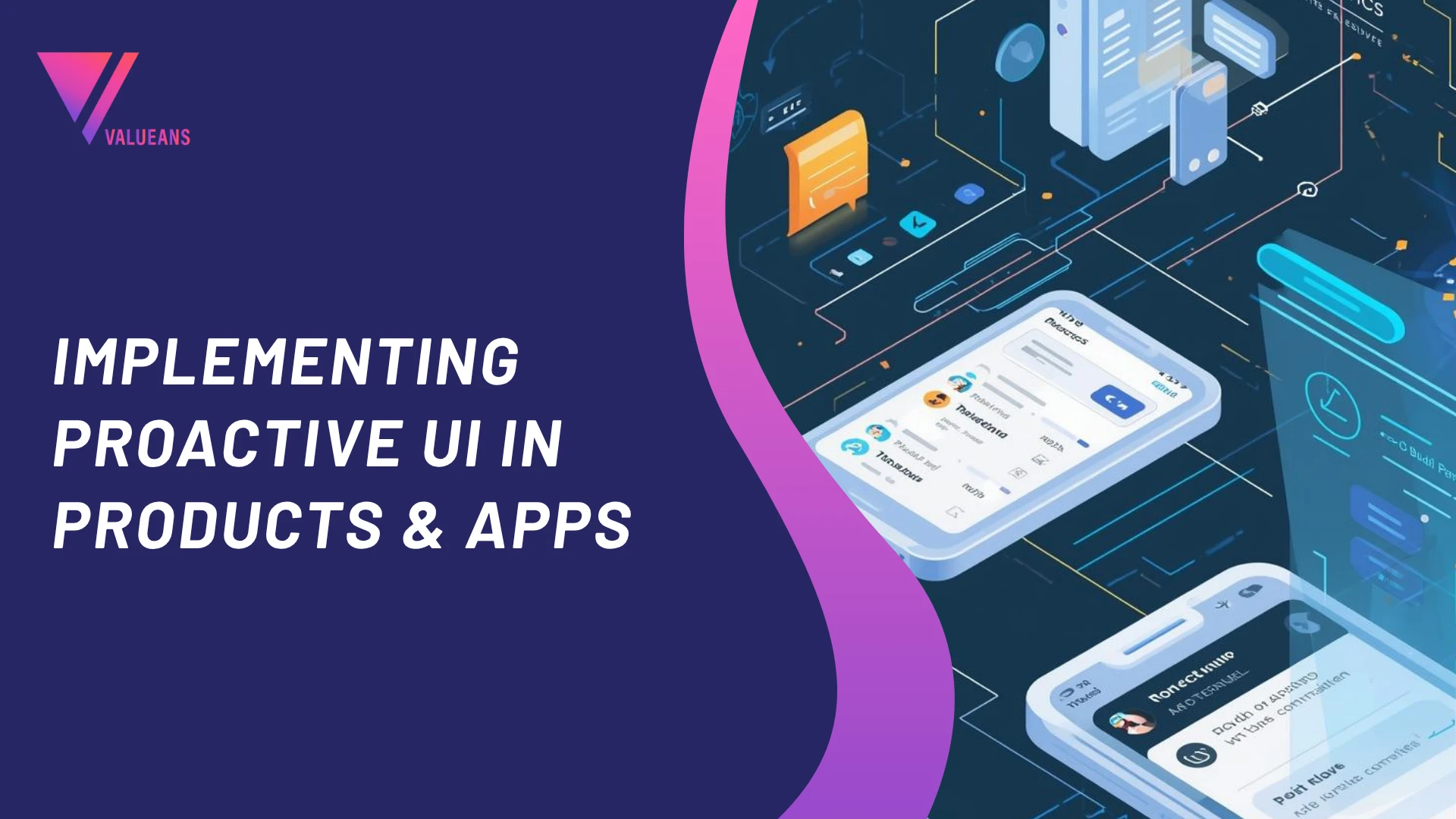

In the digital world, User Interface (UI) design has traditionally been reactive—it waits for the user to click, type, or interact, and only then provides a response. While effective, this model places the cognitive burden squarely on the user to initiate every action.
The next evolutionary leap in design is the Proactive UI. This paradigm shifts the focus from merely responding to user input to actively anticipating the user’s intent and delivering the most relevant information or function before they even explicitly ask for it. A truly proactive interface is an intelligent partner, reducing friction, eliminating unnecessary steps, and driving efficiency by seamlessly guiding the user toward their goal. Implementing this requires a deep fusion of exceptional UX UI principles with advanced data science capabilities, specifically AI and Machine Learning (ML).
Proactive UI is not about overwhelming the user with suggestions; it's about contextual intelligence and subtle guidance. It enhances the user experience (UX) by making the app feel intuitive, personalized, and even capable of reading minds. This blog delves into the core components, underlying technologies, and strategic implementation necessary to build products that are truly predictive.
The Core Pillars of Proactive UI
Proactive UI is built on three foundational pillars, all of which rely on continuous data processing and intelligence.
1. Contextual Awareness
The interface must understand the user's situation beyond the screen. This includes geographical location, time of day, device type, network speed, and most importantly, the user's history and current task flow within the application. For example, a travel app that recognizes the user is at the airport gate and immediately surfaces the boarding pass is exhibiting contextual awareness.
2. Predictive Modeling
This is the technical heart of proactive design. It involves using AI-ML solutions to analyze past behavior patterns of both the individual user and the aggregate user base to forecast the user's likely next action, need, or destination. If 90% of users check their portfolio value after logging in on a Monday morning, a proactive finance app will make that data immediately accessible on the home screen.
3. Subtlety and Non-Intrusion
The challenge of proactive design is anticipating without being annoying. A proactive intervention should be seamless and non-interruptive. It presents a helpful option but allows the user to easily ignore or dismiss it. A system that constantly throws up pop-ups or incorrect suggestions is simply being aggressive, not proactive, and will erode the user experience. The goal is to surface the right information at the right time, minimizing clicks and cognitive load.
The Technology Stack Driving Proactivity
Successfully implementing Proactive UI moves beyond traditional software development and requires expertise in sophisticated data science technologies.
1. The Engine of Prediction: AI and Machine Learning
The primary technology enabling proactivity is advanced machine learning services. These models are essential for:
- Behavioral Analysis: Training algorithms on click paths, feature usage, and session duration to identify user goals and intent.
- Recommendation Engines: Going beyond recommending products to recommending actions or flows. For instance, a collaboration tool recommending who a user should share a document with based on past team interactions.
- Anomaly Detection: Identifying patterns that suggest a user is struggling or performing an unusual task, allowing the UI to proactively offer help or guidance.
These systems are constantly learning and self-improving, ensuring the predictive accuracy increases over time, making the UI feel smarter with every interaction.
2. The Data Backbone: Engineering and Analytics
No AI business solutions can function without high-quality data. Proactive UI relies on massive, real-time datasets. This places a critical emphasis on robust Data engineering. The system must be capable of:
- Ingesting Heterogeneous Data: Collecting data from various sources—application logs, external APIs, user settings, time-series data, etc.
- Real-Time Processing: Cleaning, transforming, and feeding this data to the ML models with minimal latency, as a proactive suggestion that arrives 30 seconds late is useless.
- Scalable Storage: Building a reliable, scalable data lake or warehouse that can store the historical data necessary to train deep learning models accurately.
The data must then be interpreted using continuous data analytics. Designers and product managers use this output to validate the effectiveness of the proactive features, measuring how often the AI's suggestions are accepted versus dismissed. This human-in-the-loop review prevents the UI from becoming overly automated and ensures alignment with business goals.
3. Forecasting Intent: Predictive Analytics and NLP
To truly anticipate the next move, the interface needs to utilize specialized forecasting tools. Predictive analytics technologies use statistical modeling and data mining to predict future outcomes. In UI, this translates to predicting the specific data point or function the user is looking for.
Furthermore, when the product involves conversational interfaces (chatbots, voice assistants) or analyzes user input (search queries, form data), advanced [NLP solutions](https://alltheinternal links: https://valueans.com/technologies/nlp-solutions) become essential. NLP allows the system to understand the subtle intent and sentiment behind a user's typed or spoken request, allowing the UI to preemptively offer a solution before the user has finished their query.
Practical Implementation Strategies for Proactive Features
Moving from concept to code requires structured implementation steps focusing on value and measurable impact.
Strategy 1: Smart Defaults and Pre-population
Instead of leaving forms or settings blank, use data to provide smart, contextually relevant defaults. If a user always ships to the same address, pre-populating that field is proactive. If a user always selects "Standard Shipping," make it the default but allow easy changing. This utilizes low-risk AI-ML solutions to remove tedious interaction points.
Strategy 2: Timely Nudges and Contextual Help
Rather than a generic "Help" button, a proactive UI offers help based on observed struggle. If data analytics shows a high abandonment rate on a specific checkout step, the UI should pop up a contextual tip (e.g., "Need help with payment options?") only when a user hesitates (e.g., after 10 seconds of inactivity). This is a precise application of behavioral data to improve conversion.
Strategy 3: Action Prioritization
This is the most visible form of proactivity. The interface dynamically rearranges the layout to bring the most probable next action to the forefront. A music app might move "Play Workout Playlist" to the top of the home screen when it detects the user is connecting Bluetooth headphones at 6 AM. This requires high-accuracy predictive analytics technologies to be effective, avoiding the clutter of irrelevant suggestions.
The Partnership: UX UI and AI Business Solutions
The success of Proactive UI lies not just in the technology, but in the seamless collaboration between data science and design.
A brilliant UX UI team ensures that the proactive elements are implemented with visual clarity, appropriate hierarchy, and minimal visual noise. The design must be adaptable and flexible enough to accommodate the constant changes and re-prioritizations delivered by the AI models.
When developing a proactive product, businesses must treat it as a holistic undertaking—an AI business solutions project—rather than a feature add-on. This requires continuous investment across the entire stack: from the Data engineering team building the real-time pipelines to the design team crafting the responsive front-end.
The future of app and product interaction is intelligent anticipation. By committing to the strategic implementation of Proactive UI, companies can build experiences that are not only easier to use but that fundamentally feel more intuitive and valuable, transforming user satisfaction into a powerful competitive advantage.



























Sign in to leave a comment.