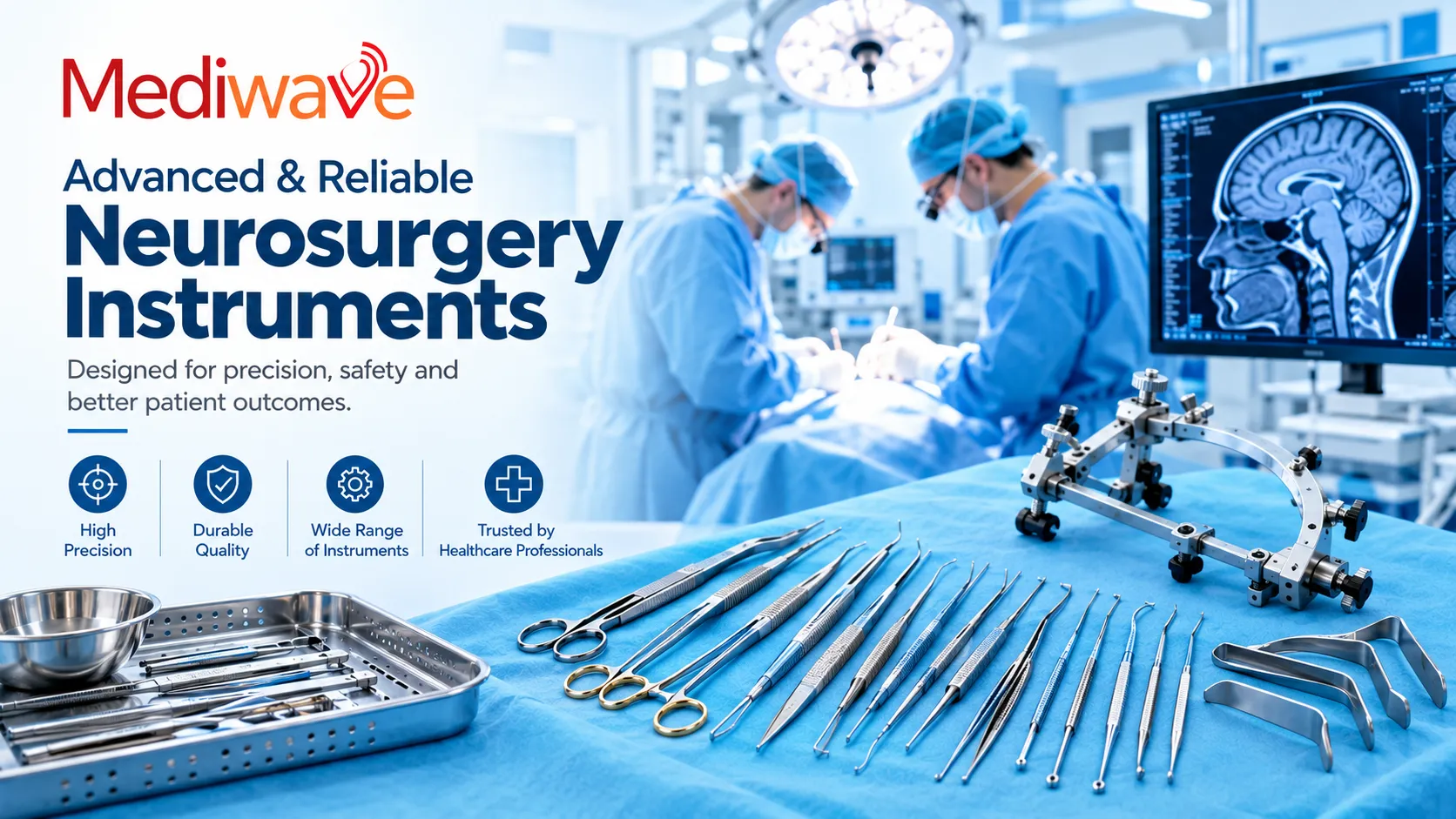

A neurosurgeon doesn't find out an instrument is wrong mid-procedure. She finds out the moment her hand reaches for a bayonet forceps that doesn't sit right, and there's no time to fix that on the table. That's the real cost of choosing Neurosurgery Instruments Manufacturers without checking the details that matter. Hospitals across India buy on price, then discover the gap between "surgical grade" on paper and surgical grade in a patient's skull. Getting this decision right isn't about ticking a procurement box. It's about instruments that behave the same way on the hundredth use as they did on the first.
Specification
Neurosurgery instruments cover a narrow but demanding range — and the differences between models matter more than most catalogs admit.
Core Instrument Categories
- Micro-dissectors and bipolar forceps — used for delicate tissue separation near vascular structures
- Cranial perforators and burr sets — for controlled bone access without thermal damage
- Retractor systems — self-retaining, with adjustable tension
- Aneurysm clips and clip appliers — precision-machined, corrosion-resistant
- Micro-scissors and needle holders — fine-tipped, for suturing in confined spaces
The Detail Most Buyers Skip
Most hospitals check material grade — usually AISI 420 or 440 stainless steel — and stop there. What they skip is the tempering process. Two instruments made from identical steel can perform completely differently in the hand depending on how they were hardened. An under-tempered tip chips. An over-tempered one bends. Neither shows up on a spec sheet; both show up in the OR.
Objective: 5 Criteria to Evaluate Any Supplier
1. Traceability of raw material. A good answer includes mill certificates and batch numbers. A bad answer is "we source quality steel" with nothing to back it.
2. Tip-to-tip consistency across a batch. Good suppliers test sample instruments from each production run. Bad ones ship an entire lot based on one approved sample from three months ago.
3. Sterilization compatibility. Good answer: instruments rated and tested for your specific autoclave cycle. Bad answer: a generic "autoclavable" label with no cycle data.
4. Repair and re-sharpening support. A supplier who can't service what they sold you isn't really in the neurosurgery instruments business — they're in the one-time-sale business.
5. Documentation for regulatory audits. If a supplier hesitates when you ask for CE or ISO 13485 paperwork, that hesitation is your answer.
Benefits
Choosing the right supplier isn't about comfort. It's about risk. Fewer instrument failures mid-procedure means fewer delayed surgeries and fewer liability conversations nobody wants to have. Consistent tip geometry across your inventory means surgeons aren't relearning feel every time a new batch arrives — that reduces error, not just irritation. Verified sterilization compatibility protects against instrument degradation that shortens usable life and quietly inflates your replacement budget. Batch traceability gives your procurement team an actual paper trail during NABH or JCI audits, instead of a scramble. And working with one supplier across neurosurgery, orthopedic, and general surgical lines cuts down the vendor management overhead that eats into a purchasing manager's week.
None of this is about buying "premium." It's about buying instruments that don't create problems six months after delivery.
Availability
We ship Neurosurgery Instruments across India, with regular movement into metro hospital hubs — Delhi NCR, Mumbai, Bengaluru, Chennai, Hyderabad — as well as tier-2 cities Where multi-specialty hospitals are growing more rapidly than local supply chains can support. That makes a bigger difference than many think.
A hospital in a tier-2 city often pays a premium not because instruments cost more to make, but because fewer suppliers are willing to hold regional stock. We keep inventory positioned to shorten that gap, which means a replacement burr set doesn't sit in transit for two weeks while a surgery schedule backs up.
About Us
We've been supplying surgical and orthopedic instruments to Indian hospitals since 2013, and Neurosurgery Instruments have been part of our catalog since 2017. We stopped sourcing one micro-forceps design from an earlier vendor in 2020 after two hospitals reported tip fatigue after roughly 150 sterilization cycles — well short of what the spec sheet promised. We switched vendors and changed our internal testing protocol to include a 200-cycle stress check before any new instrument line goes to market. That's not a marketing line. That's what happens when a complaint from a real surgeon changes how we do business.
CTA
If you're evaluating Neurosurgery Instruments for your facility, send us your procurement list along with your preferred sterilization method, and we'll respond within 24 business hours with pricing and lead times. Our standard MOQ for neurosurgery instrument sets is 10 units per SKU, though we can discuss smaller trial orders for first-time hospital partners. Email your requirement sheet or call our sales desk directly — we don't route procurement queries through a general inbox that takes three days to get a response.
Conclusion
Choosing among Neurosurgery Instruments Manufacturers in India comes down to a handful of details most buyers never ask about — tempering, batch consistency, sterilization validation. Get those right, and you've protected your surgical outcomes and your budget in one decision. As more hospitals expand neurosurgical capacity into smaller cities, the suppliers who can back their instruments with real documentation and regional stock will be the ones still standing when the next audit comes around.
FAQs
1. What makes Mediwave Neurosurgery Instruments different from generic surgical steel tools?
Each instrument also undergoes a 200-cycle sterilization stress test prior to release, which provides back-up for what is a quality check pass on a single occasion. That said, no instrument is indestructible. We always recommend visual inspection prior to each procedure.
2. Are these instruments compatible with standard hospital autoclaves?
Yes they are validated for standard steam autoclave cycle. Please let us know in advance if you are using a non-standard cycle, or if the sterilizer is chemical we‘ll validate for this if necessary.
3. Do you supply to government hospitals as well as private ones?
Definitely, with both, including tender procedures when that is part of government buying.
4. What‘s your typical lead time for bulk neurosurgery instrument orders?
There will always be some exceptions to the ‘standard’ shipping time. Standard orders are shipped within 7-10 working days. For custom configurations it may take longer, and we promise to inform you in the quotation rather than afterwards.
5. Can you provide ISO or CE certification documents?
Yes. All documentation can be provided on request, including mill certificate batch records for raw material traceability.




























Sign in to leave a comment.