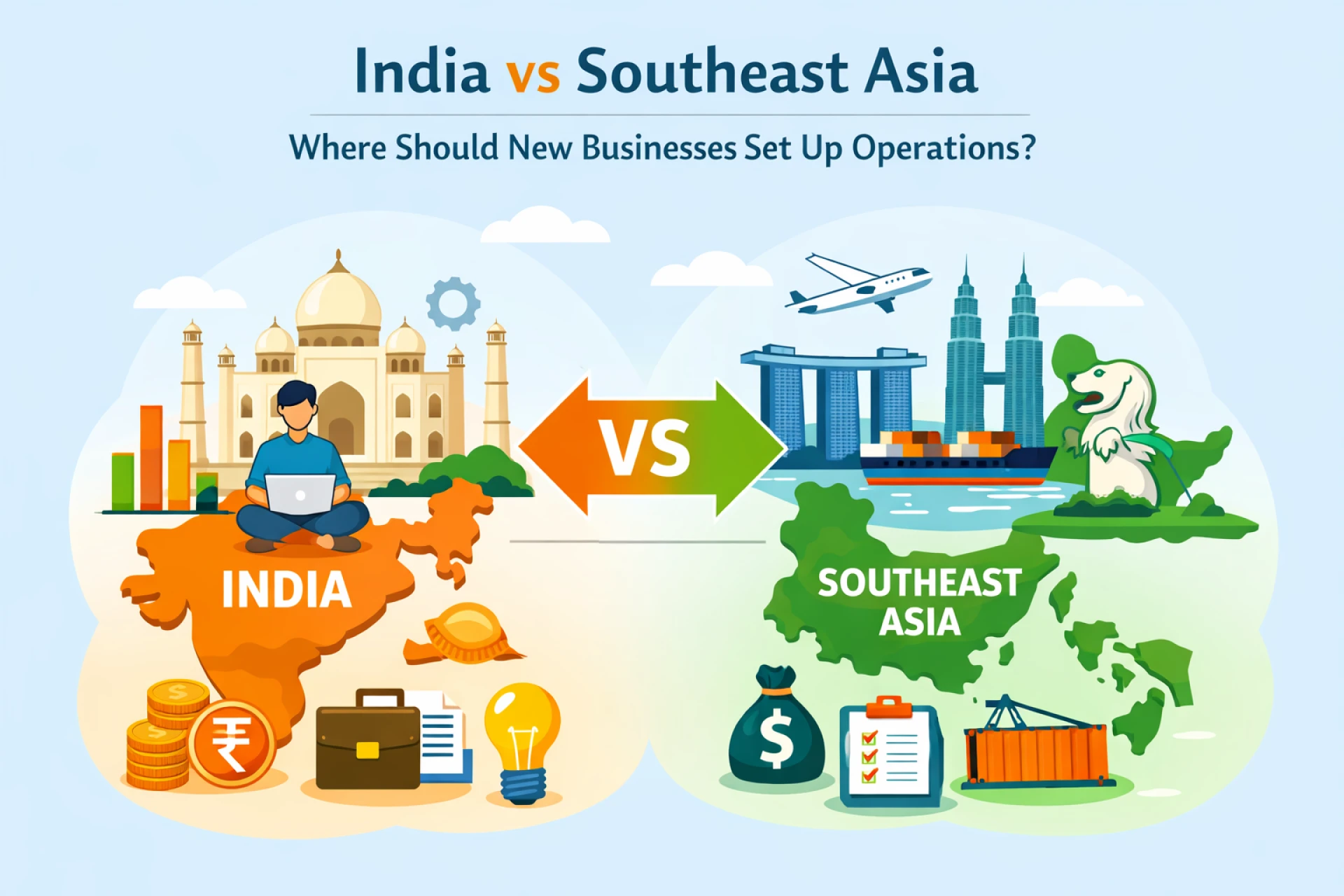

India vs Southeast Asia Where Should New Businesses Set Up Operations
Choosing the right jurisdiction is one of the earliest and most critical decisions for a new business. Location influences regulatory exposure, operating costs, access to talent, funding options and long term scalability. India and Southeast Asia often emerge as leading contenders for founders who want access to high growth markets with relatively efficient cost structures. Each region offers distinct advantages, along with practical challenges. This article provides a balanced legal and commercial comparison to help new businesses make an informed decision.
Market size and growth potential
India presents a single large domestic market with more than one billion consumers. Demand continues to grow across technology, manufacturing, healthcare, fintech and consumer services. Regulatory reforms and digital infrastructure have strengthened market access for new entrants. Businesses with a long term vision often value India for scale and depth rather than quick expansion.
Southeast Asia operates differently. It is not one market but a group of diverse economies such as Singapore, Indonesia, Vietnam, Thailand and Malaysia. Combined, the region offers a population exceeding six hundred million. Growth is rapid, particularly in ecommerce, logistics and digital services. Businesses targeting multiple countries can diversify risk but must adapt to local consumer behaviour and regulations.
Ease of incorporation and regulatory framework
India has made visible progress in simplifying business formation. Company incorporation can now be completed online, often within days. Compliance remains detailed, especially for taxation, labour and foreign exchange rules. Early stage founders benefit from clarity but must invest in professional compliance support to avoid regulatory friction later.
Southeast Asia varies by country. Singapore is known for its streamlined incorporation process and transparent governance. Vietnam and Indonesia also attract startups but regulatory interpretation can differ across regions. For founders seeking predictability and speed, Singapore often becomes a preferred base. Others choose emerging economies for lower costs and faster market penetration.
Tax structure and incentives
India operates a structured corporate tax regime with reduced rates available for new manufacturing companies and startups that meet eligibility criteria. Goods and Services Tax unifies indirect taxation, although compliance can be complex. Several states also offer incentives linked to employment generation and infrastructure investment.
In Southeast Asia, tax benefits depend heavily on jurisdiction. Singapore provides competitive corporate tax rates and extensive startup exemptions. Vietnam and Thailand offer sector specific incentives, especially in manufacturing and export driven businesses. However, understanding eligibility conditions requires careful legal review.
Access to talent and labour costs
India offers one of the largest talent pools globally. Skilled professionals in technology, finance, legal services and engineering are widely available. Labour costs remain competitive compared to Western markets, although wages in major cities continue to rise. Employment laws protect workers but allow flexibility through structured contracts.
Southeast Asia provides a mix of skilled and semi skilled labour. Singapore attracts global professionals but at higher cost. Countries such as Vietnam and Indonesia offer affordable labour for manufacturing and operations. Language diversity and training requirements may influence operational efficiency.
Funding and investment ecosystem
India has a mature venture capital and private equity ecosystem. Domestic and international investors actively fund startups across sectors. Government backed initiatives also support innovation and early stage funding. Valuations remain competitive but founders must navigate regulatory disclosures and reporting obligations.
Southeast Asia attracts strong foreign investment, especially in technology and infrastructure. Singapore acts as a regional investment hub with access to global capital. Emerging markets within the region see increasing interest from strategic investors. Funding terms and investor expectations can vary widely.
Legal certainty and dispute resolution
India follows a common law system with established judicial precedent. Contract enforcement has improved but litigation can be time consuming. Arbitration has gained acceptance, especially in commercial contracts. Founders benefit from predictable legal principles but must plan for procedural timelines.
Southeast Asia offers mixed legal systems. Singapore stands out for efficiency, strong rule of law and effective dispute resolution mechanisms. Other countries continue to modernise their legal infrastructure. Cross border dispute resolution often relies on arbitration clauses governed by neutral jurisdictions.
Foreign ownership and control
India permits foreign direct investment across most sectors, subject to caps and approval requirements in sensitive areas. Structuring ownership correctly is essential for compliance and control. Many founders explore setting up a company in India through private limited structures to balance ownership flexibility and investor confidence.
In Southeast Asia, foreign ownership rules vary. Singapore allows full foreign ownership in most sectors. Indonesia and Vietnam impose restrictions in specific industries. Understanding local investment laws is critical before committing capital.
Business structure flexibility
India offers multiple business forms including private limited companies, limited liability partnerships and sole ownership models. Entrepreneurs with limited operations often consider one person company in India as a compliant structure with separate legal identity. This flexibility supports founders at different growth stages.
Southeast Asia also provides a range of structures. Singapore companies enjoy flexibility and international credibility. In other countries, partnerships and representative offices remain common for initial market entry. The choice depends on risk appetite, funding plans and compliance capacity.
Infrastructure and operational environment
India continues to invest heavily in digital infrastructure, logistics and manufacturing corridors. Urban centres offer strong connectivity but congestion and administrative delays can affect operations. Regional cities now attract start ups due to lower costs and improving infrastructure.
Southeast Asia benefits from strategic trade routes and strong port infrastructure. Singapore ranks among the best globally for logistics efficiency. Emerging economies are investing in transport and digital connectivity, although disparities remain between urban and rural areas.
Which region suits your business
India suits businesses seeking scale, deep talent access and long term domestic growth. It rewards patience and compliance discipline. Southeast Asia appeals to founders looking for regional diversification, faster regulatory processes and strong export connectivity. Singapore often serves as a gateway for broader regional operations.
The decision should align with business goals, sector focus, funding strategy and risk tolerance. Legal advice and market research remain essential before finalising any jurisdiction.
Conclusion
India and Southeast Asia both offer compelling opportunities for new businesses. There is no universal answer. India provides scale and depth within a single market. Southeast Asia offers diversity and regional reach. A well informed decision considers legal structure, compliance capacity, growth ambition and operational realities. Founders who align jurisdiction choice with long term strategy position their businesses for sustainable success.



Sign in to leave a comment.