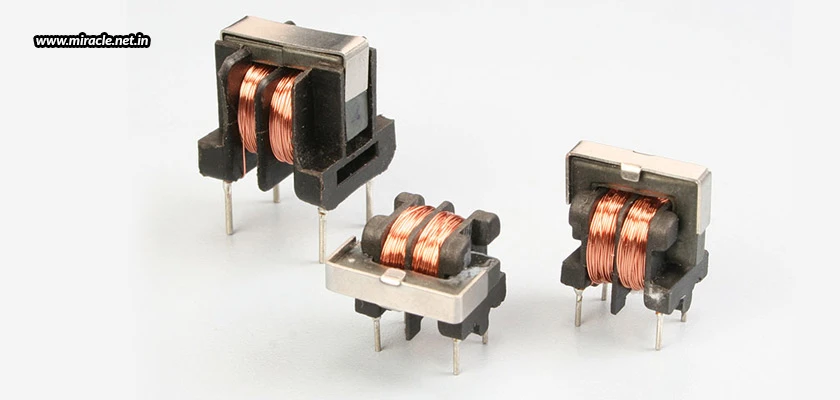

Components like transistors, resistors, and capacitors frequently take centre stage in the world of electronics. But, there’s another crucial component that quietly contributes significantly to the operation of numerous devices – the inductor, which is a passive electronic component that stores electrical energy in the form of a magnetic field. It is made up of a coil of wire twisted around a core that is often made of iron, ferrite, or air. A magnetic field is produced when electricity passes through the coil, which is what the inductor stores. We will go deep into the realm of inductors in the blog below, examining its properties, applications, and challenges it faces in modern technology.
Properties and performance
Self-inductance, commonly abbreviated as L, is an inductor’s most essential characteristic. When current flows through an inductor, its capacity to store magnetic energy is measured by this property, Henry (H) representing the unit of inductance.
Inductive reactance (XL), a characteristic of inductors in AC circuits, is dependent on both the frequency of the AC signal and the inductance magnitude. The degree of inductive reactance, which opposes variations in current, grows with frequency.
Inductors can only handle a certain amount of current before the core saturates, which results in a considerable loss of inductance. This capacity is known as the saturation current.
The quality factor (Q), which measures energy losses, shows an inductor’s effectiveness. Inductors with high Q have reduced losses.
The inductor’s inductance, saturation current, and frequency responsiveness are all impacted by the choice of core material. And, the inductance value and current-handling capacity of the inductor are determined by the number of wire turns and the gauge of the wire used in the coil.
Applications of inductors
Filter circuits for low-pass, high-pass, and band-pass filters all rely on inductors, which are widely used in these applications. They attenuate some frequencies while assisting in controlling others.
Inductors are the fundamental component of transformers, which are crucial in power distribution systems for voltage conversion and isolation.
Inductive proximity sensors use the inductance principle to identify whether or not metallic objects are present. In industrial automation, these sensors are frequently utilized.
To produce high-frequency signals for radio frequency (RF) applications, inductors are utilized in inductor-capacitor oscillators.
Inductors are crucial parts of voltage regulators and DC-DC converters for stabilizing and filtering the output voltage.
In electric and hybrid vehicle applications, inductors can store energy and release it when needed for regenerative braking or acceleration.
Challenges faced in inductor design
To satisfy the needs of contemporary electronics, the inductor design must continue to evolve, but there are a number of challenges that need to be overcome while designing an inductor.
Miniaturization: Inductors must be made smaller while preserving their performance as electronic devices get smaller. Chip inductors and surface-mount technologies are becoming commonplace.
High-frequency operation: Inductors are made to work effectively at higher frequencies due to the expansion of wireless communication and RF applications.
Energy efficiency: Inductors with low energy losses (high-Q) are increasingly being designed to improve power converter efficiency.
Customization: For certain applications, inductors are frequently made to order, taking into account aspects like size, inductance value, and current-handling capacity.
Inductors might not always be the centre of attention in the world of electronics, but there is no denying their significance. These unsung heroes ensure the effective operation of electronic circuits in countless gadgets, from power supplies to smartphones. As we continue to push the boundaries of technology in the twenty-first century, engineers and amateurs alike must understand the concepts and applications of inductors. Understanding this, Miracle Electronics manufactures the most ideal inductors for any and every application requiring a high DC current bias. The inductors manufactured here are more efficient at producing the required inductances, and each one is RoHS and REACH compliant, clearly proving how Miracle Electronics is the most reliable and genuine inductor manufacturer in India.










Sign in to leave a comment.