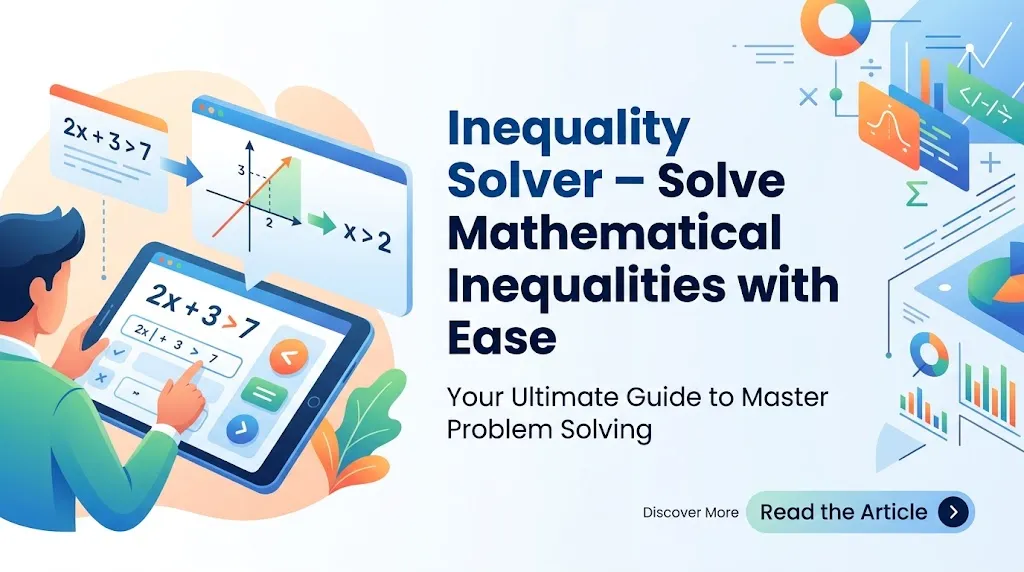

An Inequality Solver is a mathematical tool that helps students, teachers, and professionals solve inequalities quickly and accurately. Unlike standard equations, inequalities compare two expressions using symbols such as >, <, ≥, and ≤. Understanding how to solve inequalities is an essential skill in algebra, calculus, and many real-world applications.
Whether you are solving simple linear inequalities, compound inequalities, or quadratic inequalities, an inequality solver can simplify the process and provide accurate solutions within seconds.
What Is an Inequality?
An Inequality Solver is a mathematical statement that shows one quantity is greater than, less than, greater than or equal to, or less than or equal to another quantity.
Common inequality symbols include:
- > Greater than
- < Less than
- ≥ Greater than or equal to
- ≤ Less than or equal to
Examples:
- x > 5
- x ≤ 10
- 2x + 3 > 7
- x² - 4 ≤ 0
Unlike equations, inequalities usually have a range of possible solutions rather than a single answer.
How an Inequality Solver Works
An inequality solver follows mathematical rules to isolate the variable and determine the solution set.
Step 1: Simplify the Expression
Combine like terms and remove unnecessary brackets.
Example:
2x + 4 > 10
Subtract 4 from both sides:
2x > 6
Step 2: Isolate the Variable
Divide both sides by the coefficient.
2x > 6
x > 3
Step 3: Reverse the Sign When Necessary
When multiplying or dividing by a negative number, the inequality sign must reverse.
Example:
-2x > 8
Divide by -2:
x < -4
This is one of the most important rules when solving inequalities.
Types of Inequalities
Linear Inequalities
Linear inequalities contain variables raised only to the first power.
Examples:
- 3x + 5 > 14
- 2x - 7 ≤ 9
These are the most common inequalities encountered in algebra.
Compound Inequalities
Compound inequalities combine two inequalities into one statement.
Examples:
- 3 < x < 10
- x ≤ 4 or x > 12
Compound inequalities can use "and" or "or" conditions.
Quadratic Inequalities
Quadratic inequalities contain variables raised to the second power.
Examples:
- x² - 9 > 0
- x² + 2x - 8 ≤ 0
These inequalities often require factoring or graphing to identify solution intervals.
Absolute Value Inequalities
Absolute value inequalities involve expressions inside absolute value symbols.
Examples:
- |x| < 5
- |x - 2| ≥ 7
These inequalities usually produce multiple solution ranges.
Benefits of Using an Inequality Solver
An inequality solver offers several advantages:
Fast Calculations
Manual calculations can be time-consuming. An inequality solver provides answers instantly.
Improved Accuracy
Complex inequalities often lead to mistakes. A solver reduces calculation errors and improves reliability.
Step-by-Step Solutions
Many inequality solvers provide detailed explanations that help users understand the solving process.
Educational Support
Students can use inequality solvers to verify homework answers and improve their understanding of algebraic concepts.
Handles Complex Problems
Advanced inequality solvers can solve:
- Linear inequalities
- Quadratic inequalities
- Rational inequalities
- Absolute value inequalities
- Systems of inequalities
Real-World Applications of Inequalities
Inequalities are widely used across different industries and disciplines.
Finance
Businesses use inequalities to analyze profit margins, budgets, and investment risks.
Engineering
Engineers use inequalities to define design limits and safety requirements.
Science
Scientists use inequalities when measuring tolerances, error ranges, and experimental results.
Economics
Economists apply inequalities to model market behavior and optimize resource allocation.
Education
Students encounter inequalities in algebra, geometry, calculus, and statistics courses.
Common Mistakes When Solving Inequalities
Many learners make similar mistakes while solving inequalities.
Forgetting to Reverse the Sign
When multiplying or dividing by a negative number, the inequality sign must be reversed.
Incorrect:
-2x > 8
x > -4
Correct:
x < -4
Ignoring Boundary Values
When solving inequalities involving ≤ or ≥, boundary values must be included in the solution set.
Incorrect Graph Interpretation
When graphing inequalities, open circles represent excluded values while closed circles represent included values.
Sign Errors During Simplification
Carefully check positive and negative signs throughout the solving process.
Why Use an Online Inequality Solver?
An online inequality solver provides a convenient way to solve mathematical problems from any device. Users can enter an inequality, view step-by-step solutions, and verify their answers instantly.
Modern inequality solvers support:
- Linear inequalities
- Compound inequalities
- Quadratic inequalities
- Absolute value inequalities
- Graphical representations
- Interval notation
- Number line solutions
These features make online tools valuable for students, educators, and professionals alike.
Conclusion
An Inequality Solver AI is a powerful tool for solving mathematical inequalities accurately and efficiently. Whether you are working with linear, compound, quadratic, or absolute value inequalities, a reliable solver helps simplify calculations and improve understanding. By learning the fundamental rules of inequalities and using modern solving tools, users can solve mathematical problems with confidence and accuracy.
Frequently Asked Questions (FAQs)
What is an inequality solver?
An inequality solver is a tool that helps users solve mathematical inequalities and find the range of values that satisfy the given condition.
What types of inequalities can an inequality solver solve?
Most inequality solvers can solve linear, compound, quadratic, rational, and absolute value inequalities.
Why does the inequality sign reverse when dividing by a negative number?
The sign reverses because multiplying or dividing by a negative number changes the order of values on the number line.
Can an inequality have multiple solutions?
Yes. Most inequalities have a range of solutions rather than a single answer.
Are online inequality solvers accurate?
Yes. Reputable inequality solvers use mathematical algorithms to provide accurate and reliable solutions.
Who can benefit from an inequality solver?
Students, teachers, engineers, scientists, economists, and anyone working with mathematical expressions can benefit from using an inequality solver.
Can an inequality solver show graphs?
Many advanced inequality solvers provide graphical representations and number line visualizations to help users understand solutions more clearly.
Is an inequality solver useful for homework?
Yes. Students can use inequality solvers to verify answers, understand solving methods, and improve mathematical skills.


























Sign in to leave a comment.