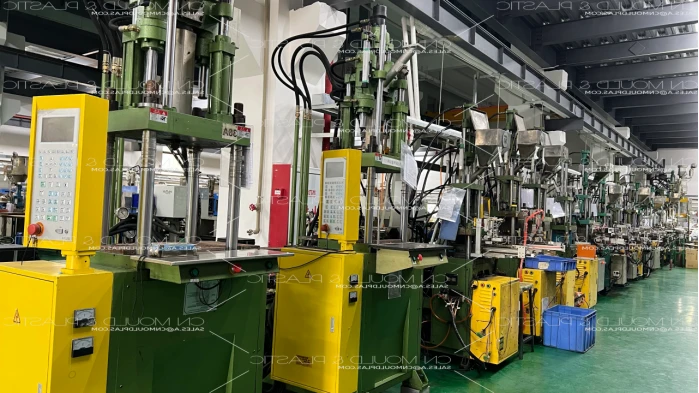

Injection Molding Machine Basics
CONTENTS OF the Injection Process
The injection molding process cycle is very short, typically lasting between 2 seconds and 2 minutes, and consists of four stages:
1
1. Clamping
Before injecting material into the mold, the clamping unit must securely close the two halves of the mold. One half of the mold is attached to the plastic injection mold and molding machine, while the other half is free to move. The clamping unit is hydraulically powered and pushes the mold halves together with enough force to keep the mold securely closed while the material is injected.
2
2. Injection
The injection unit advances the raw plastic material toward the mold after it is fed into the injection molding machine, typically in the form of pellets. Heat and pressure are used to melt the material during this process. After that, the molten plastic is swiftly injected into the mold. The shot volume, injection pressure, and injection power can all be used to estimate the injection time.
3
3. Cooling
As soon as the molten plastic inside the mold comes into contact with the internal mold surfaces, it starts to cool. The plastic will solidify into the desired shape as it cools. A number of the plastic's thermodynamic characteristics and the part's maximum wall thickness can be used to estimate the cooling time.
4
4. Ejection
After a certain amount of time has passed, the cooled part can be ejected from the mold by the Ejection System. Because the part shrinks and adheres to the mold during cooling, force is required to eject it. To aid in part ejection, a mold release agent can be sprayed onto the surfaces of the mold cavity prior to material injection.
COMMON DEFECTS OF Injection Parts
The most common apparent defects of the injection parts are weld mark, warpage, short shot, shrinkage, riding, overflow, crack, deformation and so on.
1. Analysis of the causes of short shot
Improper equipment selection.
Insufficient material supply.
Poor flow performance of raw materials.
Unreasonable Runner System design.
2. Analysis of overflow
Clamping force is insufficient .
Mold temperature is too high.
Improper injection molding process.
POST-PROCESSING OF Plastic Parts
When the parts are removed from the mold, appropriate post-processing is often required to improve the performance of the plastic parts. The post-processing method of the product mainly refers to Annealing Treatment and Humidity Treatment.
Annealing Treatment
Annealing Treatment is the heat treatment process of heating the product to a certain temperature and holding heat for a certain time. Its function is to reduce the internal stress caused by the inconsistent cooling rate of the plastic parts in the cavity. Generally, the Annealing Temperature is controlled at 10~20 ° C above the use temperature of plastic parts, or lower than the thermal deformation temperature of plastic parts 10~20 ° C.
Humidity Treatment
It is mainly used for plastic parts such as polyamide with strong hygroscopicity and easy oxidation. Parts with metal inserts, large temperature ranges, high dimensional precision requirements and large wall thickness often require Humidity Treatment.




Sign in to leave a comment.