

Preparing for the Australian intern pharmacist written exam isn't just about knowing your drugs, it's about knowing the rules of the exam itself. The written exam, administered by the Australian Pharmacy Council (APC), is a critical milestone on your path to general registration. Miss a key detail in the lead-up, and you could be out of pocket, locked out of a sitting, or worse, sitting an exam you weren't properly ready for.
Here's everything you need to know before you register.
1. Eligibility: The 75% Rule — Check This Before Anything Else
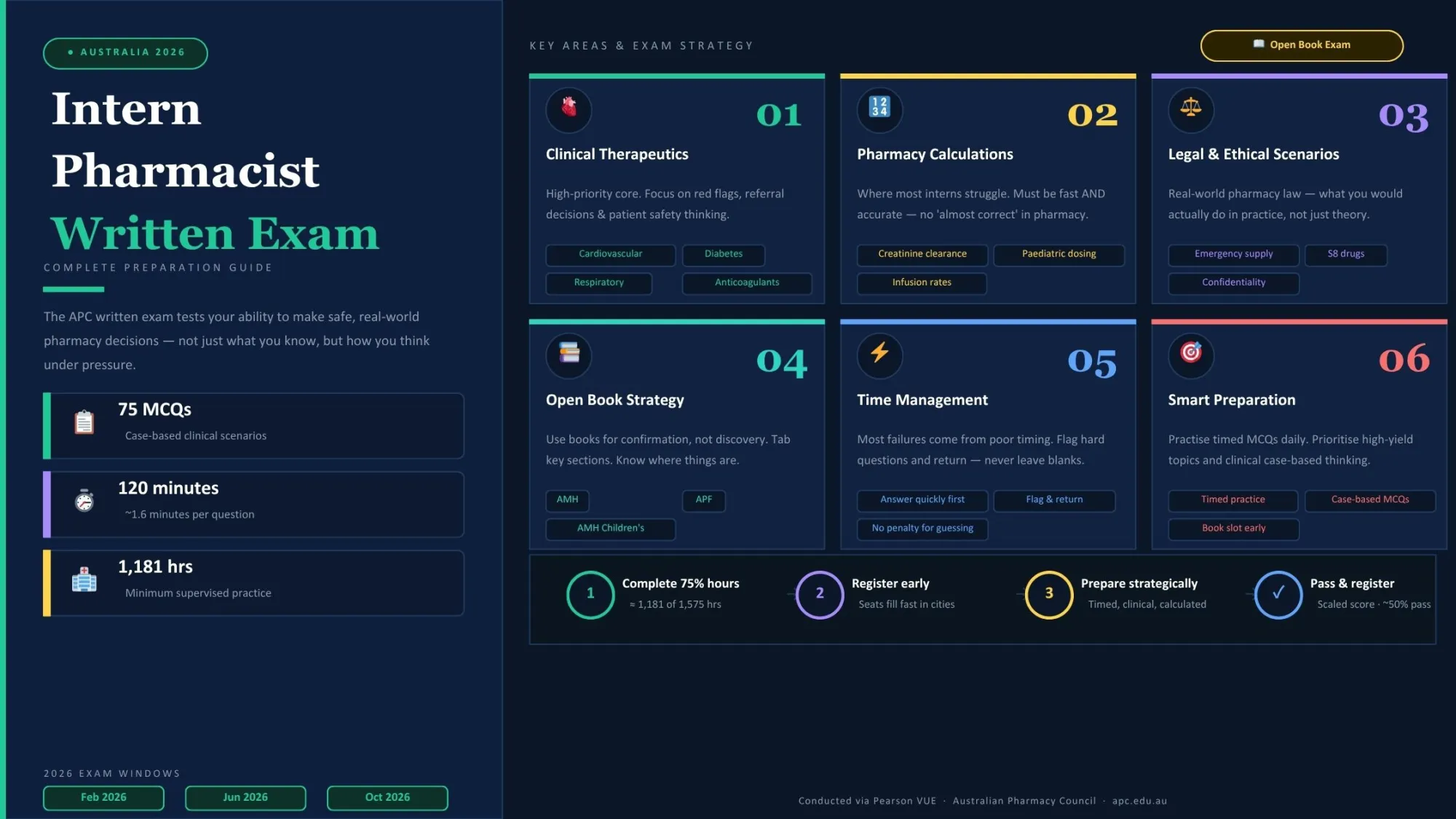
Before you book a date, confirm you actually qualify. You must be provisionally registered with the Pharmacy Board of Australia and have completed at least 75% of your required 1,575 supervised practice hours by the date of the exam, that's a minimum of 1,181 hours.
Sounds straightforward, but interns get caught out registering too early. Count your hours carefully before you commit.
2. Exam Format: 75 MCQs in 120 Minutes
The exam is computer-based, with 75 multiple-choice questions to be completed in 2 hours. That's roughly 96 seconds per question, tight if you're not used to the format.
Questions are case-based and scenario-driven, not straightforward recall. Practicing under timed, simulated conditions isn't optional; it's essential.
3. Content Areas: Six Core Competency Domains
The syllabus maps to the National Competency Standards Framework for Pharmacists in Australia. The six key areas are:
- Clinical reasoning and patient care
- Medication management and calculations
- Pharmacy law and regulatory frameworks
- Professional ethics and communication
- PBS and drug scheduling
- Counselling and health promotion
Heavy weighting falls on clinical scenarios, calculations, and law. Don't underestimate the law component, it's one of the most common areas where candidates lose marks.
4. Registration Fee and Result Validity
The registration fee is AUD 790 per attempt as of early 2026. That's a real cost if you have to resit, so preparation matters financially as much as professionally.
Once you pass, the result is valid for 18 months. You'll need to complete your oral exam and apply for general registration within that window, don't let time slip away after passing.
5. Open-Book — But Not the Way You Think
Yes, the written exam is a restricted open-book exam. But that's not a free pass. Candidates who haven't practised navigating their references under time pressure waste precious minutes flipping through content they should already know.
The Australian Medicines Handbook (AMH) is one of the key permitted references. Know its structure before exam day, not because you'll memorise everything in it, but because you need to find information fast when the clock is running.
6. ID Requirements: No Exceptions
You must present valid, original, non-expired ID that exactly matches the name you used during registration. No digital IDs. No photocopies. No nicknames or shortened names.
Name discrepancies, even a missing middle name, can result in being refused entry. Verify this the week before your exam, not the morning of.
7. Registration Deadlines and Rescheduling
The APC opens registration windows well in advance, and popular locations fill up fast. Register early to secure your preferred venue and date.
Rescheduling is only permitted within the registration period. Miss that window, and your options become very limited. The moment exam dates are announced, mark the open and close dates in your calendar.
Key Tips for Exam Day Success
- Arrive 30 minutes early: check-in takes time, and late arrivals may not be admitted
- Master PBS and drug schedules: a significant portion of law questions test this directly
- Practise calculations relentlessly: dosage, packaging, and label questions reward accuracy under pressure
- Know your references cold: speed in navigating AMH and other permitted materials is a real exam skill
- Simulate exam conditions: timed, computer-based practice is the closest thing to the real thing
One More Thing: Training Quality Makes a Real Difference
The gap between passing and resitting often comes down to how you prepared. Programs led by active Australian clinical pharmacists, Mr. Arief Mohammad & Mrs. Harika Bheemavarapu - people who write PBS authorities in the morning and run exam prep sessions in the afternoon. They bring a level of current, practical knowledge that no textbook can replicate.
When your trainer is also a preceptor at one of Australia's busiest hospitals, the scenario-based questions start making a lot more sense. If you're serious about passing first time, look for training where the educators are still working clinicians, not just theoretical instructors. That's the kind of preparation that closes the gap between knowing the content and actually performing under exam conditions.
The intern pharmacist written exam is demanding, but it's entirely passable with the right preparation. Know the rules before you register, start early, and invest in training from people who genuinely understand what clinical practice in Australia looks like today. Your general registration is waiting on the other side.



























Sign in to leave a comment.