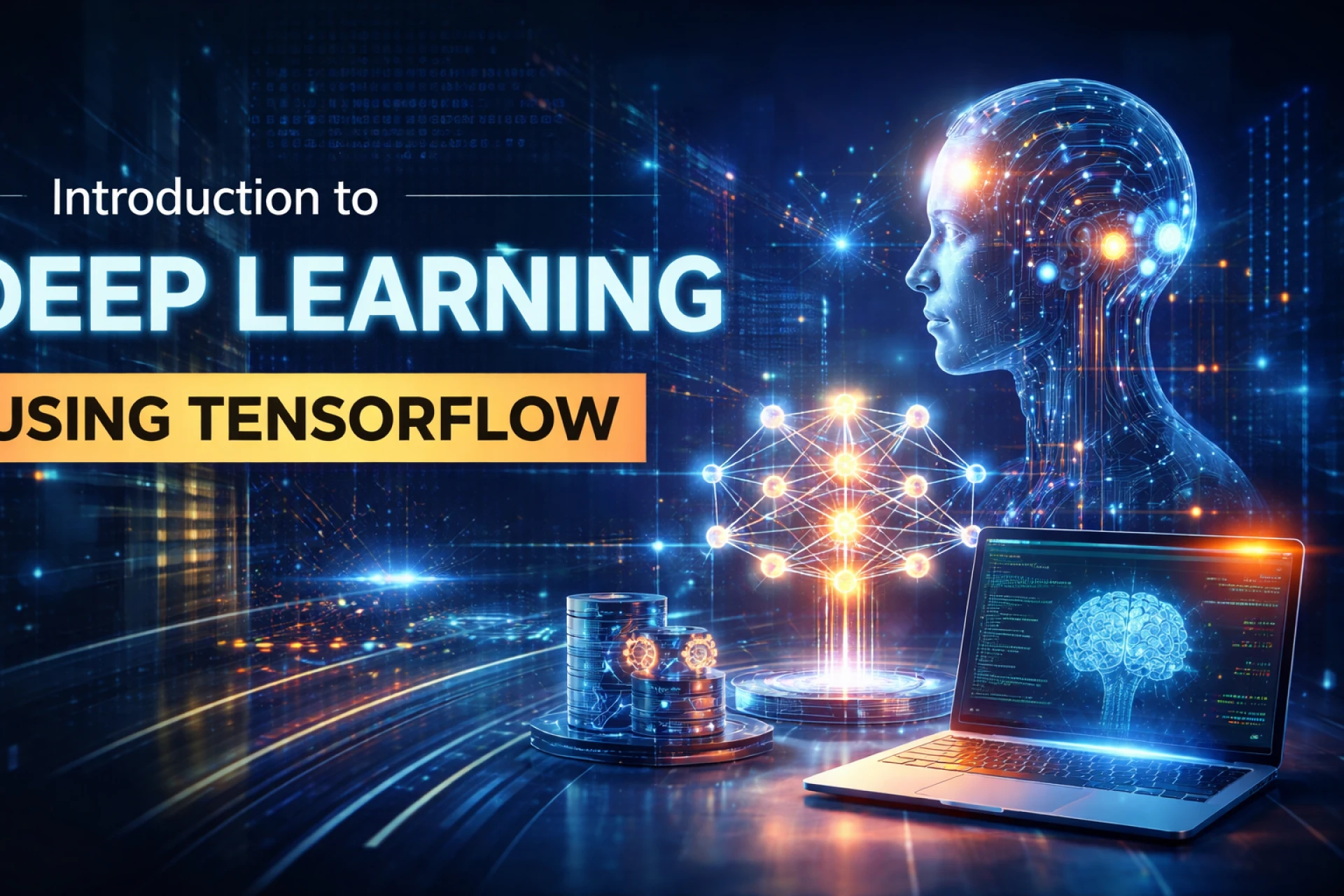

Engineers build deep learning systems to find patterns buried inside massive datasets. Google released TensorFlow to give programmers the specific mathematical tools required for this exact job. Finding quality AI training in Bangalore often starts with mastering this exact framework. The software turns raw numbers into functional predictions without requiring someone to hardcode every single rule.
The Shift from Basic Machine Learning
Older machine learning models hit a hard limit. Programmers had to manually select which data features mattered most before feeding information into the algorithm. A developer told the computer exactly what variables to track. Deep learning skips that manual extraction phase completely.
The neural network discovers the important rules on its own. A programmer feeds thousands of raw images into the system. The software automatically figures out that certain pixels represent edges, while others form distinct shapes. This self-correction process only works well when the dataset is enormous.
Basic algorithms flatline after they process a certain amount of data. Deep learning networks scale their accuracy alongside the volume of available information. Setting up these complex mathematical layers requires serious computational power. Professionals taking AI training in Bangalore learn exactly how to configure these layers without crashing their hardware.
Structuring Data for the Framework
Neural networks cannot read raw text files or jpeg images directly. Programmers must convert every piece of information into a strict numerical format. TensorFlow supplies dedicated data pipelines to handle this massive conversion job automatically. These pipelines pull information from a hard drive and transform it into numerical arrays called tensors.
Text data demands a specific breakdown process. The software chops full paragraphs into individual words or smaller sub-words. The system assigns a unique integer ID to every single piece of text. The neural network only looks at these integer IDs during the actual training phase.
Image processing follows a similar numerical conversion path. TensorFlow reads the exact color value of every pixel and scales that number down to a standard range. Squashing the data into a smaller range helps the mathematical optimizers find the correct answers much faster. Instructors teaching an ai course in bangalore spend hours drilling students on this specific normalization step.
Engineers also use augmentation techniques to artificially multiply their training examples. The software flips, rotates, or slightly zooms into an existing photo to create a brand new data point. This technique stops the network from memorizing the exact training images and forces it to learn the general shape of the object. Solid AI training in Bangalore covers these augmentation strategies aggressively to stop models from failing in the real world.
How the Framework Processes Numbers
TensorFlow moves information around using multi-dimensional arrays. Developers call these arrays tensors. The software builds a hidden computational graph to map out exactly how different mathematical operations connect to each other.
This graph structure lets the program execute calculations independently. The framework chops up the workload and sends distinct tasks to different processing cores inside the computer hardware. Splitting the math speeds up the training phase dramatically. Older linear calculation methods fall far behind this parallel processing approach.
The platform includes the Keras interface to cut down on typing. Programmers write fewer lines of code to generate standard network architectures. Quality AI training in Bangalore introduces Keras on day one so students can deploy functional prototypes quickly.
Google updates the platform constantly to kill bugs and boost processing speeds. The massive version 2.0 update removed dozens of redundant coding requirements. Users now execute commands eagerly. This eager execution means the system runs the math immediately instead of waiting for the programmer to assemble the entire graph first.
Building the Network Architecture
Every deep learning model needs an input layer, several hidden layers, and an output layer. The input layer accepts the raw numbers directly from the formatted dataset. The hidden layers execute the heavy mathematical transformations. The output layer generates the final prediction.
Nodes inside these layers link together through weighted mathematical pathways. A specific formula decides whether a node should activate and forward its signal to the next layer. Developers call this formula the activation function. The Rectified Linear Unit serves as the default choice because it stops the math from stalling out mid-calculation.
The system grades its own work after every full data pass. A loss function measures the exact mathematical difference between the model guess and the correct answer. The program then pushes this error margin backward through the entire network to modify the pathway weights.
Optimizers dictate exactly how drastically those weights change during the adjustment phase. The Adam optimizer dominates current workflows because it automatically adapts its own adjustment size on the fly. Participants in an ai course in bangalore spend significant time testing various optimizers to observe their direct impact on final accuracy.
Real-World System Deployments
Corporations deploy these models to analyze visual media instantly. A trained network scans factory products on a fast-moving conveyor belt to spot manufacturing defects. The exact same underlying mathematics help autonomous vehicles recognize pedestrians and interpret stop signs.
Natural language processing forms another massive application category. Chatbots process customer text inputs and spit out relevant answers without human intervention. Translation software converts speech between languages in real-time using specific recurrent network designs.
Financial institutions run anomaly detection models to monitor millions of daily credit card transactions. The software learns normal spending habits and blocks suspicious purchases that ignore those patterns. Retail chains evaluate past purchase histories to stock their regional warehouses accurately before major holiday seasons.
Building these specific systems represents the core curriculum of any robust ai course in bangalore today. Training institutes base their lab assignments directly on these corporate requirements. Graduates enter the technology sector knowing exactly how to implement these specific solutions.
Cloud Hardware and Deployment
Deep learning relies on specific hardware setups to function properly. Standard central processing units handle basic models just fine. Complex networks demand graphical processing units instead. These specialized microchips execute thousands of tiny calculations simultaneously.
Cloud computing providers sell remote access to these powerful chips. Programmers rent server time from Amazon or Google rather than buying expensive physical hardware. Thorough AI training in Bangalore shows students exactly how to connect local TensorFlow code to these remote servers safely.
Launching a finished model means moving it from a safe testing environment into a live application. TensorFlow Serving manages this transition for enterprise web applications. The tool guarantees the model answers live user requests rapidly without crashing the host server. Most syllabus structures in an ai course in bangalore mandate cloud deployment practice before graduation.
Mobile application developers rely heavily on the TensorFlow Lite version. This specific software shrinks heavy mathematical models so they fit neatly onto standard smartphones. A fitness application can track user movements locally without transmitting heavy video files to a distant server.
Conclusion
Neural networks handle massive datasets efficiently by automating the feature extraction process completely. TensorFlow supplies the raw mathematical backbone and practical toolsets required to construct these layered networks. Operating tensors, configuring hidden layers, and deploying finished models represent mandatory skills for modern technical professionals. Structured AI training in Bangalore delivers the exact practical knowledge developers need to build reliable machine learning applications.
Sign in to leave a comment.