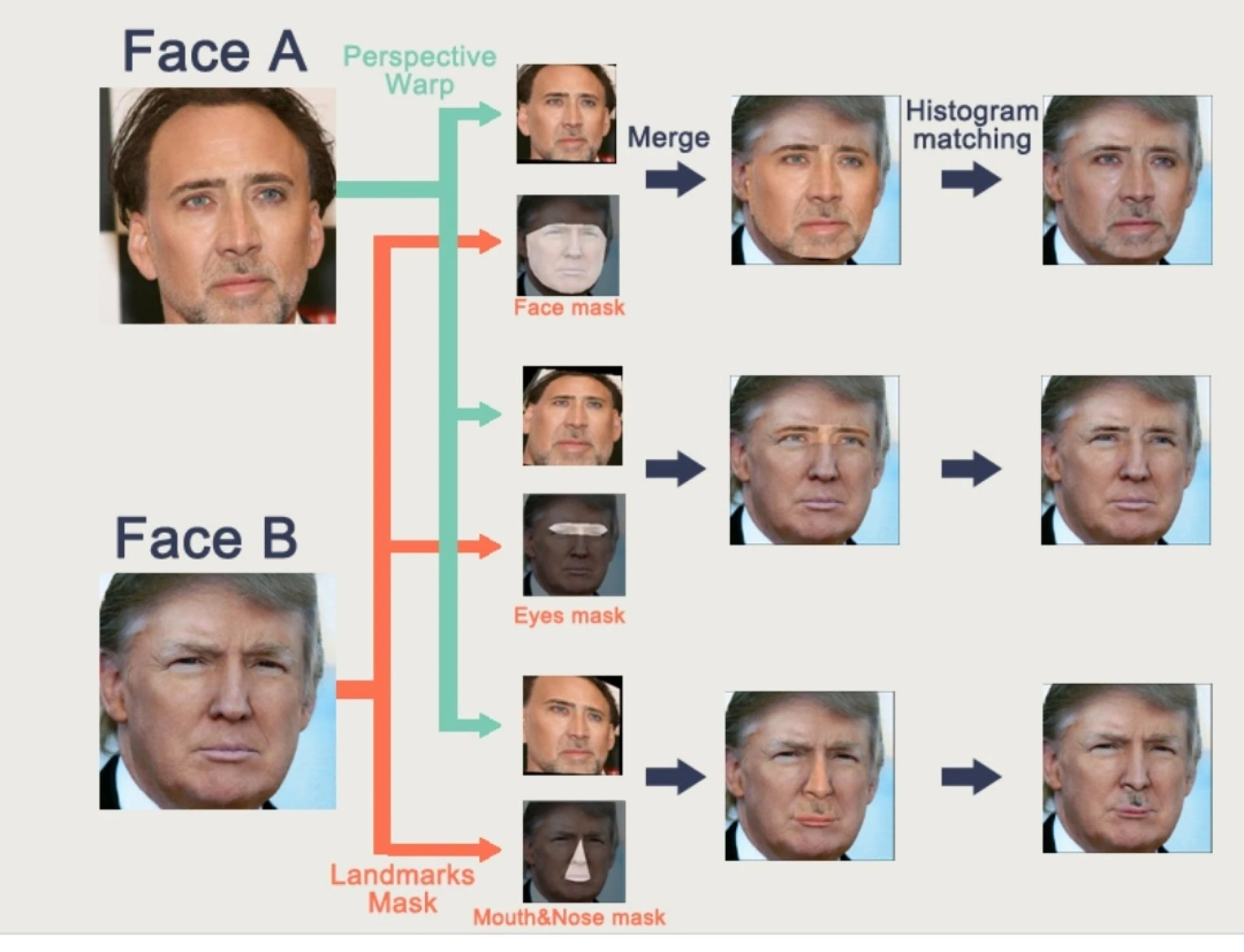

Deepfakes are synthetic media produced by machine-learning algorithms, named for the deep-learning techniques employed in creating them and the staged events they portray. Deepfake techniques cross fields and disciplines ranging from programming and computer science to computer animation, visual effects, and neuroscience. They can appear convincingly real and are difficult to spot when they are done correctly and with the help of advanced and efficient techniques.
Since deepfake has only begun to be widely used in the past few years, the laws surrounding its use haven't kept pace with technological advances. In some countries, it's not even controlled. One of the countries in which the law governing deepfake use is China. China's Cyberspace Administration of China announced that fake news produced by using deepfake is a crime. In the US, most states have laws on deepfake porn. Another law prohibits deepfake material that is harmful to candidates for public offices.
Methods and Approaches
Researchers who are interested in the potential implications of deepfake technology on private enterprises, government agencies, cybersecurity, and public safety can gain many things from studying deepfake methods and the science behind their development. With the development of deep-learning algorithms, it is becoming increasingly important for companies, researchers, and leaders worldwide to acquire the knowledge and resources to tackle the threat that harmful synthetic media could create.
The ability to design and recognize deepfake will be more valuable as technology improves and the potential for dangerous applications of deep learning increases. The following three techniques to create deepfakes are widely employed in machine-learning models.
Autoencoders
Autoencoders are the unsupervised neural network that can reduce raw data size and produce an output that mirrors its input. Autoencoders comprise encoders as well as decoders. When data is passed through the initial layer, the input layer of the autoencoder's network, the encoder compresses the image before feeding information into the decoder. The decoder then tries to recreate what was originally encoded.
Deepfakes use autoencoders by training two pairs of networks, one encoder-decoder pairing for the source-image data set and the other for the data set of the target. Both pairs are part of the encoder network, which allows the encoder to understand the anatomy of a face. If the image from the source is processed by the decoder trained to match the desired image, it synthesizes both images as it reconstructs them.
Generative Adversarial Networks
GAN is a machine learning technique in which two neural networks –a generator and a discriminator- compete to improve their precision levels. In this type of model, commonly known as zero-sum games, the generator converts random data from a dataset used for training into an image. The image is placed in the stream of actual images, which are then passed onto the discriminator. The function of the discriminator is to discern the real images from artificial images.
The aim of neural networks is to eliminate errors. For deepfakes, that means minimizing the differences between the fake and real image. To achieve this, it is necessary to repeat the process using model-weight adjustments until the output is at the accuracy desired.
First Order Motion Model
First order models animation techniques for images allow users to create animated videos with the document's source code First Order Motion Model for Image Animation.
Are Deepfakes Legal?
Deepfakes are legal as long as they aren't used in an abusive way. While it's relatively new, the rules regarding using an individual's image, slander, and false representations have been in place for quite a while.
You can't use deepfakes to market products. Imagine that instead of a cereal commercial that paid a famous person to endorse its product, instead employed a deepfake? There'd be a lot of legal backlashes. It's the same for us, and you don't use deepfake to market products.
Do not use fakes to slander. Using deepfakes to make slanderous remarks isn't just illegal and unconstitutional; it's also unethical. It is not a good idea to use deepfake to attempt to damage someone's reputation or to make them make statements they would never say in the hope that it's authentic.
Parodies are a common way to use deepfakes and create some great content. It is important to ensure that the video is clear that it is an imitation and cannot be mistaken for a real video.
Are You Ready To Make Your Own Deepfakes?
Once you know what you can do to make a deepfake, and how to create one, you're prepared to turn your creativity into meme gold. If you've got some experience in coding, we suggest using Deepswap.ai for more accurate and authentic results. If you do not have any coding expertise, you can use deepfake applications or even learn.
Conclusion
Deepfake is a young and promising technology that is still in its infancy. Humanity is still adjusting to it and hasn't yet discovered its full potential in our world. Like all technologies, there are advantages as well as disadvantages. It can be harmful or beneficial to our lives. It will take time to determine how to get the most value from it in various industries. As time passes, there will be a variety of methods to regulate it, just as with previous innovations.
0









Sign in to leave a comment.