
Introduction
In today’s competitive global market, quality, safety, and efficiency are essential for business success. This is where ISO Certification plays a crucial role. Organizations across industries adopt ISO standards to enhance credibility, streamline processes, and ensure customer satisfaction. Whether you are a startup or an established enterprise, understanding ISO Registration and the ISO 9001 Standard can help you achieve long-term growth.
What is ISO? (ISO Full Form)
The ISO Full Form is International Organization for Standardization. It is an independent, non-governmental international body that develops standards to ensure the quality, safety, and efficiency of products, services, and systems.
ISO standards are recognized worldwide and are applicable to various sectors such as manufacturing, healthcare, IT, construction, and more.
What is ISO Certification?
ISO Certification is an official recognition that a company complies with a specific ISO Standard. It demonstrates that your business follows internationally accepted best practices in terms of quality management, safety, and operational efficiency.
This certification is issued by accredited certification bodies after a detailed audit of your organization’s processes and systems.
Importance of ISO Certification
Obtaining ISO Certification offers several benefits:
- Enhances business credibility and reputation
- Improves product and service quality
- Increases customer satisfaction and trust
- Helps in regulatory compliance
- Boosts operational efficiency
- Opens doors to international markets
For many industries, ISO Certification is not just an advantage but a necessity to stay competitive.
What is ISO 9001 Standard?
The ISO 9001 Standard is one of the most popular and widely implemented ISO standards. It focuses on Quality Management Systems (QMS) and helps organizations ensure consistent quality in their products and services.
Key Principles of ISO 9001:
- Customer focus
- Leadership involvement
- Process approach
- Continuous improvement
- Evidence-based decision making
ISO 9001 can be applied to any organization, regardless of size or industry.
Understanding ISO Standards
An ISO Standard is a documented agreement containing technical specifications or criteria that ensure materials, products, processes, and services are fit for their purpose.
Some commonly used ISO Standards include:
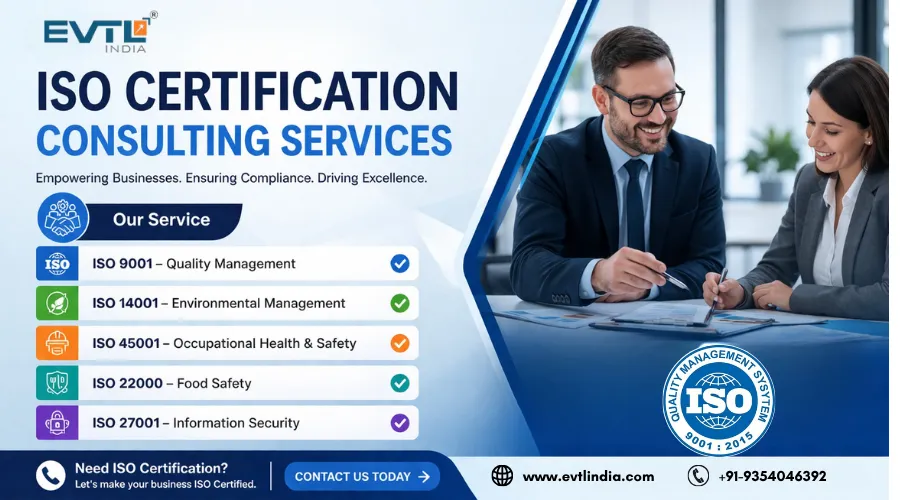
- ISO 9001 – Quality Management
- ISO 14001 – Environmental Management
- ISO 45001 – Occupational Health & Safety
- ISO 27001 – Information Security
Each standard is designed to address specific organizational needs.
ISO Registration Process
The ISO Registration process involves several steps to ensure compliance with the chosen standard:
1. Choose the Right ISO Standard
Select the ISO Standard that suits your business requirements (e.g., ISO 9001 for quality management).
2. Gap Analysis
Evaluate your current processes to identify gaps between existing practices and ISO requirements.
3. Documentation
Prepare necessary documents such as policies, procedures, manuals, and records.
4. Implementation
Implement the required systems and processes across your organization.
5. Internal Audit
Conduct internal audits to ensure compliance with ISO standards.
6. Certification Audit
An external certification body audits your organization.
7. Certification Issuance
Once all requirements are met, the ISO certificate is issued.
ISO Certificate Registration: Key Requirements
For successful ISO Certificate Registration, organizations must:
- Maintain proper documentation
- Train employees on ISO standards
- Follow consistent processes
- Conduct regular audits
- Focus on continuous improvement
Proper implementation is essential to ensure long-term compliance and benefits.
Role of an ISO Certified Consultant
An ISO Certified Consultant plays a vital role in simplifying the certification process. They provide expert guidance and help organizations achieve certification efficiently.
Benefits of Hiring a Consultant:
- Expert knowledge of ISO standards
- Faster and hassle-free certification process
- Accurate documentation support
- Audit preparation assistance
- Reduced chances of non-compliance
A professional consultant ensures that your organization meets all ISO requirements without unnecessary delays.
Common Challenges in ISO Registration
While ISO Certification offers numerous benefits, businesses may face challenges such as:
- Lack of awareness about ISO standards
- Complex documentation requirements
- Resistance to change within the organization
- Time-consuming implementation process
These challenges can be effectively managed with proper planning and expert assistance.
How ISO Certification Helps Business Growth
ISO Certification is not just about compliance; it is a strategic tool for business growth. It helps organizations:
- Improve internal efficiency
- Reduce errors and waste
- Enhance brand value
- Gain customer confidence
- Expand into global markets
Companies with ISO Certification often have a competitive edge over non-certified businesses.
Conclusion
EVTL India is one of the leading BIS Consultant in India , helping manufacturers obtain their BIS licences hassle-free.In conclusion, ISO Certification is a powerful tool that ensures quality, efficiency, and global recognition for businesses. From understanding the ISO Full Form to implementing the ISO 9001 Standard, every step of the ISO Registration process contributes to building a strong and reliable organization. With proper ISO Certificate Registration and the support of an experienced ISO Certified Consultant, businesses can achieve compliance smoothly and unlock new growth opportunities.
For organizations seeking expert guidance and a seamless certification journey, partnering with a trusted consultancy like EVTL India can simplify the entire process and help you achieve ISO Certification with confidence and efficiency.


























Sign in to leave a comment.