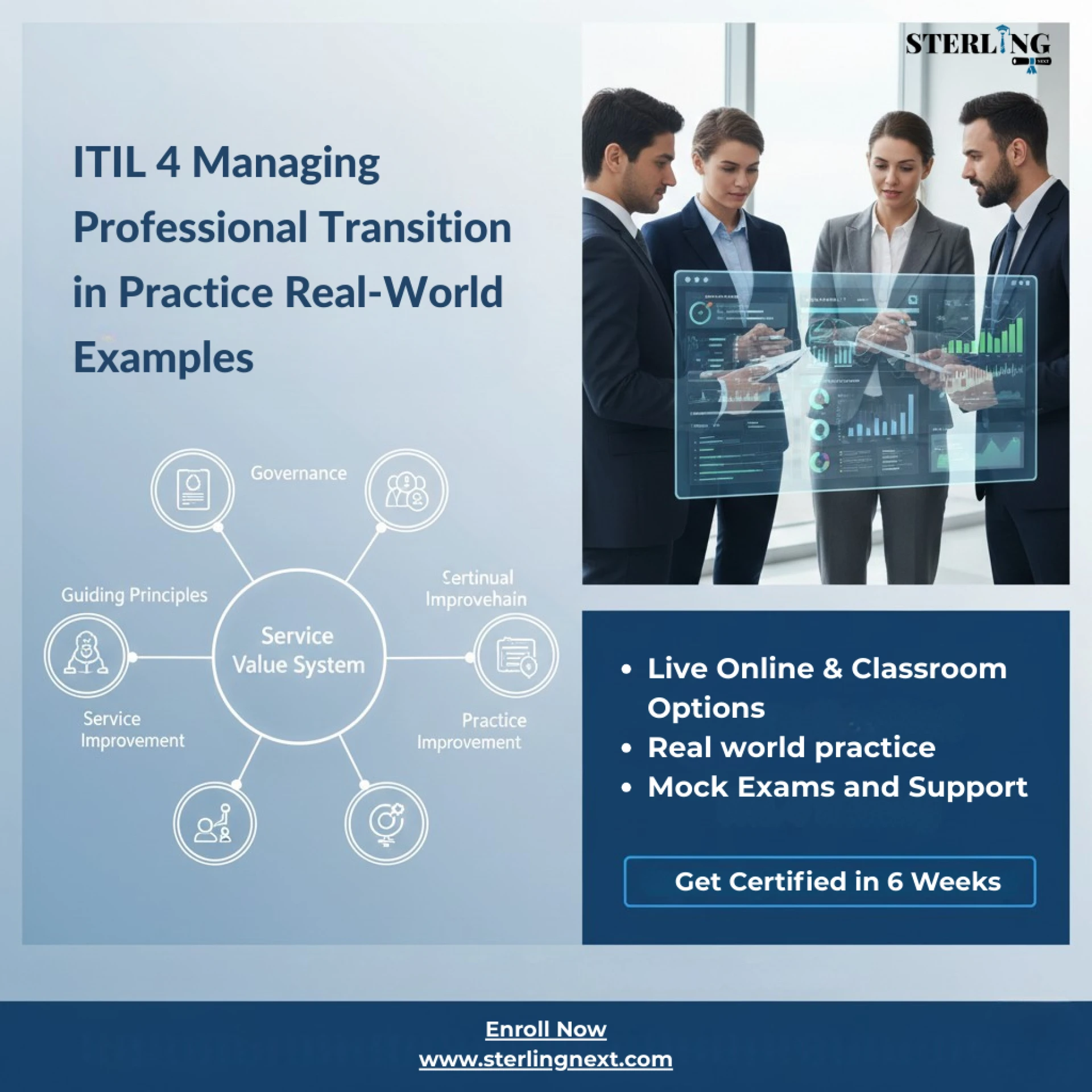
ITIL 4 Managing Professional Transition module offers ITIL v3 experts a single exam path to ITIL 4 Managing Professional status, updating to Service Value System with guiding principles, governance, and continual improvement. SterlingNext provides live online/classroom training with workshops, case studies, and mock exams for the 90-minute, 40-question test (70% pass). Covers CDS, DSV, HVIT, DPI streams, emphasizing value co-creation for service managers adapting to digital economies.
Core Components of ITIL 4 MP Transition
The CDS module focuses on service creation, delivery, and support practices. Real-world application appears in healthcare IT teams managing electronic health record rollouts, where design & transition activities ensure regulatory compliance alongside user training. SterlingNext workshops use these cases to practice incident management, problem management, and service request fulfillment, showing how a hospital cut resolution times from days to hours. HVIT addresses agile, lean, and DevOps in fast-paced environments; software development firms apply it for continuous deployment pipelines, achieving 50% faster release cycles. Training includes hands-on exercises with kanban boards and CI/CD simulations.
DSV emphasizes stakeholder relationships and value realization. Financial services organizations use it for customer journey workshops, aligning IT services with business outcomes like reduced churn. DPI covers strategic planning and measurement; manufacturing plants implement improvement registers to track metrics across value chains, yielding 15% efficiency gains. SterlingNext provides templates for maturity assessments and governance models, drawn from industry examples. The transition exam tests integration of these areas, with questions on scenario-based application rather than rote memorization.
Practical Implementation Steps:
- Identify legacy v3 processes and map to ITIL 4 practices.
- Conduct value stream analysis for key services.
- Establish governance structures with clear roles.
- Roll out pilot improvements using feedback loops.
- Measure outcomes via KPIs like MTTR and customer satisfaction.
ITIL v3 to ITIL 4 Transition Challenges and Solutions
Common hurdles include resistance to change from process-centric mindsets. A global logistics company overcame this by piloting HVIT practices in one region, scaling after proving ROI through reduced delivery errors. SterlingNext addresses skill gaps with targeted modules on agile integration and cloud service management. Data silos challenge value chain flow; energy sector examples show service configuration management resolving this via CMDB updates. Training stresses risk management in change enablement, with emergency change models preventing outages during peaks.
Scalability issues arise in large enterprises. DPI practices help by defining organizational agility targets. A media company transitioned 500+ staff using SterlingNext's blended learning, achieving 80% certification rate. Budget constraints favor online formats, offering recorded access and 24x7 support without travel costs.
Real-World Success Metrics:
- Telecom: 30% faster incident resolution via service desk optimization.
- Retail: 20% cost reduction through automate and optimize principle.
- Healthcare: 99% SLA compliance post-CDS implementation.
- Finance: 35% stakeholder satisfaction uplift from DSV.
- Software: 45% deployment frequency increase with HVIT.
Comparison Table: ITIL v3 vs ITIL 4 MP Practices
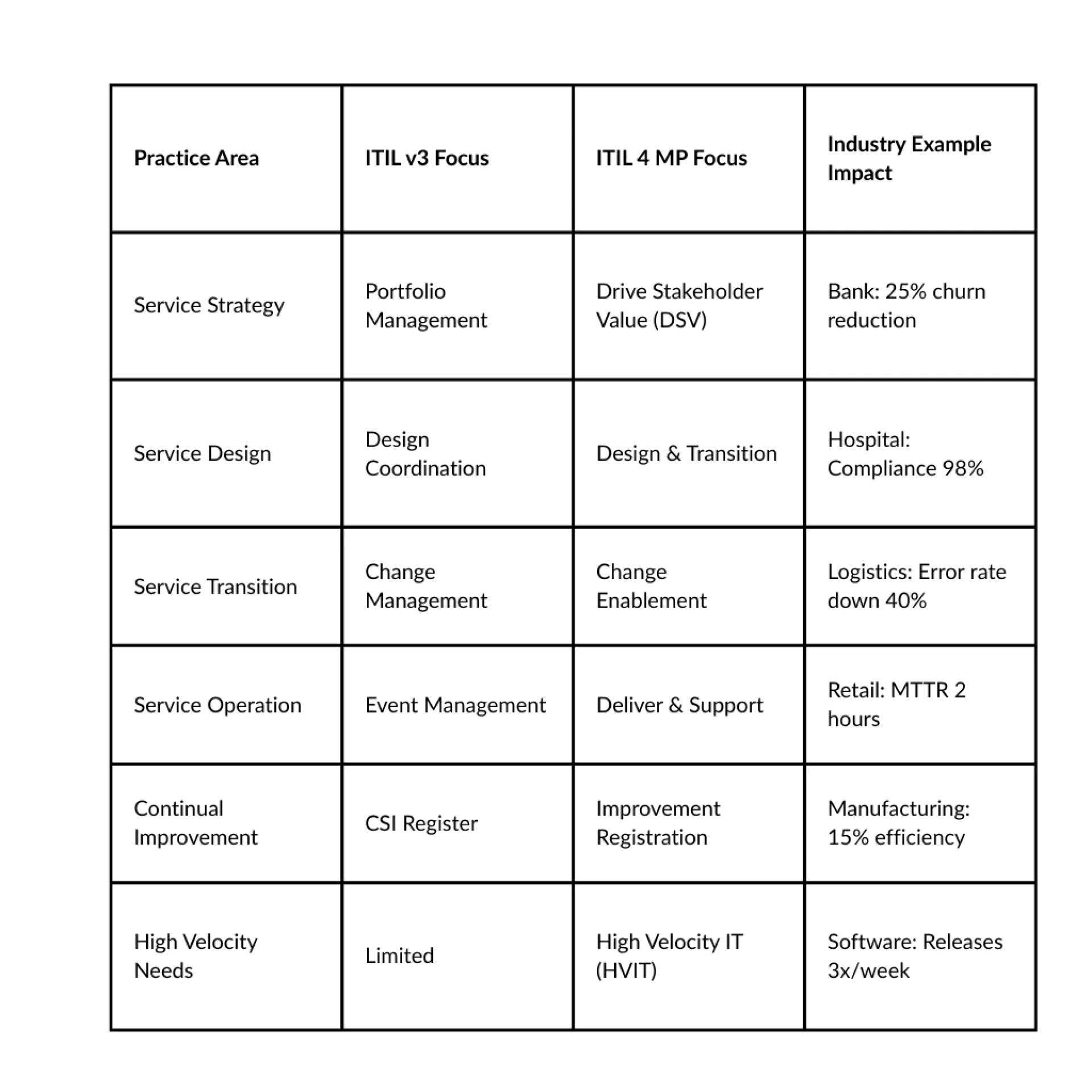
The transition module future-proofs careers amid cloud, AI, and automation trends. IT leaders report higher agility post-certification. SterlingNext ensures exam readiness with 90% pass rates in cohorts.
Best Practices for Successful Transition
Start with Value Streams: Begin your transition by identifying and mapping 2-3 critical value streams that deliver key services. Design your practices to optimize these value streams rather than implementing all 34 practices comprehensively.
Adopt Guiding Principles First: Before changing any processes or practices, ensure your organization understands and embraces ITIL 4's seven guiding principles. These principles should guide all decisions throughout the transition and beyond.
Create Cross-Functional Teams: Break down silos by creating teams organized around value streams and outcomes rather than traditional process boundaries. This organizational change is often more impactful than any process redesign.
Leverage Technology Appropriately: Invest in modern ITSM platforms that support ITIL 4's flexibility and automation capabilities. However, avoid the trap of trying to configure tools to replicate complex ITIL v3 workflows—use the transition as an opportunity to simplify.
Measure What Matters: Shift metrics from process compliance (tickets closed, SLA adherence) to value delivery (time to value, customer satisfaction, business outcomes enabled). This measurement shift reinforces the cultural transition ITIL 4 represents.
Maintain Continuous Improvement: ITIL 4 places continual improvement at the heart of the SVS. Establish regular improvement cycles using data-driven analysis to refine your practices based on actual performance and changing needs.
Call to Action
Register for SterlingNext's ITIL 4 Managing Professional Transition training today: Live sessions available with flexible pricing start your ITIL 4 journey now!










Sign in to leave a comment.