


Starting a fertility treatment journey can bring a mixture of hope, questions, and uncertainty. For couples who have been trying to conceive without success, understanding the available treatment options is often the first step toward making informed decisions.
Among the different assisted reproductive technologies, In Vitro Fertilization (IVF) is one of the most widely used treatments for certain types of infertility. It involves collecting eggs from the ovaries, fertilizing them with sperm in a laboratory, and transferring a suitable embryo into the uterus.
Although IVF is frequently discussed as a single medical procedure, it actually involves several stages that take place over a number of weeks. Each stage has a specific purpose, from evaluating fertility health to monitoring embryo development and confirming the pregnancy result.
Understanding how these stages work can help patients feel better prepared and know what questions to ask their fertility specialist.
What Is IVF and Why Is It Recommended?
In Vitro Fertilization, commonly known as IVF, is an assisted reproductive technique in which fertilization takes place outside the human body under controlled laboratory conditions.
During natural conception, an egg and sperm usually meet inside the fallopian tube. In IVF, this process takes place in an embryology laboratory. Once fertilization occurs and an embryo develops, a suitable embryo may be transferred into the uterus.
IVF may be recommended for several fertility-related conditions, including:
- Blocked or damaged fallopian tubes.
- Male-factor infertility, including certain sperm-related problems.
- Endometriosis.
- Some cases of polycystic ovary syndrome (PCOS).
- Unexplained infertility.
- Certain age-related fertility concerns.
- Previous unsuccessful fertility treatments.
However, IVF is not automatically the first treatment for every couple experiencing infertility. A fertility specialist evaluates the medical history and test results of both partners before recommending an appropriate approach.
Step 1: Begin with a Fertility Consultation
Before starting IVF, it is important to understand the possible reasons behind difficulty conceiving.
An initial fertility consultation allows the doctor to review the couple's reproductive health, medical history, previous pregnancies, and any earlier fertility treatments.
The evaluation may include:
Medical history: The specialist reviews menstrual patterns, previous pregnancies, surgeries, existing medical conditions, and the duration of attempts to conceive.
Ovarian reserve testing: Blood tests such as Anti-Müllerian Hormone (AMH) and ultrasound-based antral follicle counts may help assess the ovarian reserve.
Hormonal investigations: Depending on the patient's history, tests may be recommended to evaluate reproductive hormones and other relevant conditions.
Ultrasound examination: A pelvic ultrasound helps assess the uterus, ovaries, and other reproductive structures.
Semen analysis: Male fertility evaluation generally includes examining sperm concentration, movement, and morphology.
The results help the specialist determine whether IVF, another fertility treatment, or additional investigations are appropriate.
Couples beginning this process can learn about the importance of a specialist infertility consultation and fertility evaluation before making treatment decisions.
Step 2: Developing a Personalized IVF Treatment Plan
Once the initial investigations are complete, the fertility specialist prepares an individualized treatment plan.
IVF protocols can differ considerably because every patient's reproductive health and treatment history are different.
Some of the important factors considered include:
- Woman's age.
- Ovarian reserve.
- Hormonal profile.
- Cause of infertility.
- Sperm quality.
- Previous IVF outcomes.
- Presence of conditions such as PCOS or endometriosis.
- Any existing frozen embryos.
The doctor also determines which medication protocol may be suitable and how the patient's response will be monitored.
It is important not to compare medication schedules with those of friends or relatives who have undergone IVF. Treatment decisions should always be based on individual medical findings.
Step 3: Ovarian Stimulation and Follicle Development
In a natural menstrual cycle, the ovaries generally release one mature egg. During IVF, fertility medications are used to encourage multiple follicles to develop during the same cycle.
This stage is called ovarian stimulation.
The purpose is to provide the embryology laboratory with several eggs for possible fertilization, since not every collected egg will necessarily be mature or develop into an embryo.
Ovarian stimulation commonly involves:
- Daily fertility injections prescribed by the specialist.
- Regular ultrasound examinations.
- Hormonal blood tests when indicated.
- Adjustments to medication based on follicle development.
The stimulation phase often lasts approximately one to two weeks, although the duration varies between patients.
Some women experience bloating, mild pelvic discomfort, or temporary injection-site reactions during this period.
Close medical monitoring is important because an excessive ovarian response can increase the risk of ovarian hyperstimulation syndrome (OHSS).
Step 4: Trigger Injection and Final Egg Maturation
When the follicles have developed sufficiently, the fertility specialist schedules a trigger injection.
This medication helps complete the final maturation of the eggs before collection.
The timing of this injection is particularly important because egg retrieval must be scheduled according to the prescribed interval after the trigger.
Patients should follow their clinic's instructions carefully and should never change the injection time or dosage without medical advice.
Step 5: Egg Retrieval Procedure
Egg retrieval, also known as ovum pickup, is the procedure used to collect eggs from the ovaries.
It is generally performed under sedation or anesthesia.
Using ultrasound guidance, the doctor passes a thin needle through the vaginal wall to reach the ovarian follicles. The fluid from the follicles is collected and examined by embryologists to identify the eggs.
The procedure usually takes around 15–30 minutes, although individual circumstances may affect the duration.
After egg retrieval, patients are monitored for a short period before returning home.
Mild cramping, spotting, and abdominal discomfort may occur temporarily. Patients should follow their doctor's recovery instructions and contact the clinic if they experience severe pain, heavy bleeding, fever, or other concerning symptoms.
Step 6: Sperm Collection and Fertilization
Once the eggs have been collected, the next stage is fertilization.
A sperm sample is generally provided on the same day and processed in the laboratory. The embryology team prepares the sample to select suitable sperm for fertilization.
There are two commonly used fertilization approaches.
Conventional IVF
In conventional IVF, prepared sperm and mature eggs are placed together in a laboratory dish. Fertilization occurs naturally within the controlled laboratory environment.
Intracytoplasmic Sperm Injection (ICSI)
ICSI is a specialized fertilization technique in which a single sperm is injected directly into a mature egg using laboratory equipment.
It may be recommended in certain cases of male-factor infertility, previous fertilization problems, or when the available sperm numbers are limited.
However, ICSI is not necessary for every IVF patient.
The decision depends on the couple's medical history, sperm findings, and the fertility specialist's recommendations. Patients interested in understanding this technique can explore ICSI treatment and its role in assisted fertilization.
Step 7: Embryo Development in the Laboratory
After fertilization, the resulting structures are monitored by embryologists as they develop.
A fertilized egg is initially called a zygote. It begins dividing into multiple cells over the following days.
Embryo development generally follows this pattern:
- Day 1: Fertilization is assessed.
- Day 2–3: The embryo continues dividing into multiple cells.
- Day 5–6: Some embryos develop into blastocysts, an advanced developmental stage.
The embryology laboratory maintains carefully controlled conditions to support embryo development.
It is important to understand that not every retrieved egg will become a suitable embryo. Some eggs may be immature, some may not fertilize, and some embryos may stop developing.
This is a normal possibility within IVF treatment and should be discussed with the fertility specialist.
Step 8: Embryo Assessment and Selection
Embryologists assess developing embryos using several criteria, including their appearance, developmental stage, and cell division patterns.
Embryo grading helps the clinical team evaluate which embryos may be suitable for transfer or freezing.
In selected cases, additional technologies such as preimplantation genetic testing may be considered.
These tests can provide information about specific chromosomal or genetic conditions, depending on the type of testing performed. However, they are not required for every IVF cycle and should only be considered following appropriate medical and genetic counselling.
Embryo selection is based on the available laboratory findings and the patient's individual circumstances.
Step 9: Embryo Transfer into the Uterus
Embryo transfer is one of the important stages of IVF treatment.
During this procedure, a selected embryo is placed into the uterine cavity using a thin, flexible catheter.
The procedure is generally performed under ultrasound guidance and usually does not require anesthesia.
The process commonly involves:
- Preparing the embryo for transfer.
- Loading it into a specialized catheter.
- Gently introducing the catheter through the cervix.
- Depositing the embryo into the uterus.
- Checking the procedure before the patient leaves the clinic.
Embryo transfer is usually brief, and most patients can return home on the same day.
The timing depends on whether a fresh or frozen embryo transfer is planned.
Step 10: Understanding Fresh and Frozen Embryo Transfers
IVF treatment does not always involve transferring an embryo immediately after egg retrieval.
There are two main approaches.
Fresh Embryo Transfer
A fresh embryo transfer takes place during the same treatment cycle, generally three or five days after egg retrieval, depending on embryo development and clinical suitability.
Frozen Embryo Transfer
In a frozen embryo transfer, suitable embryos are preserved through cryopreservation and transferred during a later cycle.
A frozen transfer may be recommended when the uterine lining needs additional preparation, genetic testing results are awaited, or the doctor considers delaying transfer medically appropriate.
The decision between fresh and frozen transfer depends on factors such as hormone levels, uterine conditions, embryo development, and individual treatment needs.
Step 11: The Waiting Period After Embryo Transfer
The days following embryo transfer are commonly called the two-week wait.
For many patients, this can be an emotionally challenging period because the outcome is not immediately known.
During this time, the fertility specialist may prescribe progesterone or other medication to support the uterine lining.
Patients are generally able to continue normal daily activities, although individual restrictions may apply.
A few important points to remember include:
- Continue prescribed medication as directed.
- Follow the clinic's advice regarding physical activity.
- Avoid changing medication without consulting the doctor.
- Do not rely on early symptoms to determine whether implantation has occurred.
- Contact the clinic if significant pain, heavy bleeding, or other concerning symptoms develop.
Symptoms such as breast tenderness, mild cramps, or bloating are not reliable indicators of pregnancy because they may also result from hormonal medication.
Step 12: Pregnancy Testing and Follow-Up
The final stage involves checking whether pregnancy has occurred.
A blood test called beta-hCG measures the level of human chorionic gonadotropin, a hormone associated with pregnancy.
The fertility clinic generally schedules this test around 10–14 days after embryo transfer, although the recommended date varies with the treatment protocol.
If the result is positive, the doctor may recommend repeat blood testing and a subsequent ultrasound to assess early pregnancy development.
If the result is negative, the fertility specialist reviews the treatment cycle, discusses the findings, and explains possible next steps.
These may include a frozen embryo transfer, further investigations, or a modified treatment approach.
A negative result from one cycle does not automatically mean that future treatment will be unsuccessful.
How Long Does the Complete IVF Process Take?
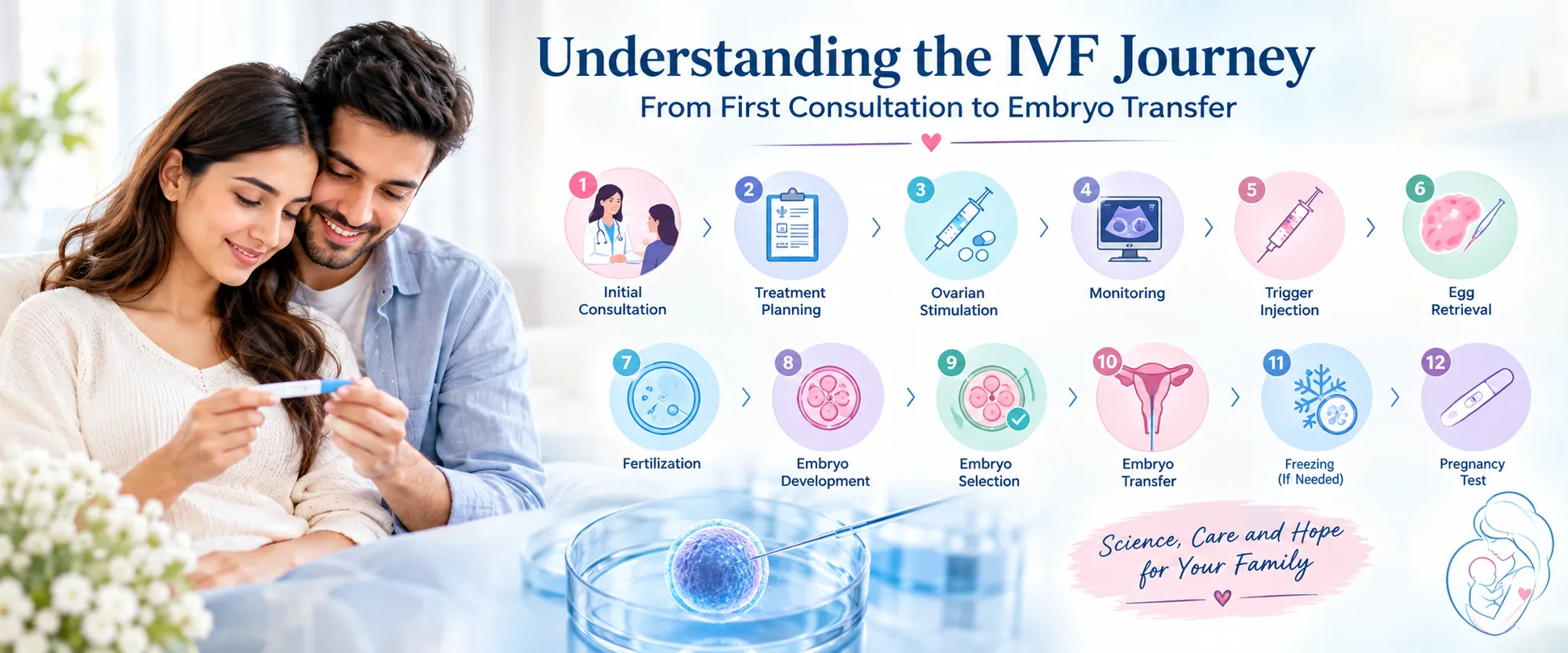
The timeline varies depending on the treatment protocol and whether a fresh or frozen embryo transfer is planned.
A typical IVF cycle may follow this general schedule:
| Treatment stage | Approximate timing |
|---|---|
| Initial evaluation | Before treatment begins |
| Ovarian stimulation | Around 1–2 weeks |
| Trigger injection | Before egg retrieval |
| Egg retrieval | Usually about 34–36 hours after trigger |
| Fertilization | After egg collection |
| Embryo development | Around 3–6 days |
| Fresh embryo transfer | Usually day 3 or day 5 |
| Pregnancy blood test | Around 10–14 days after transfer |
These timings are illustrative rather than fixed. A frozen embryo transfer may require a separate preparation cycle.
What Factors Can Influence IVF Treatment Outcomes?
IVF outcomes vary between individuals. Several medical and reproductive factors may influence the likelihood of success.
Age: A woman's age is an important factor because egg quality and reproductive potential change over time.
Ovarian reserve: The number of eggs available for stimulation can influence the response to medication.
Sperm health: Sperm concentration, movement, and other characteristics may affect fertilization.
Embryo development: The number and developmental quality of embryos influence available transfer options.
Uterine health: Conditions affecting the uterine cavity or endometrial lining may need evaluation before transfer.
Underlying medical conditions: PCOS, endometriosis, thyroid disorders, and other conditions may influence treatment planning.
Previous fertility treatment: Earlier IVF outcomes can provide useful information when planning subsequent cycles.
No single factor determines the outcome, and general success rates cannot accurately predict an individual's chances. Patients should discuss age-specific and diagnosis-specific expectations with their fertility specialist.
How Can Patients Prepare for an IVF Journey?
Preparing for IVF involves more than attending medical appointments. Understanding the treatment schedule and maintaining communication with the fertility team can make the experience easier to manage.
Some practical suggestions include:
- Keep a record of medical investigations and previous treatment reports.
- Understand the medication schedule provided by the clinic.
- Attend monitoring appointments as instructed.
- Ask questions whenever a procedure or medication is unclear.
- Maintain a balanced diet and follow medical advice about exercise.
- Avoid smoking and discuss alcohol consumption with your doctor.
- Arrange emotional support from a partner, family member, or counsellor.
- Discuss treatment costs and possible additional procedures in advance.
It is equally important to recognize that IVF can be emotionally demanding. Couples should allow themselves time to process the experience and seek support when needed.
Final Thoughts
IVF is a carefully planned fertility treatment involving several connected stages, beginning with an initial consultation and continuing through ovarian stimulation, egg retrieval, fertilization, embryo development, and pregnancy testing.
Although the overall process follows a recognizable sequence, the details can differ significantly from one patient to another.
Understanding what happens at each stage helps couples approach treatment with more realistic expectations and greater confidence. Choosing an experienced fertility team, asking questions, and following individualized medical advice are important parts of the journey.
Most importantly, remember that fertility treatment is not a race. Every patient's circumstances are different, and the appropriate treatment plan should reflect their individual medical needs.
Medical disclaimer: This article is intended for general educational purposes and does not replace consultation with a qualified fertility specialist. IVF medications, procedures, timelines, and treatment decisions must be individualized.


















Sign in to leave a comment.