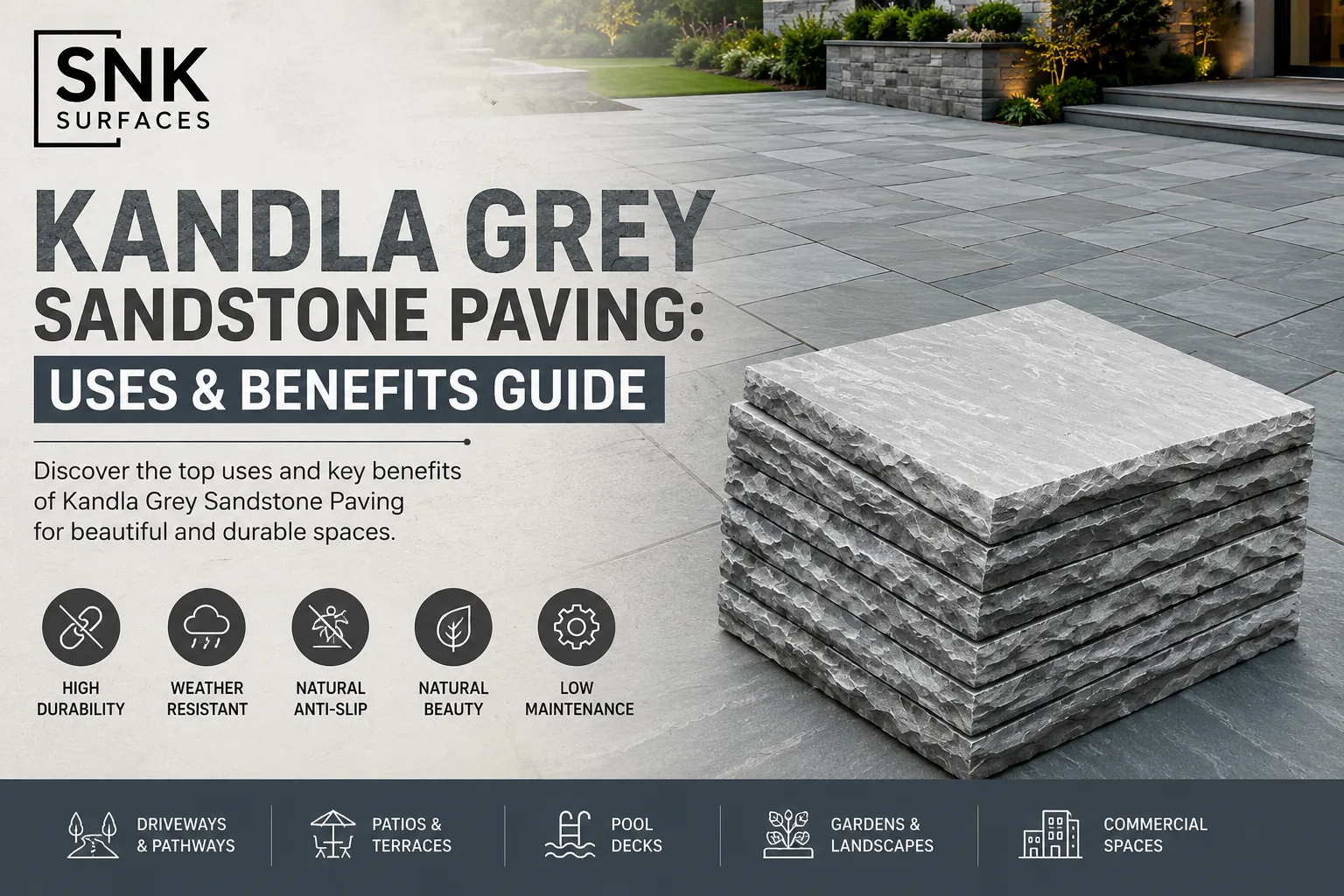

If you are sourcing stone for a patio, driveway, or a large commercial paving project, Kandla Grey Sandstone Paving is one of the first materials your supplier will mention, and for good reason. It is the most consistent, least variable grey stone in the entire Indian sandstone range, which is exactly why architects, contractors, and importers keep specifying it project after project. This guide walks through what the stone actually is, where it works best, how it compares to alternatives, and what to check before you place an order.
Quick Answer: Kandla Grey Sandstone Paving is a natural, quartz-rich sedimentary stone quarried in Rajasthan, India. It has a soft grey-blue tone with occasional beige shading, a hard-wearing surface that resists frost and heavy foot traffic, and it is supplied in slabs, tiles, blocks, coping, and steps for patios, driveways, pathways, courtyards, and pool surrounds.
Key Takeaways
- Kandla Grey Sandstone Paving is quarried across the Bhilwara, Kota, and Bundi belt in Rajasthan and is prized for its even, low-variation grey colour.
- It is a hard, low-porosity sandstone, so it holds up well against frost, rain, and heavy footfall in outdoor UK, Irish, and European climates.
- Standard sizes run from 300x600mm up to large-format 600x1200mm slabs, in thicknesses from 12mm to 30mm.
- Finishes include natural riven, sandblasted, honed, smooth, flamed, and tumbled, so the same stone can suit a traditional garden or a contemporary courtyard.
- Buying directly from a Kandla Grey Sandstone manufacturer instead of a trader usually means better pricing, more consistent batches, and reliable container-load supply.
Table of Contents
- What Is Kandla Grey Sandstone Paving
- Uses and Applications
- Key Benefits
- Key Features and Technical Specifications
- Kandla Grey Sandstone vs Kandla Grey Porcelain
- Pros and Cons
- Buying Guide
- Installation Guide
- Maintenance Guide
- Common Mistakes to Avoid
- Expert Tips
- Frequently Asked Questions
- Conclusion and Next Steps
What Is Kandla Grey Sandstone Paving
Kandla Grey Sandstone Paving is a natural sedimentary stone made of compacted quartz grains bonded together with silica and calcite. That composition is what gives it a dense, weather-resistant structure rather than a soft or crumbly one. According to the Natural Stone Institute, sandstone is grouped commercially by how it performs and looks rather than by strict geological classification, and Kandla Grey is a textbook example of a commercial sandstone chosen for consistent colour and reliable outdoor performance. The stone gets its name from its trade routing through Kandla port in Gujarat, though the quarries themselves sit further inland across Rajasthan. Buyers usually see it described as a gentle grey-blue with subtle veining, sometimes with a light beige or charcoal undertone, and that narrow colour range is why it reads as tidy and uniform once it is laid, rather than patchy or mismatched.
Uses and Applications
Kandla Grey Sandstone Paving is specified for a wide range of outdoor and some indoor applications, including:
- Residential and commercial patios
- Driveways, in 20mm or 22mm calibrated thickness
- Garden pathways and courtyards
- Pool surrounds and pool coping
- Wall cladding and low garden walls
- Steps, kerbs, and window sills
- Large-format commercial paving for public realm and landscaping projects
Because it is supplied as slabs, tiles, blocks, coping, and steps from the same batch, a single order can cover an entire outdoor scheme without colour mismatches between the paving and the surrounding features.
Key Benefits
Durability in changeable weather.
The low porosity of Kandla Grey sandstone means it does not absorb much water, which reduces the risk of frost damage and surface scaling through cold UK and Irish winters.
Consistent, neutral colour.
Unlike some Indian sandstones that show strong colour bands, Kandla Grey stays close to a uniform grey-blue tone across a batch, which matters when a contractor needs hundreds of square metres to look the same from one end of a project to the other.
Design flexibility.
The natural riven texture suits a traditional cottage garden, while a smooth or honed finish gives the same stone a sharp, modern look for contemporary architecture.
Slip resistance underfoot.
The natural riven and sandblasted finishes provide reliable grip in wet conditions, which is a common requirement around pools and public walkways.
Long service life.
As a hard, quartz-heavy stone, Kandla Grey resists abrasion and heavy footfall better than softer sedimentary stones, so it holds its surface quality over decades rather than years.
Cost-effective for large projects.
Because it is quarried in bulk across a wide Rajasthan belt and shipped in container loads, it remains one of the more competitively priced natural stones for commercial-scale paving.
Key Features and Technical Specifications
| Property | Detail |
|---|---|
| Material | Natural sandstone, sedimentary, quartz and silica bonded |
| Colour | Soft grey-blue with occasional beige or charcoal shading |
| Sizes | 300x600mm, 600x290mm, 600x400mm, 600x450mm, 600x600mm, 600x900mm, 600x1200mm |
| Thickness | 12mm, 18mm, 20mm, 22mm, 25mm, 30mm |
| Finishes | Natural riven, sandblasted, honed, smooth, flamed, tumbled |
| Formats | Blocks, slabs, tiles, coping, steps |
| Common applications | Patios, driveways, pathways, courtyards, pool surrounds, wall cladding |
| Typical use case | 22mm calibrated for patios, 20mm for driveway-grade slabs |
Custom sizing and project-specific quantities are usually available when ordering directly from a Kandla Grey Sandstone manufacturer for container loads.
Kandla Grey Sandstone vs Kandla Grey Porcelain
| Factor | Kandla Grey Sandstone | Kandla Grey Porcelain |
|---|---|---|
| Look and feel | Genuine natural texture and colour depth | Consistent manufactured grey, uniform tone |
| Maintenance | Benefits from sealing every couple of years | No sealing required, resists staining |
| Frost resistance | Strong, low porosity | Very strong, virtually non-porous |
| Cost | Generally lower per square metre | Generally higher per square metre |
| Best for | Buyers who want authentic natural stone character | Buyers who want low-maintenance uniformity |
Both options come from the same manufacturer range, so a project can mix and match sandstone paving with porcelain edging or steps without sourcing from two different suppliers.
Pros and Cons
Pros
- Naturally weather-resistant and long-lasting
- Even, predictable colour across large orders
- Available in multiple sizes, thicknesses, and finishes
- Works for both traditional and contemporary design briefs
- Competitively priced for the quality and durability it offers
Cons
- Requires occasional sealing to protect against staining
- As a natural product, very slight shade variation between batches is normal
- Heavier than porcelain, so delivery and handling costs can be marginally higher
- Cutting requires proper stone tools rather than standard tile cutters
Buying Guide
When you are comparing a Kandla Grey Sandstone Paving supplier, a few checks make the difference between a smooth order and a delayed one.
Confirm the source.
Ask whether you are buying from a Kandla Grey Sandstone manufacturer directly or from a trading intermediary. Manufacturer-direct sourcing generally means tighter quality control and better pricing on container-load orders.
Check certifications.
Look for UKCA and CE marking along with ISO 9001:2015 certification, particularly if the paving is going into a commercial or public project in the UK or Europe.
Ask for real samples.
A reliable Kandla Grey Sandstone supplier will send free samples so you can check colour, finish, and thickness before committing to a full container.
Confirm shipping capability.
If you are importing into the UK, Ireland, or mainland Europe, work with a Kandla Grey Sandstone exporter that regularly ships to those markets and understands the paperwork and lead times involved.
Match sizing to the job.
Choose 22mm calibrated for standard patios, 20mm for driveways, and confirm whether patio packs (mixed sizes) or single-size pallets suit the layout better.
Get everything in writing.
Batch numbers, finish, thickness tolerance, and delivery timeline should all be confirmed on the order before payment.
Installation Guide
- Prepare a firm, well-compacted sub-base, typically MOT Type 1 for driveways and a lighter compacted base for patios.
- Lay a full mortar bed rather than dabs, since Kandla Grey slabs perform best with full, even support.
- Set slabs with consistent joint widths, usually 8mm to 10mm, and check falls for drainage as you go.
- Tap each slab level using a rubber mallet and check with a spirit level across multiple points.
- Allow the mortar bed to cure fully before pointing the joints.
- Point joints with a suitable jointing compound and clean excess residue from the surface before it sets.
- Leave the finished paving to cure for the manufacturer-recommended period before heavy foot or vehicle traffic.
Maintenance Guide
- Sweep regularly to prevent grit build-up that can wear the surface over time.
- Wash with a mild detergent and water rather than harsh acidic cleaners.
- Reseal every two to three years to protect against staining and to keep the colour looking fresh.
- Treat organic growth such as moss or algae promptly with a stone-safe cleaner.
- Avoid pressure washing at very close range, since it can strip the surface texture on riven finishes.
Common Mistakes to Avoid
- Laying slabs without checking batch consistency first, which can cause visible colour patchwork.
- Skipping the sub-base preparation, which leads to cracking and uneven settling later.
- Using the wrong jointing compound for outdoor exposure.
- Ordering from a supplier who cannot confirm certification or shipping experience to your region.
- Ignoring drainage falls, which causes standing water and accelerates staining.
Expert Tips
- Order five to ten percent extra material to account for cuts, breakages, and future repairs.
- Mix slabs from multiple packs while laying so any minor shade variation blends naturally across the area.
- For pool surrounds, choose a sandblasted or riven finish for better grip when wet.
- Ask your Kandla Grey Sandstone Paving supplier for a written specification sheet to keep on file for commercial project records.
Frequently Asked Questions
What is Kandla Grey Sandstone Paving best used for?
It is most commonly used for patios, driveways, pathways, courtyards, and pool surrounds, thanks to its durability and consistent grey tone.
Is Kandla Grey Sandstone Paving suitable for driveways?
Yes. At 20mm or 22mm calibrated thickness, it is dense enough to handle regular vehicle traffic as well as pedestrian areas.
Where does Kandla Grey Sandstone Paving come from?
It is quarried across a wide belt in Rajasthan, India, primarily in the Bhilwara, Kota, and Bundi districts.
Does Kandla Grey Sandstone Paving need sealing?
Sealing is not compulsory, but doing it every two to three years helps protect against staining and keeps the surface looking its best.
How does Kandla Grey sandstone compare to Kandla Grey porcelain?
Sandstone offers genuine natural texture and colour depth with some maintenance needs, while porcelain gives a similar grey look with virtually no sealing required.
What sizes and thicknesses are available?
Sizes range from 300x600mm up to large-format 600x1200mm, with thicknesses from 12mm to 30mm depending on the application.
Can I get free samples before ordering?
Most established suppliers, including direct manufacturers, will send free samples so you can check colour and finish before a full order.
Is Kandla Grey Sandstone Paving frost resistant?
Yes. Its low porosity and hard quartz structure make it well suited to cold, wet climates like the UK and Ireland.
What finishes are available for Kandla Grey Sandstone Paving?
Common finishes include natural riven, sandblasted, honed, smooth, flamed, and tumbled.
Do suppliers ship Kandla Grey Sandstone Paving internationally?
Yes, established exporters regularly ship container loads to the UK, Ireland, Europe, and other international markets.
Conclusion
Kandla Grey Sandstone Paving earns its place as one of the most specified grey stones in outdoor projects because it combines a genuinely consistent colour with real durability against frost, footfall, and time. Whether you are planning a private patio or sourcing container loads for a commercial development, the details that matter are the same: confirm the source, check the certifications, and order samples before committing to volume.
If you are ready to move forward, SNK Surfaces supplies Kandla Grey Sandstone Paving directly as a manufacturer, with worldwide shipping and main markets across the UK, Ireland, and Europe. Visit https://snksurfaces.com to request free samples and get a trade quote for your next project.


























Sign in to leave a comment.