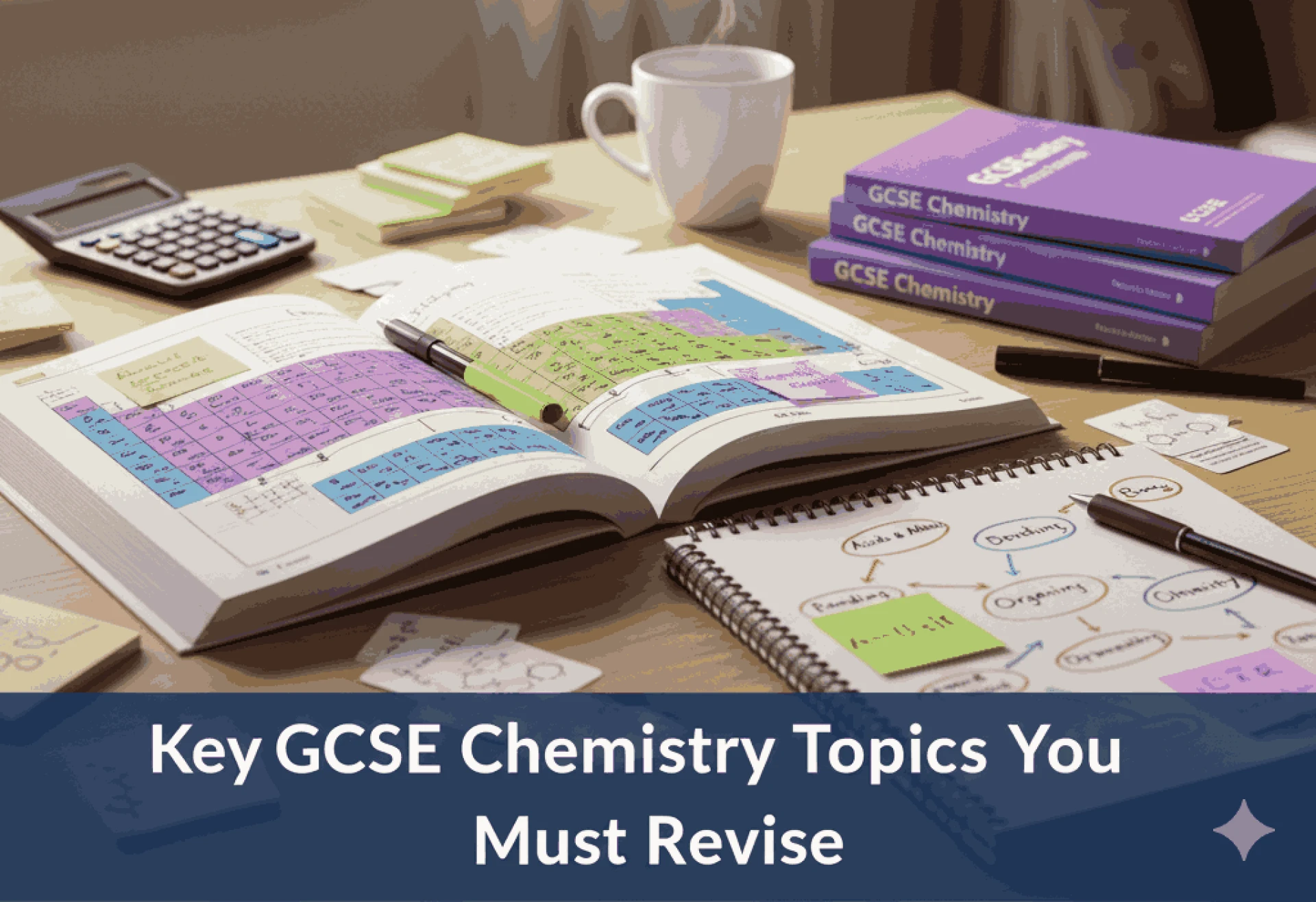

Are you struggling to effectively revise for the GCSE Chemistry exam? It is not an easy subject, and there are a lot of key GCSE Chemistry topics to cover before the exams. It requires the right strategies, approach and thorough understanding of key topics to achieve top grades in the GCSE Chemistry exam.
In this blog, we cover the key GCSE Chemistry topics you must revise to achieve 4/5 in the foundation tier and 8/9 in the higher tier exams.
Key GCSE Chemistry Topics
The application of GCSE Chemistry is everywhere around us. The numerous chemical reactions happening in the universe are examples of Chemistry.
Many students struggle to master challenging GCSE Chemistry topics. It is crucial to have a solid understanding of key GCSE Chemistry topics to secure top grades. Students boost their learning when they prepare for exams with expert GCSE Chemistry tutoring, led by highly qualified, DBS-checked tutors.
Here is the complete breakdown of essential GCSE Chemistry topics that students must revise:
Atomic Structure and Mass Number
Atomic structure is the key topic of GCSE Chemistry, in which every student should have a strong command. It covers:
- Structure of the atom: The key elements in and around the atom, including the proton, electron and neutron and how they are arranged.
- Atomic number and mass number: Understanding how to calculate atomic number and mass number, and how isotopes behave
- Electron configuration: How the chemical properties of atoms depend on electronic configuration
- Periodic table: The arrangements of elements in the periodic table.
Bonding of Atoms
This topic in GCSE Chemistry covers how atoms react and bond with other atoms to form entirely new elements.
It also sheds light on how the chemical and physical properties of components, such as melting and boiling points, are affected by the bonding.
Students study all 3 types of bonding:
- Ionic bonding: The bonding which takes place due to the complete transfer of electrons
- Covalent bonding: The covalent bonds are formed due to the sharing of electrons
- Metallic bonding: Delocalised electrons and why metals conduct electricity.
Quantitative Chemistry
Quantitative chemistry includes logical questions and those that include calculations, such as calculating atomic number and mass number.
- Relative formula mass
- The mole concept
- Chemical equations
- Percentage yield
- Concentration of solutions.
Chemical Changes
The chemical changes topic covers how the substances react and the patterns in those reactions. The main subtopics feature:
- The reactivity series: Displacement reactions
- Acids and alkalis: Reactions of acids and bases and the process of neutralisation
- Electrolysis: Nonspontaneous chemical reactions, applications
- Redox reactions: Oxidation and reduction reactions
Energy Changes
The Energy topic acts as a relationship builder between Chemistry and Physics. It mainly highlights:
- Exothermic and endothermic reactions: Definitions, examples and applications
- Reaction profiles: Activation energy, Bond energy, Energy transfer
- Practical experiments: Interpreting results
The Rate and Extent of Chemical Change
It is a crucial topic which helps understand the chemistry of chemical reactions, the rate at which they occur and how to control inputs and outputs.
- Factors affecting the rate of the reactions
- Reversible and irreversible reactions
- State of equilibrium
Organic Chemistry
It helps students understand the hydrocarbons and the chemical reactions involved. Organic Chemistry has vast applications in the industrial world.
- Hydrocarbons: Alkane, Alkenes and Alkynes
- Addition reactions and polymerisation: Formation of plastics and their impact on the environment.
- Alcohols, carboxylic acids, and esters: Properties and reactions.
Chemical Analysis
The Chemical Analysis topic tested in the GCSE Chemistry exam deals with how to identify different substances. It has applications in the forensic industry.
- Pure vs impure substances
- Chromatography
- Tests for gases
Chemistry of the Atmosphere
This topic teaches students the chemical reactions taking place in the atmosphere and how human activities affect the environment.
- Composition of the Earth’s atmosphere.
- The evolution of the atmosphere
- Greenhouse gases
- Global warming.
- Pollutants and their effects
Renewable and Nonrenewable Resources
It is a key topic tested in the GCSE Chemistry exam. It highlights sustainable ways to reuse products and real-life applications.
- Life Cycle Assessments
- Water purification and analysis.
- Recycling
- The Haber Process
How to Revise Effectively for the GCSE Chemistry Exam?
To confidently tackle questions of key topics in the GCSE Chemistry exam, it is crucial to revise effectively. The following are the key tips to maximise GCSE Chemistry revision.
- Use Interactive Revision Tools: Make GCSE Chemistry exam revision engaging and fun with interactive tools like flashcards, online quizzes and apps.
- Past Papers: Many students underestimate the importance of past papers. Go through all past papers of major exam boards, including AQA, Edexcel and OCR and solve a few under timed conditions.
- Exam Board Websites: The websites of AQA, Edexcel, and OCR exam boards offer GCSE Chemistry practice resources that enhance understanding and exam confidence.
- Tutoring Platforms: The one-to-one lessons and mock exams offered by various online tutoring platforms enable students to effectively revise key GCSE Chemistry topics.
- GCSE Chemistry Revision Guides: GCSE Chemistry revision guides include practice questions, examples and quizzes, helping students revise crucial topics.
Conclusion
Among the key topics of GCSE Chemistry are atomic number, bonding of atoms, chemical changes, energy changes, chemical analysis and renewable and non-renewable resources. The GCSE Chemistry exam seems like an insurmountable challenge, but with effective review of the key topics, students can secure 4/5 grades in the Foundation tier and 8/9 grades in the Higher tier exams.










Sign in to leave a comment.