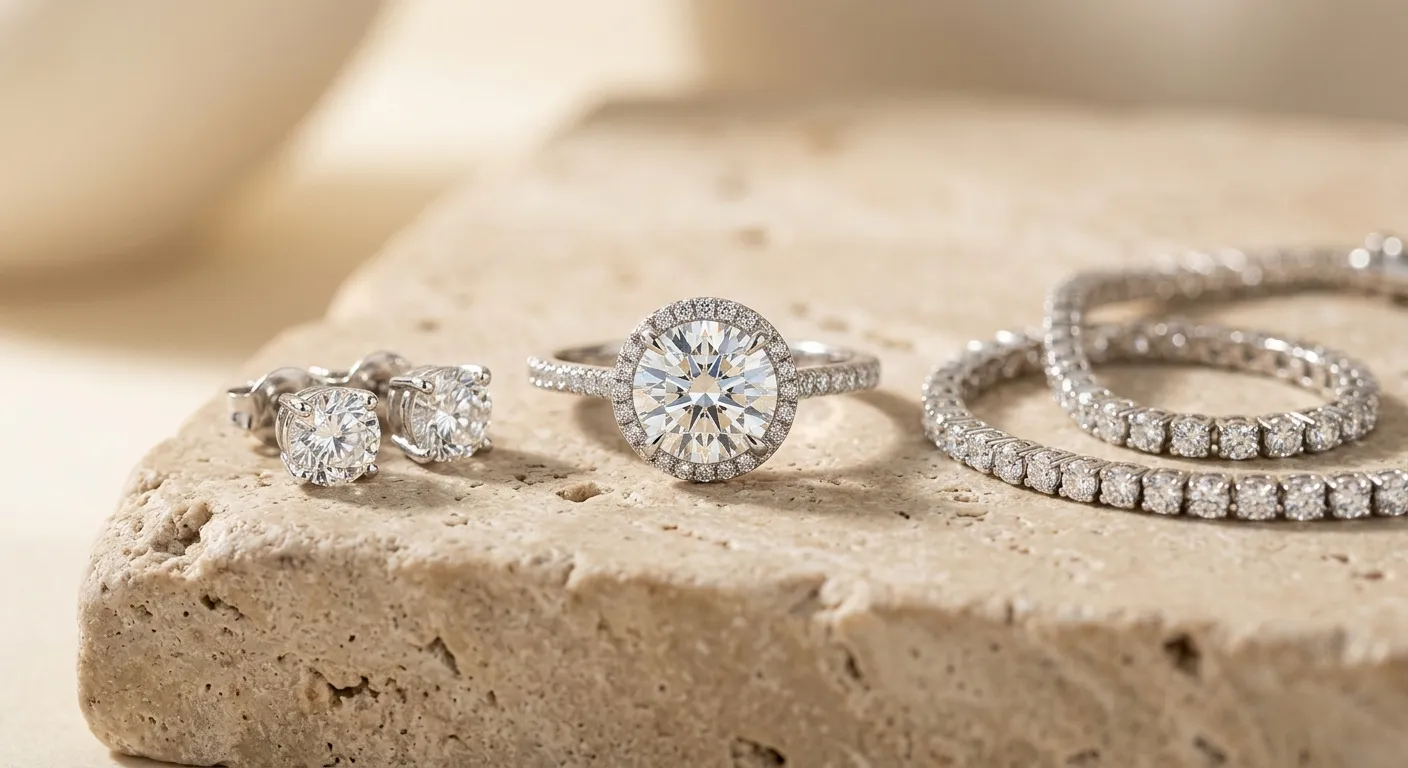

Shopping for lab-grown diamond jewelry is easier when you start with the type of piece you want. Engagement rings have different priorities from everyday earrings. A tennis bracelet also calls for different choices than a pendant.
Lab-grown diamonds are available across the same major jewelry categories as mined diamonds. Shop by piece first. Then narrow your options by diamond shape, setting, metal, and size.
Shop Lab-Grown Diamond Jewelry by Type
Lab-Grown Diamond Rings
Rings cover everything from engagement rings to wedding bands and eternity bands. The design you choose should fit how you plan to wear it.
For an engagement ring, start with the center stone. Round, oval, emerald, pear, cushion, marquise, and radiant shapes each create a different look.
The setting matters just as much. A solitaire keeps the design simple and puts the focus on one center diamond. Pavé adds smaller stones along the band, while a halo surrounds the center stone with additional diamonds.
If you'll wear the ring every day, look at it from the side, not just from above. A high-profile setting can look very different on the hand than it does in a product photo.
Lab-Grown Diamond Earrings
Earrings are often an easier place to start if you want diamond jewelry for regular wear.
Studs work with almost anything. Hoops and drop earrings make more of a statement.
Total carat weight isn't the only thing that matters. Shape, setting, metal, and proportion all affect how the earrings actually look when worn.
A simple first pair offers more flexibility. It works with jeans as easily as it works with a formal outfit.
Lab-Grown Diamond Necklaces
Necklaces give you plenty of room to vary the look.
A single-diamond pendant has a very different effect from a tennis necklace. Chain length and diamond size change that effect further.
Choose a pendant when you want one clear focal point. Choose a tennis necklace when you want a continuous line of diamonds that draws more attention.
Think about your existing jewelry before buying. If you already wear several necklaces, something you can layer will get more use than a standalone statement piece.
Lab-Grown Diamond Bracelets
Bracelets range from subtle diamond accents to full tennis styles.
A tennis bracelet is built around a continuous row of diamonds. Other designs rely on individual stones, mixed shapes, or a single accent setting.
If you'll wear the bracelet often, check the clasp and construction closely. A beautiful design isn't worth much if it's hard to secure or uncomfortable during everyday activities.
How to Choose a Lab-Grown Diamond
Once you know what type of jewelry you want, focus on the diamond itself.
The traditional starting point is the 4Cs: cut, color, clarity, and carat weight. The Gemological Institute of America explains how these characteristics are used to describe diamond quality in GIA's diamond buying guide.
Diamond Shape
Shape has an immediate effect on a piece of jewelry.
Round diamonds have a classic look. Oval and elongated cushion shapes stretch the appearance of the stone, making it look longer on the finger. Emerald and Asscher cuts read as more structured and geometric.
Pear and marquise shapes stand out more, and they change how a ring or pendant reads from across a room.
There's no universally best shape. The right choice depends on the design and your own taste.
Cut
Cut affects how a diamond handles light.
For round diamonds, cut matters most when you're comparing stones of similar carat weight. A poorly proportioned diamond can look dull in person even if it looks bright in a photo.
When shopping online, don't stop at the product image. Check the grading information and compare specifications between stones.
Color and Clarity
Color describes how much tint is visible in a diamond. Clarity describes its inclusions and blemishes.
You don't need the highest grade in either category. What matters is how the diamond looks in the finished piece, and whether it fits your budget.
A solitaire draws more attention to its single center stone, so its color and clarity carry more weight. In a piece with many smaller diamonds, the overall design matters more than any one stone.
Carat Weight
Carat measures weight. It doesn't directly tell you how large a diamond looks from above.
Shape affects perceived size too. An elongated diamond can look larger across its face than a round diamond of the same carat weight.
Check the actual measurements, not just the carat weight, when comparing jewelry online.
What Makes Lab-Grown Diamonds Different?
A lab-grown diamond is not the same thing as a diamond simulant such as cubic zirconia.
GIA explains that laboratory-grown diamonds have essentially the same chemical composition and crystal structure as natural diamonds. Their origin is different because they are produced using technological processes rather than formed naturally.
Two main production methods are used: chemical vapor deposition (CVD) and high-pressure, high-temperature (HPHT).
That distinction is worth understanding before you shop. If you specifically want a lab-grown diamond, check the product description and documentation to confirm what you're buying.
Choosing Jewelry for Different Occasions
The best piece depends partly on when you expect to wear it.
Engagement and Wedding Jewelry
Engagement rings take more thought than most other jewelry purchases. You'll usually wear the ring every day.
Consider how the center stone works with the setting. If you already have a wedding band in mind, check that the two rings sit comfortably together on the finger.
Eternity bands and diamond wedding bands can also stand alone, or pair with an engagement ring.
Everyday Jewelry
For everyday wear, versatility usually matters more than making a statement.
Diamond studs, smaller pendants, simple bracelets, and understated rings move easily between different outfits.
Hold the jewelry up against your actual wardrobe. A piece that works with what you already wear is more likely to become part of your regular rotation.
Gifts and Special Occasions
Earrings, necklaces, and bracelets can be easier gifts than engagement rings. You don't need to know a ring size or choose a setting to match another ring.
Personal style still matters, though.
Look at what the recipient already wears. Metal color, necklace length, diamond size, and overall design tell you more than a product description ever will.
Why Shop by Jewelry Category?
Online jewelry stores often organize products by both jewelry type and diamond characteristics. That makes it easier to narrow a large selection without comparing unrelated pieces.
Someone looking for an engagement ring can start with rings. From there, they can compare shapes such as oval, round, emerald, pear, or cushion.
The same approach works for earrings, bracelets, and necklaces.
This matters even more online. Product photographs can make different pieces look deceptively similar until you compare their measurements, settings, and proportions side by side.
If you want to browse different lab-grown diamond styles in one place, karaters jewelry includes engagement rings, eternity bands, tennis bracelets, tennis necklaces, earrings, and other pieces. The site also lets shoppers browse by diamond shape, including round, oval, emerald, radiant, pear, marquise, cushion, and other cuts.
What to Check Before Buying Online
Online shopping gives you access to a large selection, but product photos shouldn't be your only source of information.
Before placing an order, check:
- Diamond shape
- Carat weight
- Cut information
- Color and clarity
- Metal type
- Jewelry dimensions
- Setting details
- Grading information
- Return policy
- Warranty terms
- Shipping and sizing information
Grading information matters most on higher-value purchases.
GIA explains that laboratory-grown diamond reports can identify a diamond as laboratory-grown and provide information about its characteristics, as outlined in GIA's lab-grown diamond report information.
Check the retailer's return policy too. Fit is hard to judge from a screen, especially for rings and bracelets.
Frequently Asked Questions
Is lab-grown diamond jewelry real diamond jewelry?
Yes. Lab-grown diamonds share essentially the same chemical composition and crystal structure as natural diamonds. Only their origin differs: they're produced in a laboratory instead of forming underground, per GIA's explanation of lab-grown diamonds.
What types of lab-grown diamond jewelry are available?
Common options include engagement rings, wedding bands, eternity bands, earrings, necklaces, and bracelets. Designs range from simple pieces to elaborate styles with multiple diamonds.
Are lab-grown diamonds suitable for everyday jewelry?
Lab-grown diamonds share essentially the same physical properties as natural diamonds, so they suit many of the same designs. The durability of the finished piece still depends on its setting and construction, according to GIA's information on lab-grown diamonds.
How should you choose a lab-grown diamond?
Start with the piece you want to buy. Then compare the diamond's shape, cut, color, clarity, and carat weight. A grading report adds detail about the individual stone.
Can lab-grown diamonds be identified?
Yes. Their appearance can closely resemble natural diamonds, so specialized gemological equipment determines their origin. Laboratory-grown diamond reports can also identify a stone as laboratory-grown, as explained in GIA's lab-grown diamond report information.
Finding the Right Lab-Grown Diamond Jewelry
Start with the type of jewelry you actually want to wear.
For an engagement ring, focus first on the center stone and setting. For everyday earrings, comfort and versatility matter more than making a statement. For a bracelet or necklace, think about how the piece works with what's already in your jewelry box.
Then compare the details that shape the diamond's appearance: shape, cut, carat weight, metal, setting, and proportion.
The best purchase isn't necessarily the piece with the largest stone or the highest grade. It's the one that fits how you'll wear it, the design you prefer, and the details you're comfortable with before you place the order.

























Sign in to leave a comment.