
Introduction
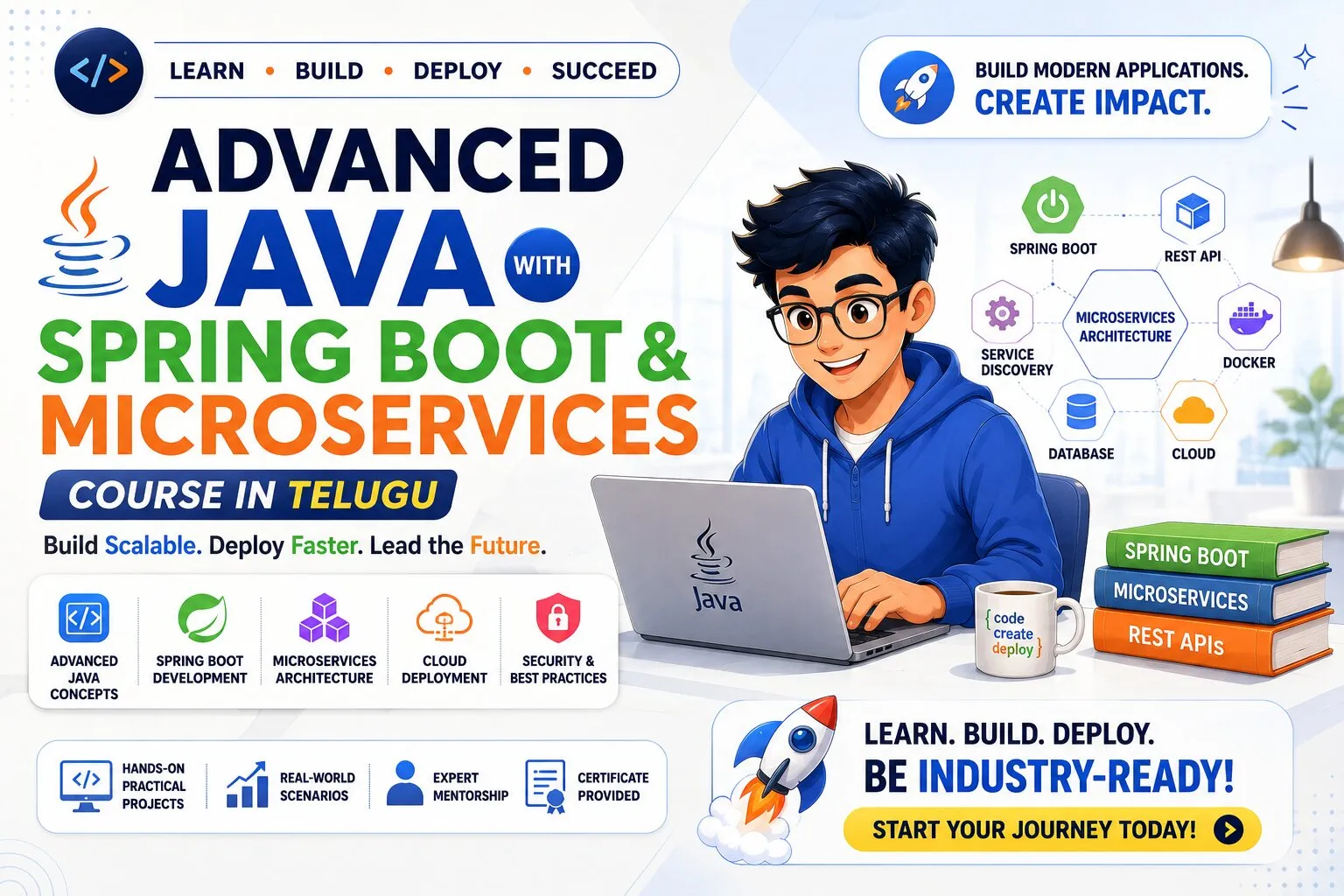
Advanced Java concepts are easier to remember when they solve a visible problem inside a project. Collections make more sense when organizing business data, transactions become meaningful when multiple database changes must succeed together, and concurrency becomes important when several users act simultaneously. An Advanced Java with Spring Boot & Microservices Course in Telugu can help learners study these concepts through enterprise-style projects instead of treating each topic as an isolated chapter.
Projects should become learning laboratories.
Project 1: Expense Management System
Build a backend where employees submit expenses.
Features can include:
Employee registration.
Expense submission.
Categories.
Manager approval.
Status tracking.
Reports.
This project can teach Java classes, Collections, Spring Boot, JPA, validation, and REST APIs.
Add Business Rules
An expense cannot contain a negative amount.
Certain expenses may require additional approval.
Rejected expenses need a reason.
These rules help you practice service-layer design.
The project now moves beyond CRUD.
Project 2: Inventory Management
Build a system for:
Products.
Stock.
Suppliers.
Purchases.
Stock movements.
This introduces data consistency.
If stock is sold, inventory must be updated correctly.
Transactions become important.
Add Search and Filtering
Allow users to search products.
Filter by category.
Sort by price.
Find low-stock products.
Use Java Streams for in-memory exercises and database queries for persistent datasets where appropriate.
This helps you understand where different approaches belong.
Project 3: Online Booking System
Build:
Users.
Services.
Time slots.
Bookings.
Cancellations.
This introduces concurrency.
What happens if two users choose the same slot?
Now transaction isolation, constraints, and concurrency control have a practical purpose.
Project 4: Employee Leave System
Create:
Employees.
Managers.
Leave requests.
Approvals.
Leave balances.
Notifications.
This project teaches role-based security and workflow-like business processes.
Add Exception Handling
For every project, define realistic errors.
Employee not found.
Insufficient balance.
Product unavailable.
Booking conflict.
Unauthorized operation.
Create clean application-level handling.
This strengthens Advanced Java exception knowledge.
Add Generics and Reusable Components
Create reusable response wrappers or utility components where they genuinely simplify the project.
Use generics thoughtfully.
Avoid creating abstractions only to demonstrate a concept.
Enterprise code should be reusable when reuse provides real value.
Use Streams for Reporting
Suppose the expense project needs a monthly summary.
Use Streams in a controlled exercise to:
Filter records.
Group expenses.
Calculate totals.
Sort categories.
Then compare this with database-side aggregation for large persistent datasets.
This teaches both Java capability and architectural judgment.
Add Asynchronous Work
Suppose approval confirmation does not need to block the main request.
Explore asynchronous processing concepts.
Learn CompletableFuture or Spring asynchronous capabilities at an appropriate stage.
Then understand the limitations and operational considerations.
Add REST APIs
Expose each project's business operations through APIs.
Don't stop at CRUD.
Examples:
Approve expense.
Cancel booking.
Adjust stock.
Calculate leave balance.
These endpoints represent business actions and make projects more realistic.
Add Security
Implement authentication.
Define roles.
Protect operations.
Test unauthorized scenarios.
Enterprise applications require access control.
Add Testing
Create unit tests for business rules.
Integration tests for important application flows.
Test failures as carefully as success cases.
Projects become more professional when behavior can be verified automatically.
Convert One Project Toward Microservices
Choose the most suitable project.
For inventory, perhaps Notification functionality can be separated first.
For booking, payment may become another service in a more advanced version.
Observe how communication changes.
Learn the additional complexity rather than simply celebrating the separation.
Document the Project
Create documentation explaining:
Problem.
Architecture.
Database design.
APIs.
Security.
Important business rules.
Testing.
Challenges.
Future improvements.
This helps you practice technical communication.
Conclusion
Practical enterprise projects provide an effective way to learn Advanced Java because they give every concept a reason to exist. Expense systems teach workflows, inventory systems develop transaction thinking, booking systems introduce concurrency, and employee applications demonstrate authorization and business rules.
An Advanced Java with Spring Boot & Microservices Course in Telugu can help learners connect Java, Spring Boot, databases, REST APIs, security, testing, and Microservices through these realistic projects. Instead of building many shallow applications, choose a few projects and progressively make them more complete. The deeper you understand your own implementation decisions, the more valuable the project becomes as a learning experience.





















Sign in to leave a comment.