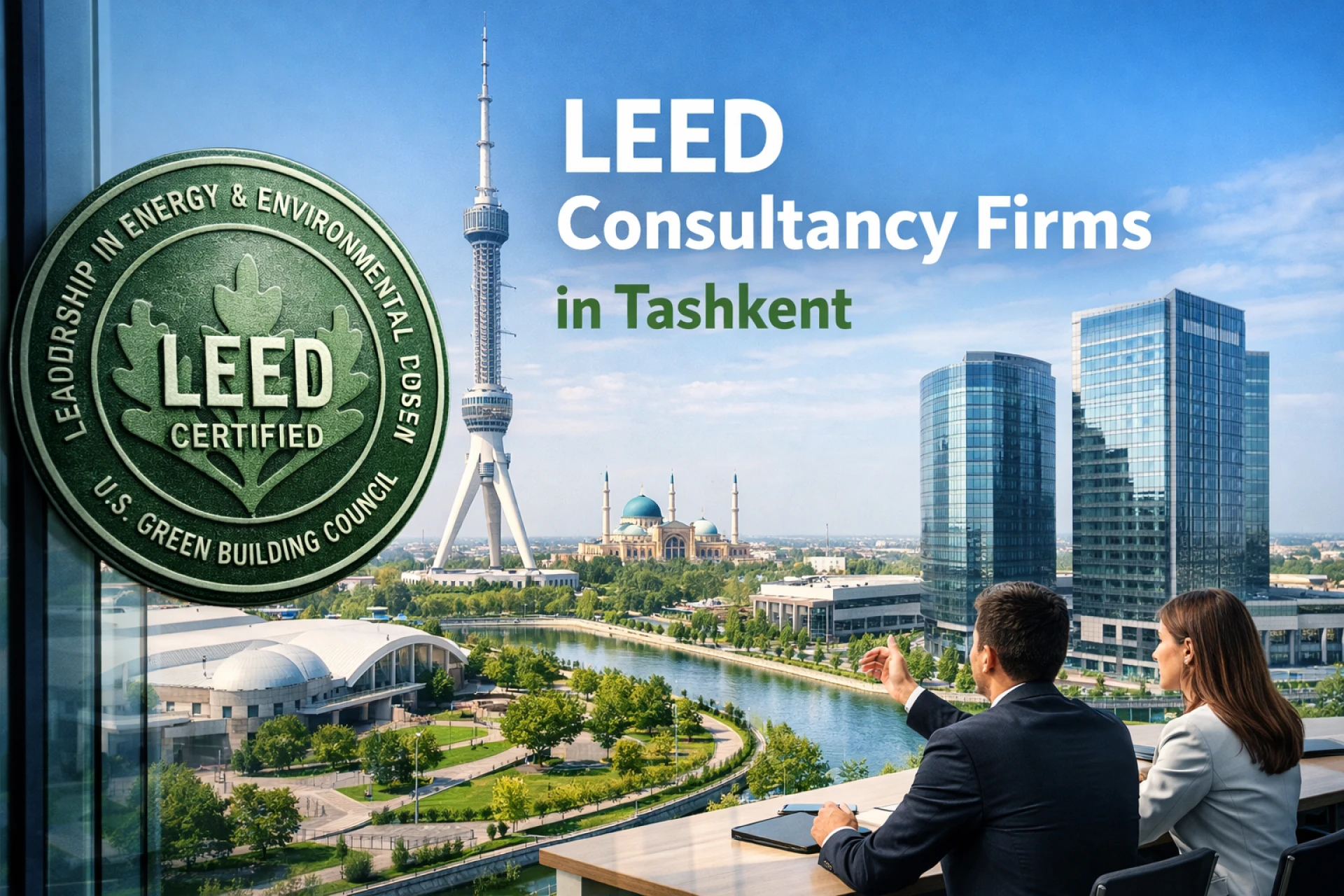

Tashkent is undergoing a period of accelerated urban and economic development, driven by government-led reforms, foreign direct investment, and large-scale commercial and infrastructure projects. New office buildings, business districts, healthcare facilities, educational campuses, hotels, and mixed-use developments are reshaping the city’s built environment, with increasing involvement from international developers and financiers.
Within this context, LEED (Leadership in Energy and Environmental Design) has emerged as the most recognised international green building certification system referenced in Tashkent-based projects. LEED is typically pursued for developments seeking alignment with global sustainability standards, international tenant requirements, development bank funding criteria, or ESG reporting frameworks. Its flexibility and global acceptance make it suitable for Uzbekistan’s evolving regulatory and construction environment.
The adoption of LEED in Tashkent requires consultancy firms capable of translating international certification requirements into practical strategies aligned with local climate conditions, material availability, and construction practices.
Scope of LEED Consultancy Services in Tashkent
LEED consultancy firms in Tashkent generally provide support across all certification phases, from early-stage feasibility to final certification. Typical services include LEED scorecard development, credit feasibility analysis, sustainability strategy workshops, coordination with architectural and engineering teams, energy and water efficiency optimisation, materials and indoor environmental quality compliance, construction-phase documentation tracking, and submission management to the U.S. Green Building Council.
Local considerations play a significant role in LEED delivery. Continental climate conditions, heating and cooling demands, evolving building codes, and limited availability of locally documented green materials require careful credit selection and optimisation. Consultants with regional experience are better positioned to balance certification targets with constructability and cost control.
1. ERKE Consultancy
ERKE Consultancy is a sustainability-focused consultancy with extensive experience delivering LEED certification services across international and emerging markets. Founded in 2007, ERKE operates through offices in Istanbul, Dubai, and London and supports LEED projects across more than 15 countries, including Central Asia.
ERKE has delivered over 200 LEED-certified projects worldwide, covering offices, healthcare facilities, airports, transportation centres, hospitality developments, and large mixed-use projects. This global portfolio demonstrates ERKE’s ability to manage LEED certification under diverse climatic, regulatory, and market conditions similar to those found in Tashkent.
A defining strength of ERKE is its fully in-house expert team. ERKE employs LEED Fellows, LEED APs, WELL APs, BREEAM Assessors, EDGE Experts, and sustainability specialists who manage all LEED categories internally. This integrated structure ensures consistent credit interpretation, efficient coordination with project teams, and high-quality documentation throughout the certification process.
ERKE’s experience in emerging markets enables LEED strategies to be adapted effectively to Tashkent’s climate, construction practices, and regulatory environment, making the consultancy well suited for international-grade developments in Uzbekistan.
2. Arup
Arup provides multidisciplinary engineering and sustainability consultancy services globally, including LEED support as part of broader building performance and environmental design scopes.
For projects in Tashkent, Arup’s LEED involvement is typically associated with complex developments led by international investors or institutions.
3. WSP Global
WSP Global offers LEED consultancy services alongside environmental and engineering advisory roles. LEED certification is usually integrated into wider sustainability, ESG, or portfolio-level strategies.
WSP is relevant for projects in Tashkent involving multinational operators or cross-border investment structures.
4. Ramboll
Ramboll provides sustainability and environmental engineering services aligned with European and international standards. Its LEED consultancy work focuses on energy efficiency, indoor environmental quality, and life-cycle performance.
Ramboll is suited to projects requiring strong technical analysis to support LEED credits in mixed climate conditions.
5. AtkinsRéalis
AtkinsRéalis delivers LEED-related services primarily within large-scale infrastructure, transport-linked, and complex mixed-use developments. LEED certification is typically part of a broader sustainability or project management scope.
The firm is relevant for projects with complex stakeholder coordination and international delivery teams.
6. Mott MacDonald
Mott MacDonald offers sustainability and green building advisory services, including LEED support, often integrated into infrastructure, healthcare, and public-sector projects.
Its experience is relevant where LEED certification must align with wider environmental and social performance requirements.
7. Khatib & Alami
Khatib & Alami provides sustainability and engineering consultancy services across emerging markets, including LEED support for international developments.
Its regional experience makes it relevant for projects in Tashkent involving Middle Eastern investors and contractors.
Summary
This article reviews LEED consultancy firms relevant to projects in Tashkent across different consultancy models and project scales. ERKE Consultancy focuses on dedicated LEED certification delivery supported by an in-house multidisciplinary team experienced in emerging markets and evolving regulatory environments. Arup, WSP Global, Ramboll, AtkinsRéalis, Mott MacDonald, and Khatib & Alami typically integrate LEED services within broader engineering, sustainability, or project management frameworks.
- ERKE Consultancy
- Arup
- WSP Global
- Ramboll
- AtkinsRéalis
- Mott MacDonald
- Khatib & Alami
The appropriate consultancy depends on project type, certification objectives, local constraints, delivery complexity, and available budget.





























Sign in to leave a comment.