

When a business evaluates the environmental performance of a product, it is easy to focus on what happens inside its own operations. Energy used in a factory, waste generated during production, or emissions from company vehicles are visible and relatively easy to measure. However, these activities represent only part of a product's environmental story.
The materials used to make the product may have required significant energy and resources. Components may have travelled across multiple locations before reaching the factory. After the product is sold, its use can create additional environmental impacts, followed by impacts associated with recycling, treatment, or disposal.
Looking at these connections is the foundation of life cycle assessment. Rather than asking whether one individual activity is environmentally efficient, LCA considers how impacts can arise across the wider life cycle of a product, process, or service.
Seeing the Full Environmental Picture
Every product has a story that begins before it reaches the customer.
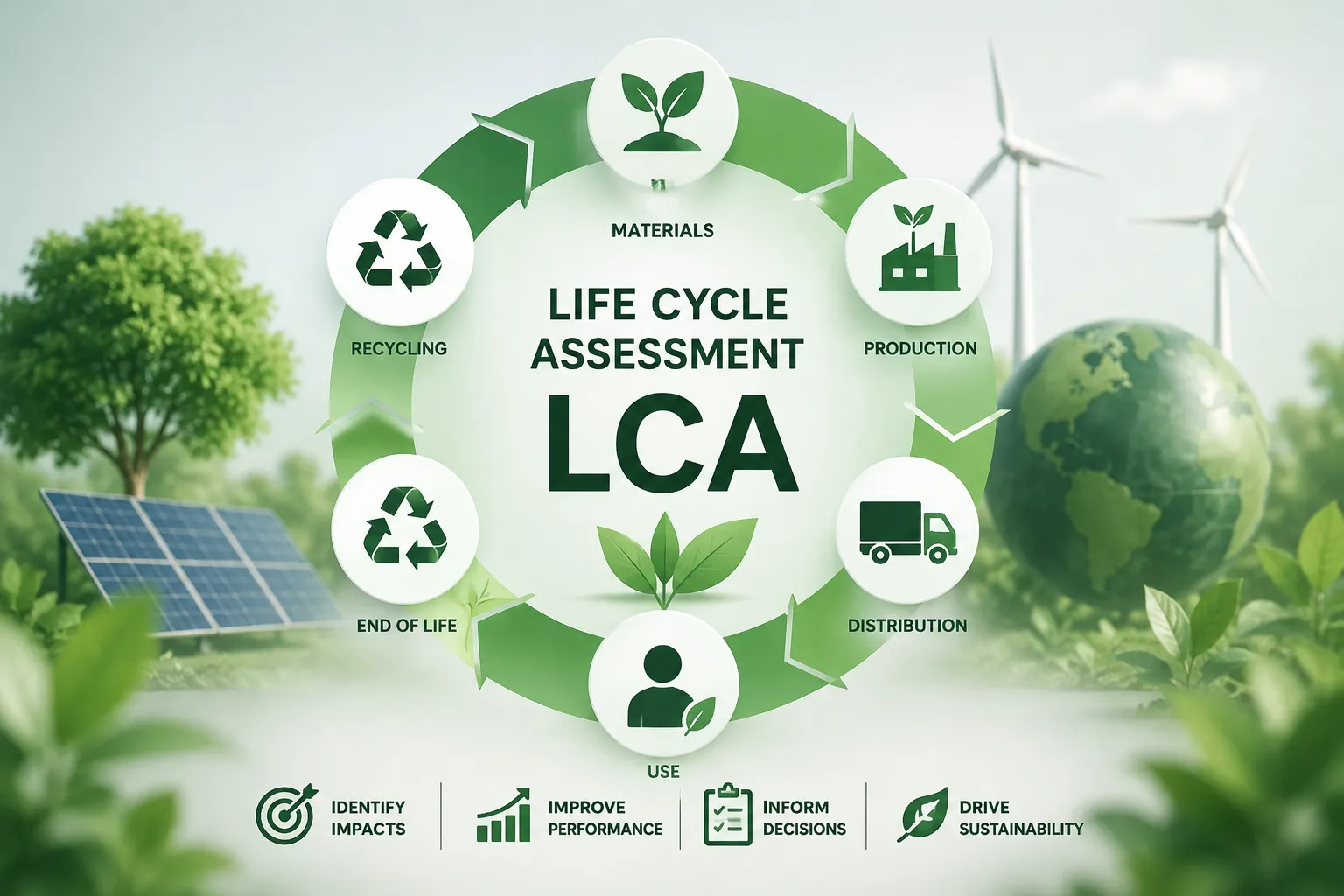
Consider a simple manufactured product. Its journey may involve extracting raw materials, processing those materials, manufacturing components, assembling the final product, packaging it, transporting it to customers, and eventually managing it at the end of its useful life.
Each stage can require resources and generate environmental impacts.
This is why focusing on only one stage can sometimes lead to incomplete conclusions. A material that performs well during manufacturing may have a comparatively high impact during extraction. Similarly, a lightweight product may reduce transportation impacts but require a more energy-intensive production process.
A lifecycle perspective helps businesses understand these relationships before making environmental decisions.
What Is Life Cycle Assessment?
Life cycle assessment is a systematic approach for evaluating the potential environmental impacts associated with a product, process, or service over its defined life cycle.
The boundaries of an assessment depend on its purpose. A study may examine a product from raw material extraction through disposal, or it may focus on selected stages that are particularly relevant to a specific business question.
An LCA life cycle assessment can consider information such as:
- Materials and resources used
- Energy consumption
- Manufacturing activities
- Transportation
- Water use
- Emissions
- Waste generation
- Product use
- End-of-life treatment
The objective is not simply to produce a large dataset. The real value comes from using that information to understand environmental performance and support better decisions.
Why LCA Is More Than a Carbon Footprint
Carbon emissions are an important part of environmental performance, but they do not represent every possible environmental impact.
A product can have a relatively low greenhouse gas footprint while still creating pressure through water consumption, resource extraction, land use, or other environmental pathways.
This is one of the strengths of lifecycle thinking. Instead of concentrating on a single environmental indicator, businesses can consider a wider range of potential impacts.
That broader view can reveal trade-offs that might otherwise be overlooked.
For example, replacing a material may reduce greenhouse gas emissions but increase another type of environmental pressure. Understanding such trade-offs allows businesses to make decisions based on evidence rather than assuming that an alternative is automatically better.
The Role of Life Cycle Impact Assessment
Once information about a product's inputs and outputs has been collected, it needs to be interpreted in an environmental context. This is where life cycle impact assessment becomes important.
Life cycle impact assessment connects inventory information with relevant environmental impact categories. Depending on the methodology used, an assessment may examine areas such as climate change, water-related impacts, resource use, acidification, or eutrophication.
The process helps answer a practical question: Which parts of the life cycle are contributing most significantly to the environmental impacts being assessed?
This can help businesses identify hotspots and understand where changes could potentially have the greatest effect.
For instance, a company may initially assume that its manufacturing facility is the primary source of environmental impact. A lifecycle study could instead show that the production of purchased materials is a much larger contributor. That finding could shift the company's attention toward material selection or supplier engagement.
How an LCA Study Is Typically Conducted
Although the details differ depending on the project, a structured LCA generally follows several key steps.
Defining the Purpose
Before collecting data, it is important to establish what the assessment is intended to achieve.
Is the business comparing two materials? Reviewing an existing product? Exploring opportunities for redesign? Understanding environmental performance across a supply chain?
The answer influences the boundaries, data requirements, and methodology of the study.
Building the Life Cycle Inventory
The next step is to gather relevant information about the system being assessed. This may include material quantities, energy consumption, transportation distances, production processes, emissions, water use, and waste.
Primary data from the organisation can be particularly useful, while appropriate secondary datasets may be used where direct information is unavailable.
Evaluating Environmental Impacts
The inventory information is then assessed against selected environmental impact categories. This is the stage where life cycle impact assessment provides meaning to the underlying inventory data.
The results can highlight which materials, processes, or lifecycle stages are particularly significant.
Interpreting the Findings
Finally, the results are reviewed in relation to the original purpose of the study. Limitations, assumptions, data quality, and potential uncertainties should be considered before concluding.
This final step is important because LCA results are most valuable when they can be translated into practical business decisions.
Where Businesses Can Use LCA
LCA can be useful well beyond environmental reporting. It can support decisions made during product development, procurement, manufacturing, packaging, and supply-chain management.
Product and Packaging Design
Environmental considerations can be introduced earlier in the design process by comparing different materials, components, or packaging options.
Rather than selecting an alternative based on one characteristic, businesses can examine its potential performance across relevant lifecycle stages.
Procurement and Supplier Decisions
The environmental impact of purchased materials can be significant for many businesses. Lifecycle information can help organisations understand where upstream impacts occur and identify areas for further supplier engagement.
Manufacturing Improvements
An assessment may reveal that certain production processes, energy sources, or material losses are contributing significantly to environmental impacts.
This information can help guide improvement initiatives and prioritise areas for investigation.
Strategic Sustainability Planning
Lifecycle results can also complement broader sustainability strategies. They provide a more detailed environmental perspective that can support decisions around products, resources, supply chains, and operational improvements.
Avoiding the Problem of Burden Shifting
One of the most valuable aspects of lifecycle thinking is its ability to highlight unintended consequences.
Imagine that a business replaces one material with another because the new option appears to have a lower environmental impact. If the alternative requires substantially more energy to produce, the environmental benefit may not be as significant as initially expected.
This is sometimes described as burden shifting—reducing an impact in one area while increasing another.
A properly designed LCA life cycle assessment can help identify these trade-offs and provide a more balanced basis for comparison.
What Makes an LCA Useful?
The quality of an assessment depends on more than the software or database used. Clear objectives, appropriate system boundaries, reliable data, consistent assumptions, and suitable impact assessment methods all matter.
It is also important to understand the limitations of the results. LCA is a decision-support tool, not a simple label that classifies a product as "good" or "bad" for the environment.
The most useful assessments are those that answer a clearly defined question and provide information that businesses can actually use.
How Impact HQ Can Support Your Sustainability Journey
For organisations that want to understand the environmental performance of their products or processes, specialist guidance can make the assessment more meaningful and easier to connect with broader sustainability objectives.
Impact HQ provides environmental and sustainability consulting services, including Life Cycle Assessment support. Its approach can help businesses examine relevant lifecycle stages, understand environmental hotspots, and use the findings to inform practical sustainability decisions.
LCA can be particularly valuable when it is connected to a wider strategy rather than treated as an isolated technical exercise.
Moving Towards Evidence-Based Sustainability
Sustainability decisions are becoming more complex. Businesses are expected to reduce environmental impacts while continuing to manage cost, quality, supply-chain requirements, customer expectations, and operational priorities.
Making these decisions based on assumptions can create unintended outcomes. Lifecycle analysis provides a way to bring more evidence into the process.
By understanding where impacts occur and how different choices affect the overall lifecycle, businesses can identify improvement opportunities with greater confidence.
Frequently Asked Questions
What is life cycle assessment used for?
Life cycle assessment is used to evaluate potential environmental impacts across the life cycle of a product, process, or service. It can help organisations compare alternatives, identify hotspots, and explore improvement opportunities.
What is included in an LCA?
Depending on the study scope, an LCA can include raw material extraction, material processing, manufacturing, transportation, product use, waste management, and end-of-life treatment.
What is life cycle impact assessment?
Life cycle impact assessment is the part of an LCA process that evaluates inventory data against selected environmental impact categories, helping businesses understand the potential significance of different environmental flows.
Is LCA the same as a carbon footprint assessment?
No. A carbon footprint generally focuses on greenhouse gas emissions, while LCA can examine a broader range of environmental impact categories depending on the purpose and methodology of the study.
How can LCA help product manufacturers?
Manufacturers can use LCA to compare materials, identify environmental hotspots, evaluate design alternatives, improve processes, and understand potential impacts throughout a product's lifecycle.
Why is lifecycle thinking important?
Lifecycle thinking helps businesses avoid focusing on a single stage or environmental indicator. It provides a broader view that can reveal trade-offs and prevent environmental burdens from simply being shifted elsewhere.
Can small and medium-sized businesses use LCA?
Yes. The scope of an assessment can be designed around the organisation's objectives, available data, product complexity, and intended use of the results. A clearly defined study can provide useful insights without necessarily assessing every possible lifecycle detail.
How can Impact HQ help with Life Cycle Assessment?
Impact HQ provides sustainability and environmental consulting support, including Life Cycle Assessment services, to help organisations understand product and process impacts and use lifecycle insights to support better environmental decisions.
Conclusion
A product's environmental footprint does not begin when it leaves a factory, nor does it end when a customer finishes using it. Its environmental story can extend across raw materials, manufacturing, transportation, use, and end-of-life management.
Life cycle assessment provides a structured way to examine this complete picture. Through life cycle impact assessment, businesses can gain a clearer understanding of the environmental significance of different activities and identify potential hotspots.
For organisations looking to make more informed environmental decisions, an LCA life cycle assessment can provide valuable evidence for product development, procurement, supply-chain management, and sustainability planning.
The goal is not simply to measure environmental impact. It is to understand it well enough to make better decisions.




















Sign in to leave a comment.