
The UAE’s logistics industry is expanding rapidly, creating a growing need for reliable digital solutions that can manage shipments, fleets, warehouses, and deliveries. As businesses move away from spreadsheets and disconnected systems, custom logistics software is becoming an important investment for improving operational visibility, reducing manual work, and supporting faster decision-making.
From transportation companies and fleet operators to third-party logistics providers, businesses are adopting technology to streamline daily operations and improve customer experiences. But how much does logistics software development cost in the UAE in 2026? The answer depends on the software’s features, complexity, integrations, development approach, and scalability requirements.
Estimated Logistics Software Development Cost in UAE
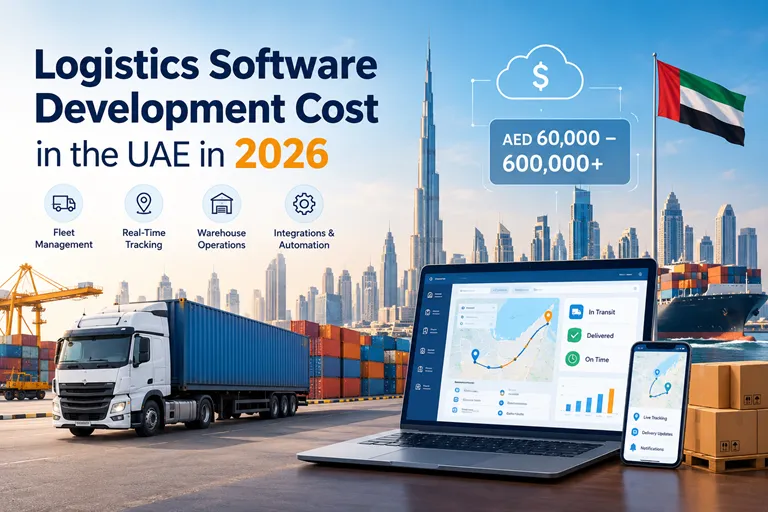
For most custom projects, logistics software development in the UAE can broadly range from AED 60,000 to AED 600,000 or more. These are approximate estimates, and the actual cost will depend on the project scope and technical specifications.
Estimated cost breakdown
| Software Type | Estimated Cost |
| Basic logistics software | AED 60,000–120,000 |
| Mid-level logistics platform | AED 120,000–300,000 |
| Enterprise logistics software | AED 300,000–600,000+ |
A basic application may include shipment management, driver tracking, delivery notifications, dashboards, and electronic proof of delivery. A mid-level platform may add route planning, warehouse management, customer portals, advanced reporting, and ERP integrations.
Enterprise-level solutions can connect transportation management, warehouse management, fleet systems, billing, telematics, and analytics into one unified platform. These systems often require more extensive planning, testing, and infrastructure.
What Influences Logistics Software Development Costs?
Several factors determine the final development budget:
1. Features and Functionalities
Shipment tracking, dispatch management, route optimization, inventory visibility, automated alerts, invoicing, and delivery confirmation each add development complexity. The number of workflows and the level of automation required will directly affect the project timeline and cost.
2. Mobile and Web Applications
Businesses may require separate interfaces for administrators, drivers, warehouse teams, customers, and logistics managers. Driver apps may also need GPS tracking, barcode scanning, digital signatures, push notifications, and offline functionality, increasing development and testing requirements.
3. Third-Party Integrations
Connecting the software with ERP systems, accounting platforms, ecommerce applications, mapping services, payment gateways, and telematics providers can significantly affect costs. API availability, subscription fees, data synchronization, and integration complexity should be considered during planning.
4. AI and IoT Capabilities
Advanced features such as predictive maintenance, demand forecasting, AI-assisted route optimization, and real-time vehicle telemetry require additional data infrastructure and engineering. These capabilities can improve efficiency but may increase the initial investment.
5. Security and Scalability
Encryption, access controls, audit logs, backups, monitoring, and disaster recovery are essential for systems handling customer, driver, and shipment data. A scalable cloud architecture also helps the software support growing transaction volumes and users.
How Businesses Can Manage Development Costs
A practical approach is to begin with the most important operational problem instead of building every feature at once. For example, a logistics company may initially prioritize fleet tracking, dispatch, and electronic proof of delivery before expanding into warehouse automation or predictive analytics.
A well-defined Minimum Viable Product (MVP) helps businesses validate workflows, collect user feedback, and control initial costs. A modular architecture can also make it easier to add new integrations and capabilities as the business grows.
Businesses should evaluate not only the initial development quote but also maintenance, cloud infrastructure, third-party API charges, security updates, and long-term ownership costs. Comparing vendors based on technical expertise, industry experience, delivery methodology, and post-launch support can help establish a more realistic budget.
Final Thoughts
Logistics software development in the UAE requires careful planning around business workflows, integrations, real-time data, and future scalability. Whether a company needs a focused fleet application or an enterprise logistics ecosystem, the right solution should address current operational challenges while supporting long-term growth.




















Sign in to leave a comment.