
Introduction
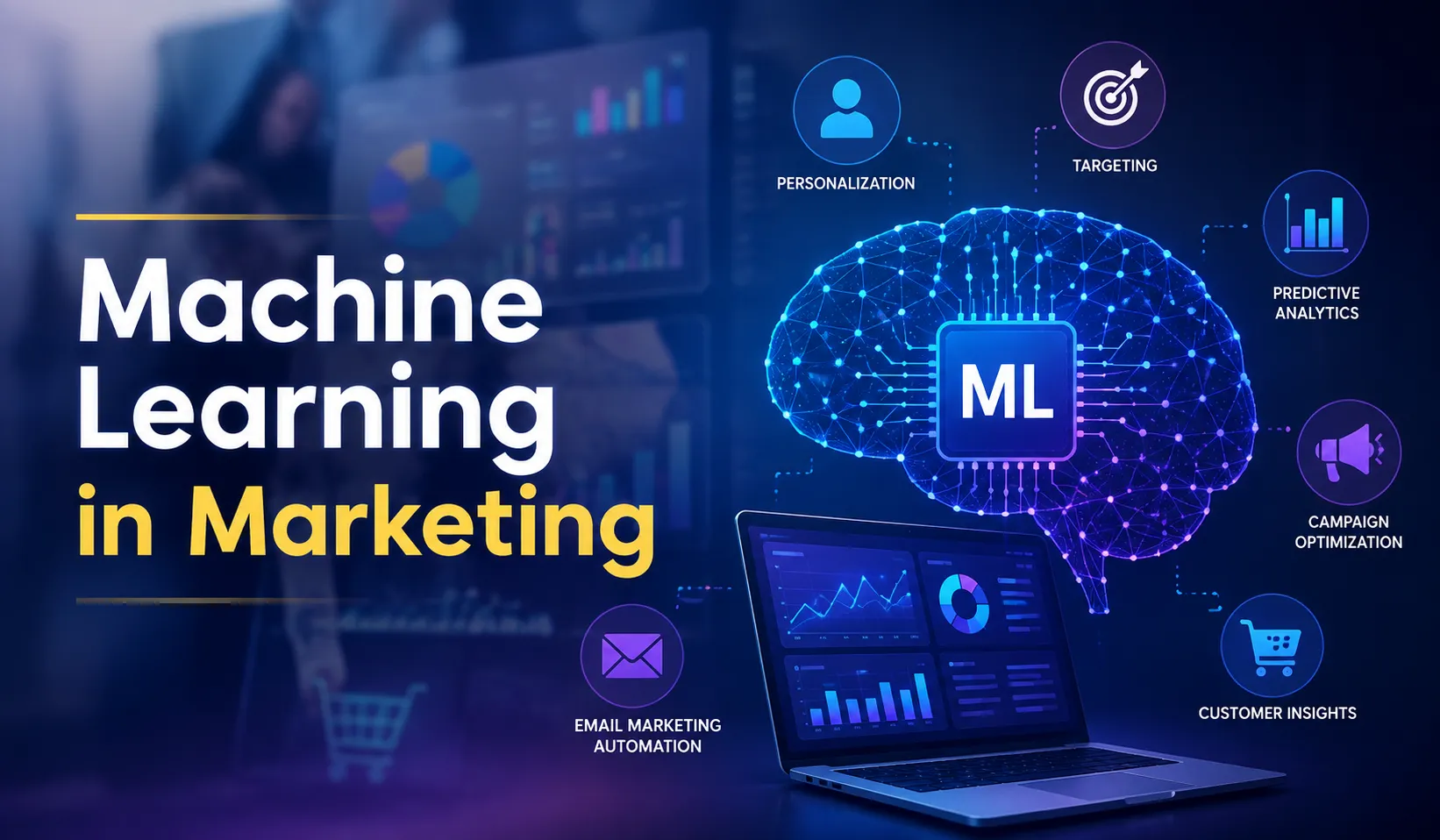
Marketing has changed dramatically over the last decade. Today, businesses have access to vast amounts of customer data, making it easier to understand consumer preferences and buying behavior. However, analyzing this information manually is time-consuming and often inefficient. This is where machine learning in marketing makes a real difference. Machine learning enables businesses to process large datasets, identify meaningful patterns, and make data-driven decisions faster than ever before. Whether it's delivering personalized product recommendations, predicting customer behavior, or automating marketing campaigns, machine learning helps brands create more engaging customer experiences while improving overall marketing performance. As digital competition continues to grow, businesses that leverage machine learning gain a significant advantage by making smarter decisions, improving campaign effectiveness, and maximizing return on investment (ROI).
What is Machine Learning in Marketing?
Machine learning in marketing is the use of artificial intelligence (AI) algorithms to analyze customer data and continuously improve marketing activities. Instead of relying on fixed rules, these algorithms learn from historical and real-time data to identify trends, predict customer behavior, and automate decision-making. By studying factors such as browsing history, purchase behavior, demographics, and customer interactions, machine learning helps marketers deliver personalized content, optimize advertising campaigns, and improve customer engagement across multiple channels.
Benefits of Machine Learning in Marketing
Personalized Customer Experiences
Customers expect brands to understand their preferences. Machine learning analyzes user behavior to recommend relevant products, personalize emails, and display targeted advertisements. This creates a more engaging customer experience while increasing conversions.
Improved Customer Segmentation
Traditional customer segmentation often groups users based on age or location. Machine learning goes much deeper by analyzing purchasing habits, browsing activity, and customer interests, allowing businesses to create highly targeted marketing campaigns.
Predictive Analytics
Machine learning helps businesses anticipate customer needs before they happen. By analyzing historical data, it predicts purchasing behavior, identifies future trends, and enables marketers to make better strategic decisions.
Marketing Automation
Many repetitive marketing tasks, including email scheduling, audience targeting, campaign optimization, and reporting, can be automated with machine learning. This saves valuable time while improving overall efficiency.
Better Return on Investment (ROI)
Machine learning continuously analyzes campaign performance and optimizes marketing efforts in real time. Businesses can reduce unnecessary advertising spend, improve targeting accuracy, and achieve higher returns on their marketing investments.
Key Use Cases of Machine Learning in Marketing
Product Recommendations
Online retailers use machine learning to recommend products based on customer preferences and previous purchases. Personalized recommendations encourage additional purchases and improve customer satisfaction.
Predictive Lead Scoring
Not every lead has the same potential to become a customer. Machine learning evaluates customer data and ranks leads based on their likelihood of converting, helping sales teams focus on high-value opportunities.
Dynamic Pricing
Businesses can automatically adjust product pricing based on demand, customer behavior, competitor pricing, and market trends. This allows companies to stay competitive while maximizing revenue.
Customer Churn Prediction
Machine learning identifies customers who may stop using a product or service by analyzing behavioral patterns. Businesses can then take proactive steps to improve retention through personalized offers or engagement strategies.
Sentiment Analysis
By analyzing customer reviews, social media conversations, and online feedback, machine learning helps businesses understand how customers feel about their products or services. These insights support better marketing and product decisions.
AI-Powered Chatbots
Machine learning enables chatbots to answer customer questions, resolve common issues, and provide instant support around the clock. This improves customer satisfaction while reducing the workload for support teams.
How Machine Learning Improves Marketing Campaigns?
One of the biggest advantages of machine learning is its ability to optimize marketing campaigns in real time. Instead of waiting until a campaign ends, marketers can monitor performance continuously and make immediate adjustments based on customer responses.
Machine learning helps businesses identify the best-performing marketing channels, improve audience targeting, optimize advertising budgets, and increase conversion rates. As a result, campaigns become more efficient, data-driven, and profitable.
Challenges of Implementing Machine Learning in Marketing
While machine learning offers significant benefits, successful implementation requires careful planning. Businesses commonly face challenges such as maintaining high-quality customer data, protecting user privacy, integrating AI with existing marketing platforms, and managing implementation costs. Another challenge is finding skilled professionals who understand both machine learning and digital marketing. Partnering with an experienced technology provider can help businesses overcome these obstacles and ensure successful implementation.
Future Trends of Machine Learning in Marketing
Machine learning is expected to play an even bigger role in the future of digital marketing. Businesses are increasingly adopting hyper-personalization, AI-generated content, predictive customer analytics, voice search optimization, and intelligent marketing automation. The combination of machine learning with generative AI is also creating new opportunities for personalized content creation, automated customer engagement, and smarter marketing strategies. As technology continues to evolve, businesses that embrace these innovations will be better equipped to meet changing customer expectations and stay ahead of the competition.
Why Choose Moon Technolabs?
Moon Technolabs helps businesses harness the power of AI and machine learning to build smarter marketing solutions. With over 16 years of experience in custom software development, our team develops scalable, secure, and intelligent applications tailored to unique business needs. From AI-powered recommendation engines and predictive analytics to marketing automation platforms and customer engagement solutions, we deliver innovative technologies that help businesses improve marketing performance, enhance customer experiences, and achieve long-term growth. Our agile development process, transparent communication, and commitment to quality make us a trusted technology partner for digital transformation.
Conclusion
Machine learning is changing the way businesses approach marketing by turning large volumes of customer data into meaningful insights. From personalized recommendations and predictive analytics to campaign automation and customer retention, it enables marketers to make faster, smarter, and more informed decisions. As customer expectations continue to evolve, adopting machine learning in marketing is becoming essential for businesses that want to stay competitive. Organizations that invest in AI-powered marketing today will be better positioned to improve customer engagement, optimize campaign performance, and drive sustainable business growth in the years ahead.






















Sign in to leave a comment.