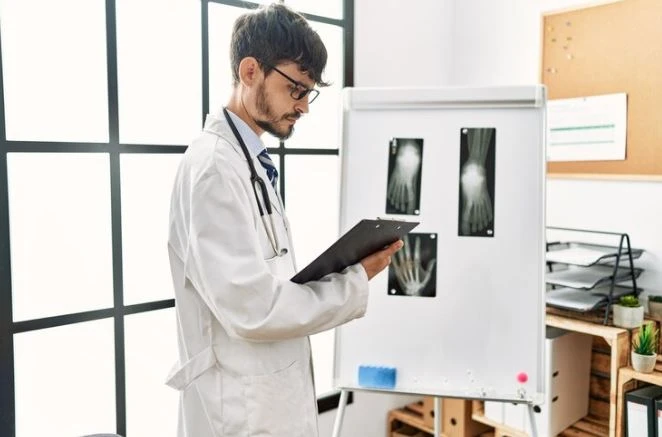

The world of medical imaging relies on a skilled team, and X-ray technicians play a vital role in capturing clear and accurate X-ray images. Here at the Council of Education and Development Programmes (CEDP), we understand the importance of proper equipment handling for X-ray technicians. After all, using these machines safely and efficiently is crucial for both patient care and your own well-being.
Understanding Your X-Ray Arsenal
There are two main types of X-ray machines you\'ll encounter: stationary and portable. Stationary units are typically found in radiology departments and offer a wider range of positioning options. Portable X-ray machines, on the other hand, are designed for use at patients\' bedsides or in emergency situations.
Beyond the main unit, you\'ll also work with various X-ray equipment:
- X-ray tube: This is the heart of the machine, generating the X-ray beam that passes through the body.
- Collimator: This device helps control the size and direction of the X-ray beam, minimizing unnecessary radiation exposure.
- Cassette or detector panel: This captures the X-ray image after it passes through the patient.
- Patient positioning aids: Sandbags, wedges, and other tools help position patients for optimal image acquisition.
- Lead aprons and gloves: These essential personal protective equipment (PPE) shields you from radiation scatter.
Lifting with Care: Proper Equipment Handling Techniques
X-ray equipment can be heavy, so proper lifting techniques are essential to prevent injuries. Here are some key points to remember:
- Plan your lift: Assess the weight and awkwardness of the equipment before moving it.
- Bend at the knees, not your back: Keep your back straight and core engaged as you lift.
- Get help for heavy equipment: Don\'t hesitate to ask a colleague for assistance with particularly heavy pieces.
- Use proper lifting aids: Lifting carts or straps can significantly reduce strain on your body.
Maintaining a Safe and Efficient Workflow
Beyond lifting, proper equipment handling involves creating a smooth workflow:
- Organize your workspace: Keep cassettes, collimators, and other frequently used items within easy reach.
- Perform routine checks: Ensure all equipment is functioning correctly before each use. Report any malfunctions immediately.
- Clean and disinfect: Regularly clean surfaces that come into contact with patients to prevent the spread of infection.
Prioritizing Your Safety: Radiation Protection
X-ray machines emit ionizing radiation, which can be harmful if not managed properly. Here\'s how to protect yourself:
- Minimize exposure time: Keep the time patients are exposed to radiation as low as reasonably achievable (ALARA principle).
- Maintain distance: Stand as far away from the X-ray source as possible during image acquisition.
- Wear your PPE consistently: Lead aprons and gloves are your first line of defense against radiation scatter.
- Monitor your radiation dose: Wear a dosimeter badge to track your radiation exposure and ensure adherence to safety limits.
Investing in Your Success
By mastering proper equipment handling techniques, you\'ll contribute to a safe and efficient X-ray department. Here at CEDP, we are committed to providing educational resources and training programs to equip X-ray technicians with the necessary skills to excel in their field. Remember, taking care of the equipment and yourself is an investment in your long-term success as a valuable member of the healthcare team.




























Sign in to leave a comment.