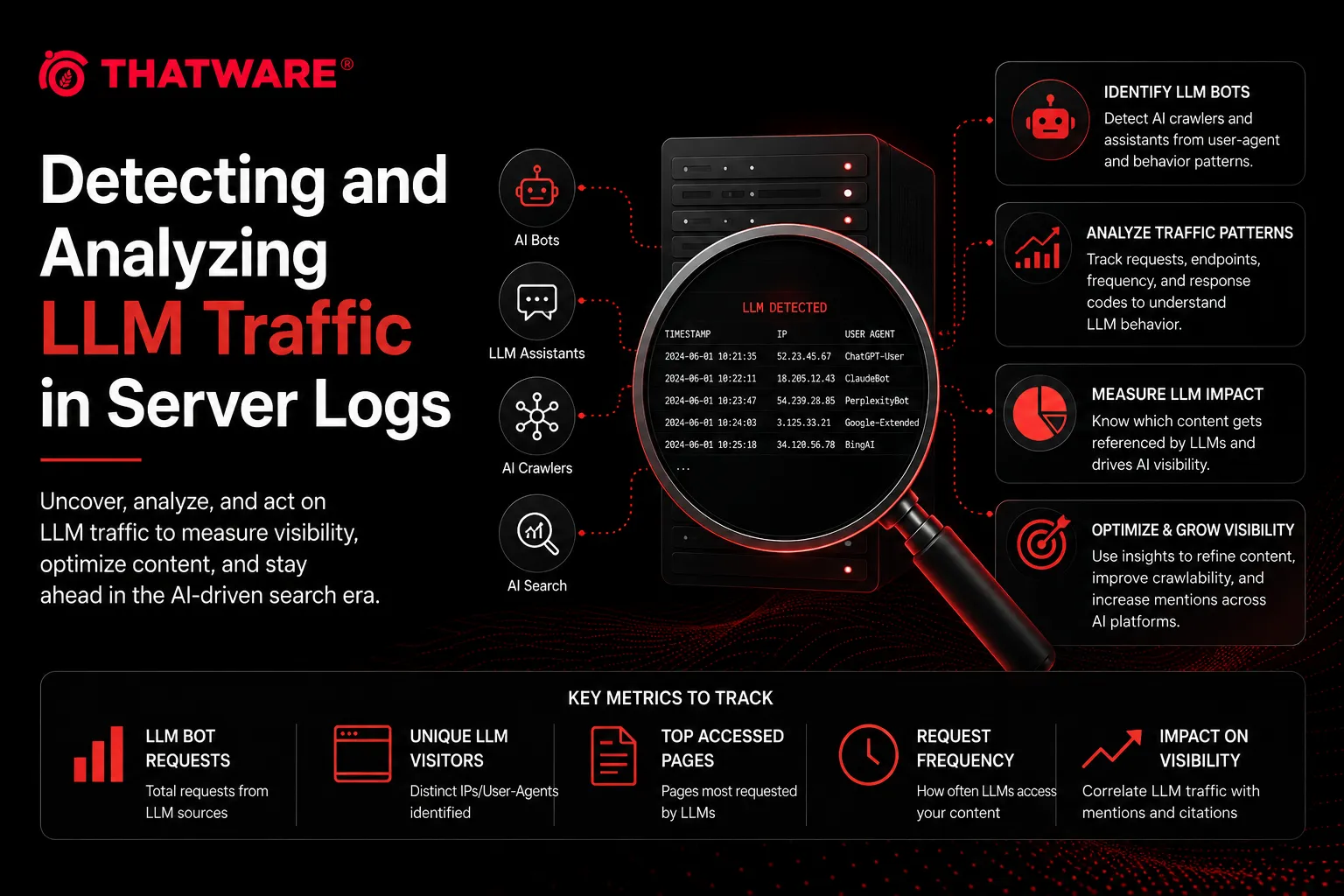

The way people discover information online is changing rapidly. Traditional search engines are no longer the only gateways to websites. Large Language Models (LLMs) such as ChatGPT, Gemini, Claude, and Perplexity are increasingly becoming information intermediaries, influencing how users find brands, products, and services.
As AI-powered search continues to expand, businesses are facing a new challenge: understanding when and how AI systems interact with their websites. This has made detecting and analyzing LLM traffic in server logs a critical component of modern digital marketing strategies.
Organizations investing in LLM SEO services are beginning to recognize that visibility within AI-generated responses can be just as important as rankings in traditional search engines. However, without proper monitoring and analysis, valuable insights about AI crawler behavior remain hidden.
This article explores the importance of LLM traffic analysis, how businesses can identify AI-driven visits in server logs, and why advanced reporting is becoming essential for measuring digital visibility in the age of artificial intelligence.
Understanding LLM Traffic and Its Growing Importance
LLM traffic refers to visits, crawls, and interactions generated by artificial intelligence systems that gather, analyze, or reference website content. These interactions may come from AI crawlers, retrieval systems, indexing bots, or content discovery mechanisms used by large language models.
Unlike conventional search engine bots, AI crawlers often operate differently. Their objective is not only to index web pages but also to understand context, relationships, and semantic meaning.
As more consumers use AI assistants to answer questions, recommend products, and summarize information, businesses need visibility into how these systems access and interpret their content.
The rise of AI-driven discovery has significantly increased demand for specialized LLM SEO services, helping organizations understand their presence within emerging AI ecosystems.
Why Traditional Analytics Are No Longer Enough
Most website analytics platforms focus on human visitors and conventional search traffic. While these tools provide valuable insights, they often fail to identify the growing volume of AI-related activity.
Server logs contain a wealth of information that can reveal:
- AI crawler visits
- Frequency of content retrieval
- Crawl patterns across website sections
- Resource consumption
- Indexing behavior
- AI platform interactions
Without proper log analysis, businesses may struggle to understand whether their content is being discovered and utilized by large language models.
This gap in visibility creates challenges when measuring return on investment from LLM SEO services and AI-focused optimization efforts.
How LLM Crawl Tracking Works
One of the most effective methods for measuring AI visibility is through LLM crawl tracking. This process involves monitoring server logs for signatures associated with AI bots and language model crawlers.
By analyzing user agents, IP patterns, request frequencies, and content access behaviors, businesses can identify interactions from AI systems.
Advanced LLM crawl tracking enables organizations to determine:
Which pages receive the most AI crawler attention.
How frequently AI systems revisit content.
Whether important resources are accessible to language model crawlers.
Which content categories are most valuable for AI retrieval systems.
Potential technical barriers affecting AI discoverability.
As AI search continues to evolve, LLM crawl tracking provides the foundation needed to understand how content performs beyond traditional search engine rankings.
Key Metrics Businesses Should Monitor
Measuring AI visibility requires a different set of performance indicators than conventional SEO campaigns.
Modern reporting frameworks increasingly focus on metrics such as crawler frequency, AI referral patterns, content retrieval rates, citation opportunities, and visibility trends across major language model platforms.
These emerging reporting methodologies help marketers connect AI visibility with broader business objectives.
Businesses utilizing professional LLM SEO services often combine technical log analysis with strategic reporting to gain a more complete understanding of their digital footprint.
Common Challenges in Detecting AI Traffic
Despite growing interest in AI visibility, identifying LLM-related traffic remains challenging.
Many AI systems use varying crawler identities, while others access content through third-party retrieval mechanisms. Some interactions may appear similar to conventional bot traffic, making classification difficult.
Additionally, AI platforms continuously evolve their crawling and indexing methods. What works today may require updates tomorrow.
Organizations must therefore adopt flexible monitoring systems capable of adapting to new AI technologies and crawler behaviors.
This is where experienced providers of LLM SEO services can offer significant value by maintaining updated detection methodologies and monitoring frameworks.
The Role of Server Logs in AI Visibility Analysis
Server logs remain one of the most reliable sources of information for understanding AI interactions.
Unlike analytics platforms that rely on tracking scripts, server logs capture every request reaching the web server. This creates a comprehensive record of crawler activity.
By leveraging server log analysis, businesses can uncover insights such as:
Content frequently accessed by AI crawlers.
Areas of the website receiving limited AI attention.
Technical issues preventing crawler access.
Emerging AI platforms interacting with website content.
Long-term trends in AI-driven discovery.
These insights form the foundation of effective LLM crawl tracking initiatives and support data-driven optimization strategies.
Why Businesses Are Investing in LLM SEO Services
Recent industry trends indicate that AI-generated search experiences are becoming increasingly influential in customer decision-making.
As consumers rely more heavily on conversational AI tools, brands must ensure their content is visible, accessible, and understandable to large language models.
Professional LLM SEO services help organizations:
Improve AI discoverability.
Optimize content for language model understanding.
Monitor crawler activity.
Measure AI visibility growth.
Develop reporting frameworks aligned with business goals.
Identify opportunities for enhanced AI citations and references.
Companies that invest early in AI-focused optimization may gain competitive advantages as AI-powered search adoption continues to expand globally.
How ThatWare LLP Helps Businesses Adapt
As a leader in AI-driven digital marketing innovation, ThatWare LLP has been at the forefront of developing advanced optimization strategies for emerging search technologies.
The company's expertise in LLM SEO services helps businesses navigate the evolving relationship between traditional SEO and AI-powered search ecosystems.
Through advanced analytics, technical optimization, and comprehensive LLM crawl tracking, ThatWare LLP assists organizations in understanding how language models interact with their digital assets and how they can improve visibility across AI platforms.
The Future of AI Search Visibility
The shift toward AI-assisted information discovery represents one of the most significant changes in the history of digital marketing.
As large language models continue to influence how users access information, businesses must move beyond conventional analytics and embrace new measurement approaches.
Detecting and analyzing LLM traffic in server logs is no longer a niche technical exercise. It is becoming an essential practice for organizations seeking to maintain visibility in an increasingly AI-driven internet.
The ability to measure crawler behavior, understand AI interactions, and implement effective LLM SEO services will play a crucial role in future digital success.
Conclusion
AI-powered search is transforming how users discover content online. As this shift accelerates, businesses need better tools and methodologies to understand their visibility within large language model ecosystems.
Detecting and analyzing server log data through effective LLM crawl tracking provides critical insights into AI crawler behavior, content accessibility, and emerging discovery opportunities. Combined with advanced LLM SEO services, organizations can build stronger digital strategies that align with the future of search.
To learn more about measuring AI visibility and improving your presence across language model platforms, visit ThatWare LLP and explore cutting-edge solutions designed for the next generation of search.




























Sign in to leave a comment.