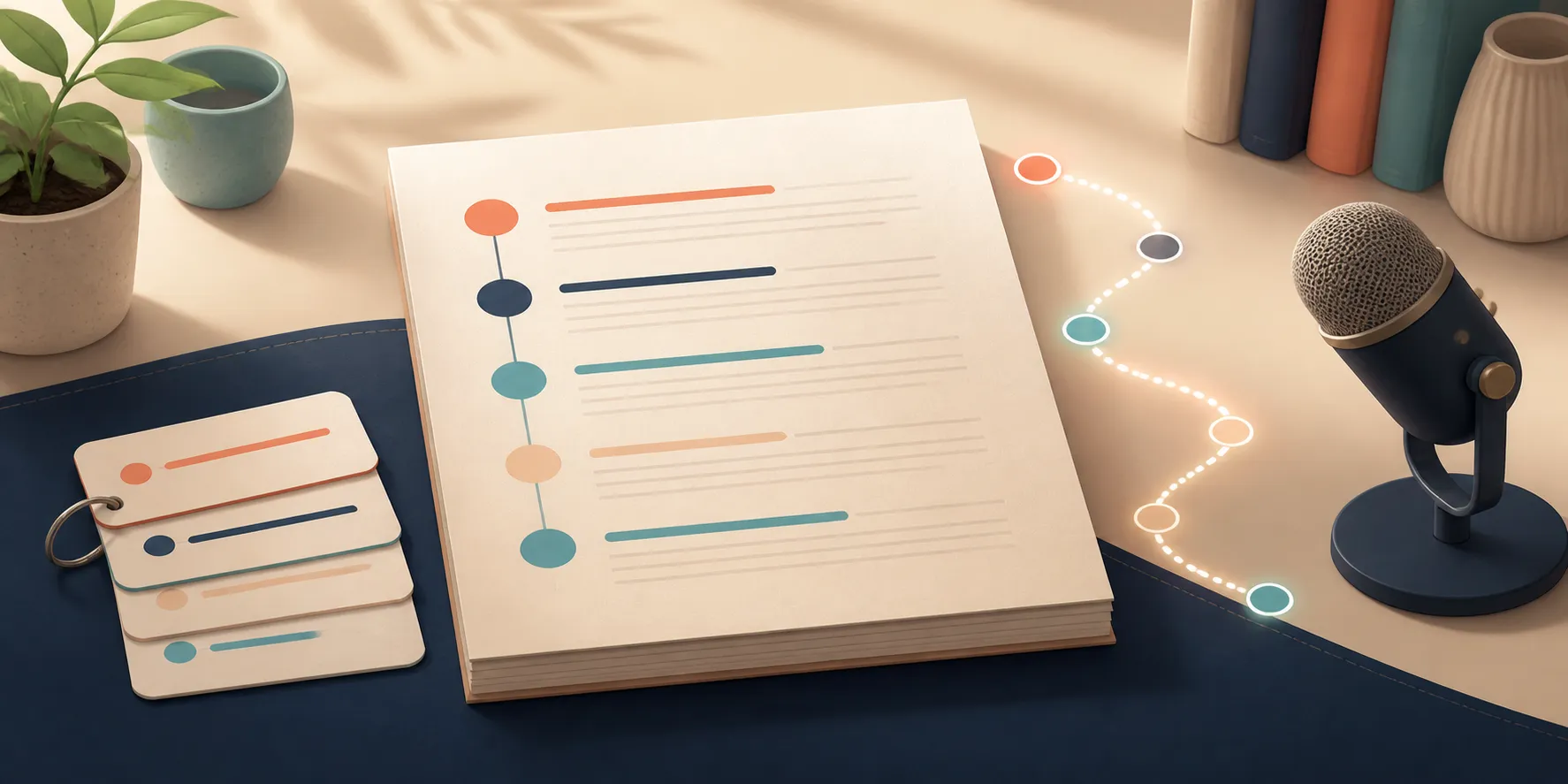

I had eight minutes of material and about ninety seconds of memory.
This was a best man speech. I'd read it on my phone maybe forty times on the drive up and thought that counted as practice. Two lines in, my brain handed me nothing. The speech turned out fine after an awkward pause, but the twenty seconds where I had no idea what came next stayed with me longer than the rest of the night.
The mistake wasn't nerves. It's that rereading a script feels like learning and mostly isn't. That gap is why I eventually built Memorize Speech.
Why rereading fails
By the twentieth read, you recognize your words rather than know them. Recognition feels great and predicts almost nothing, because on stage nobody hands you the text to recognize. You have to produce it from an empty page.
The fix has a boring name: retrieval practice. You get better at recalling something by recalling it, script face down. And spacing beats cramming, so six thirty-minute sessions across a week beat one six-hour night, even though the total is identical.
How to memorize a speech: four stages
Learn the structure before the words. Write down the skeleton, not sentences. Open with the airport story, then Chicago, then the toast. Five or six beats for ten minutes. Now if a sentence vanishes mid-speech you don't need that sentence, you need to know you're between beat three and beat four. Pay special attention to the seams between sections, because that's where people actually get lost.
Cut the script down to cues. "Airport, 2am, wrong terminal" is a cue. "I want to tell you about the time we met at the airport" is a sentence you're still reading. Sparse cues feel too thin to be useful, which is the point: they force retrieval instead of letting you read.
Test yourself, don't review. Script out of sight, say the section out loud, then check what you missed. Out loud matters more than people expect, since your mouth has its own things to learn about a sentence. Better still, answer questions cold: "what are the three reasons I give for the budget increase?" is harder than glancing at a cue card, and closer to what your brain has to do when you lose your place. One habit to break: don't restart from the top every time you stumble, or you'll build a speech you can only deliver from the beginning. Practice starting from the middle of section four.
Review on a schedule. Today, tomorrow, two days later, the day before. Each pass shorter, each one starting with a test. Do the final full run the morning before, then leave it alone.
Where the speech memorizer comes in
All of that works if you do it. The catch is that building cue cards is thirty minutes of manual work, and writing recall questions about material you already know is a strange thing to ask of yourself.
That's the gap the tool fills. Paste your script, say whether the talk is tomorrow or next week, and about twenty seconds later you have:
- A Memory Blueprint with your sections, key points, and transitions
- Cue Cards that reduce each section to a prompt
- Recall Questions for testing yourself before you check the original
- A timed review schedule based on how long you actually have
It takes pasted text or .txt, .md, .docx, and text-based PDFs, keeps the original passage next to the blueprint, and exports to PDF for the cards you want in your pocket. The deadline setting is the part I use most: a plan for tomorrow morning and a plan for next Thursday shouldn't look the same, and I used to guess at that every time.
Pricing is one-time, not a subscription, since most people are memorizing a speech for one specific Saturday. Two free plans to try it, no card.
Students with a graded presentation use it, along with professionals prepping a keynote or business update, debaters, job seekers, and a steady stream of wedding speeches. Interviews are the interesting case: you don't want word-for-word there, just the blueprint and the specifics, so you can rebuild the answer around whatever they actually asked.
The honest version
A speech memorizer doesn't memorize the speech. You still have to say the words out loud, alone, badly, several times.
What it removes is the setup, which is the part that stops people. Nobody skips rehearsal because saying a speech out loud is hard. They skip it because building cue cards at 9pm on a Tuesday feels like a project, so they reread the script on their phone and call it practice. I know, because I did exactly that on a drive to a wedding.
If you've got something coming up, paste your script and see what the plan looks like. Then go say it out loud.























Sign in to leave a comment.