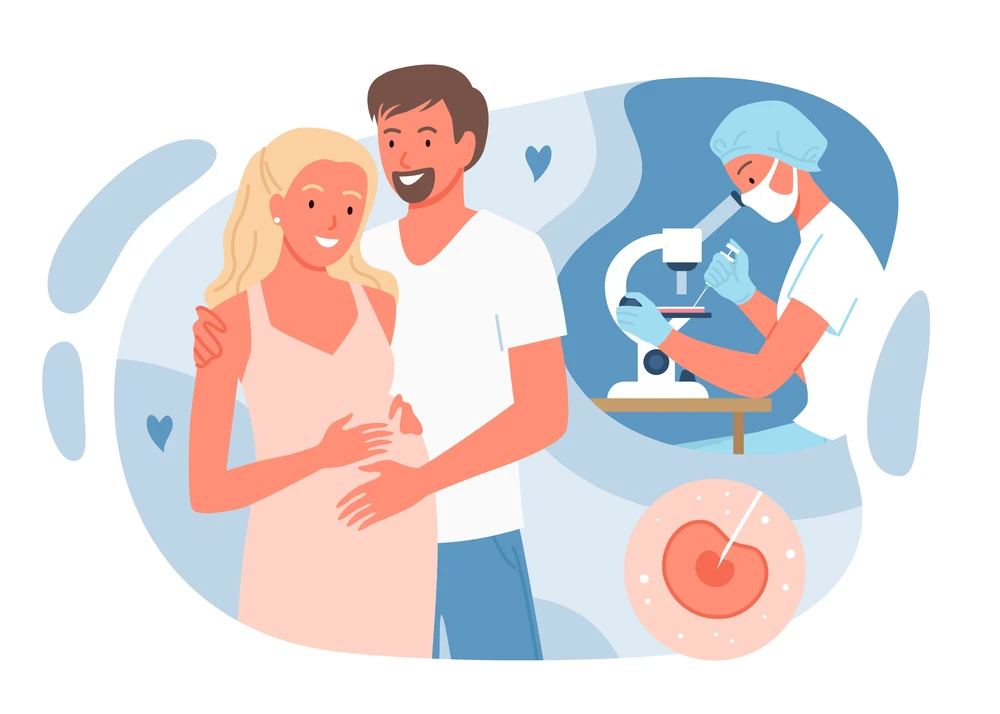

Wondering who suffers more from infertility either men or women? This article can help you find out.
This article briefly discusses male infertility, female infertility, male vs female’s contribution to infertility cases, along with how male and female infertility can be treated effectively.
What is male infertility?
Male infertility is a a male’s incapablity of inducing conception through sexual intercourse. It is when a male’s sperm cannot fertilize the female partner’s egg successfully, resulting in a failed pregnancy attempt. There are a number of causes that contribute to male infertility that include:
Azoospermia (absence of sperm)
One of the common causes that causes a male to be incapable of inducing conception successfully by fertilizing the female partner’s mature egg is azoospermia. Azoospermia is a male reproductive health condition where there is an absolute absence of sperm in the ejaculated semen. It may be a result of a blockage preventing the sperm from ejaculating with semen or an abnormal ejaculation condition called retrograde ejaculation where the semen goes into the bladder rather than ejaculating from the penis during orgasm.
Oligospermia (low sperm count)
Oligospermia is another male infertility cause which is more common than other male infertility causes. Oligospermia is a condition where the ejaculated semen contains sperm less than normal. Normally, sperm count above 15 million healthy sperms per ml of semen or 39 million healthy sperms per ejaculation is considered adequate to fertilize the female partner’s egg and induce conception successfully. Men having fewer sperm counts than mentioned above are affected by oligospermia.
Abnormal sperm function
Abnormal sperm function as a part of male infertility can be defined as a male’s sperm having a head or trail defect such as sperm having a deformed or larger head or a curved or double tail. Abnormal sperm function also includes poor sperm motility. To be able to fertilize an egg successfully, healthy sperm must have a forward progression of at least 25 micrometres per second. Poor sperm motility can be defined as a condition when sperms’ forward progression is less than the distance mentioned above.
What is female infertility?
Female infertility can be defined as a female’s reproductive inability to achieve a healthy pregnancy regardless of having unprotected sex for about a year. Female infertility is when a female is not capable to achieve fertilization or sustain a healthy pregnancy due to some certain reproductive condition that include:
Women with infrequent ovulation
Women who have irregular periods or menstrual cycles have an infrequent ovulation cycle as well. When a woman is not ovulating regularly in her reproductive age, it may result in failed conception attempts.
Low egg reserve or poor egg quality
Women are most fertile from their early to late 20s. As women age, they tend to have a significant decline in their ovarian egg reserve and egg quality. This affects their chances of attaining a healthy pregnancy and being able to sustain it.
Infertility disorders
Certain female reproductive disorders such as blockage in fallopian tubes (fertilized egg cannot travels down to the uterus to attach to the uterine lining and start developing), endometriosis (abnormal growth of endometrium tissue outside the uterus) and polycystic ovary syndrome (PCOS) (hormonal imbalance that causes irregular periods) can affect a female’s chances of attaining and sustaining a healthy pregnancy too.
What do the statistics tell about male vs female’s contribution to Infertility cases?
According to a report issued by PubMed Central (PMC), infertility estimatedly affects about 15% of couples in which males are found solely responsible for only 20 to 30% infertility cases. Males’ contribution in overall infertility cases are 50% which also involves some degree of female infertility. Therefore, it is very obvious that women suffer more from fertility issues.
How can male and female infertility be treated?
With advancement in health technology, there are a number of medical and clinical procedures that can help both men and women with fertility issues conceive successfully and have a child. These fertility treatments include:
IUI
Intrauterine insemination (IUI) is a clinical pregnancy procedure called an assisted reproductive technology (ART) that involves inseminating washed and concentrated sperm directly into the uterus around the period of ovulation to improve conception chances. Women with blocked fallopian tubes and men with oligospermia are best candidates for IUI treatment.
IVF
In-vitro fertilization (IVF) is another ART which involves collecting the female’s mature egg and fertilizing it with the intended father’s sperm in a lab. Then the fertilized egg is transferred back to the uterus around the uterine lining so that the egg attaches to the lining and pregnancy begins. Women with blocked fallopian tubes, irregular ovulation, endometriosis, PCOS and men with oligospermia and azoospermia are best candidates for IVF treatment in Jammu. Couples with reproductive abnormalities can also consider IVF with donor egg, sperm or embryos.
ICSI
Intracytoplasmic sperm injection (ICSI) is a type of IVF where sperm are washed and concentrated and healthy ones are directly injected into the mature eggs to cause fertilization. Then the fertilized egg is implanted as if in conventional IVF. ICSI is ideal for men with azoospermia and abnormal sperm.
The bottom line
Though a couple has some fertility issues, there are a number of fertility treatments available that can still help them conceive. All you may need is to find the best IVF Centre in Gurgaon such as Grace Fertility for that. Get required preconception tests done, have a discussion with choose a fertility treatment for yourself.
0











Sign in to leave a comment.