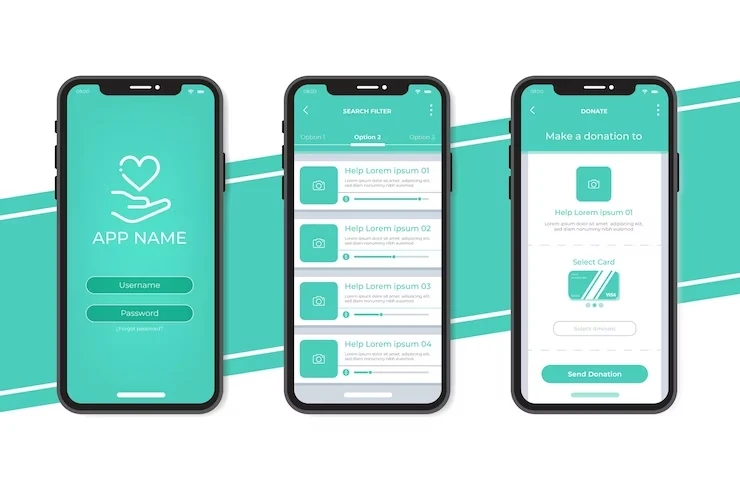

As the digital landscape continues to evolve, the prominence of mobile apps has grown exponentially in the global market.
By addressing customer concerns and fostering collaboration through a shared vision, these enterprises establish a strong, lasting connection with their clientele.
According to a recent report by Statista, it is projected that the revenue of mobile apps worldwide will reach an astounding 613 billion U.S. dollars by 2025.
This highlights the tremendous potential in the mobile app industry for businesses and developers alike. With users demanding more accessible and sophisticated experiences, the need for innovative and cutting-edge apps has never been higher, ultimately shaping the future of mobile technology.
To thrive in today's highly competitive landscape, one must carefully select an appropriate Mobile App Architecture. This choice plays a critical role in determining the performance, scalability, and overall success of the application.
What is mobile app architecture?
Mobile app architecture comprises the structural elements, interfaces, and overall system behavior. These components are designed to work together seamlessly, ensuring optimal performance and user experience. By defining and implementing effective architectural principles, developers can create efficient, scalable, and maintainable applications.
Why should you bother about a good mobile app architecture?
Incorporating a robust and efficient mobile app architecture not only ensures long-term stability but also facilitates seamless user experience, preventing unforeseen challenges.
By paying keen attention to each architectural component, you pave the way for a thriving app ecosystem that can adapt and scale as needed.
Ultimately, investing time and resources upfront in creating a well-crafted architecture will save you a considerable amount of time, energy, and costs in the future, contributing to the overall success of your mobile app project.
What Is a Mobile App Architecture Diagram?
Good architecture is, first and foremost, a profitable architecture that makes the process of developing and maintaining a program simpler and more efficient. By implementing well-thought-out designs, engineers ensure that the end product conforms to industry standards and exhibits a high level of maintainability.
Android Mobile App Architecture
Transitions between layers in Android mobile app architecture play a crucial role in maintaining seamless communication and functionality. These transitions are carried out through Boundaries, utilizing two distinct interfaces to ensure proper execution.
The first interface is responsible for handling the request, while the second one manages the answer. When you Hire android developers, this well-structured approach enables developers to build more stable and efficient applications, setting clear pathways for data exchange between layers.
iOS Mobile App Architecture
MVC (Massive View Controller) and its prototypes have dramatically impacted the development of high-quality iOS mobile applications.
This innovative architectural pattern streamlines the process of designing and constructing user interfaces, promoting consistency and efficiency. Separating visual components into distinct entities, enables developers to create more modular and easily maintainable code.
Hybrid Mobile App Architecture
Hybrid mobile app architecture offers a unique combination of capabilities, bringing together the best of native and web solutions.
By bridging the gap between native and web-based apps, the hybrid architecture enables developers to create versatile applications that can function seamlessly across different platforms, without compromising performance or user experience.
Cross-Platform Mobile App Architecture
It has revolutionized the way developers approach app creation, as it combines the most-utilized codebases with unique platform capabilities found in native shells.
This innovative method moves away from relying on web languages and instead leverages powerful frameworks such as React to enhance the overall experience.
Enterprise Mobile App Architecture
In the enterprise mobile app architecture, there is often a discrepancy between the IT infrastructure and business requirements, which is caused by rapid market changes. This imbalance can create challenges for organizations seeking to maintain a competitive edge in today's fast-paced business landscape.
To address this issue, it is crucial for enterprises to adopt a flexible and agile approach to app development that allows for seamless adaptation to shifting priorities.
Tips To Build Mobile Application Architecture
Determine the device type
Firstly, one should anticipate how the app will function on screens with different sizes and DPIs, as this will have an impact on usability and user experience. Secondly, compatibility with different processors (CPUs) must be taken into account, since this may limit the range of devices that can efficiently run the application.
Finally, understanding the memory requirements for your app will help maintain smooth and responsive functionality for users, preventing crashes or sluggish performance.
Different bandwidth scenario
Users all around the world rely on a diverse range of networks, including Wi-Fi, 4G, and 5G, to access their favorite apps and services. The user experience can be significantly impacted if an app doesn't function seamlessly across these various connection types.
Define user interface
The key to success in today's competitive software market lies in providing users with an application solution that strikes the perfect balance between simplicity and creativity.
By designing intuitive user interfaces and implementing innovative features, developers can ensure an engaging and seamless user experience.
Select the right navigation method
When designing intuitive and easy-to-use interfaces, it is essential to anticipate potential usability issues and offer users clear guidance while navigating apps.
By doing so, it is possible to achieve a cohesive solution that caters to both user satisfaction and optimal app performance.
How to Choose the Right Architecture for Your Mobile App?
App architecture comprises 3 layers:
Data Layer- Data layers are crucial aspects of modern information systems, serving as the foundation for secure data maintenance. They incorporate a wide range of tools and utilities that ensure the accessibility, integrity, and confidentiality of critical information. These service tools collaborate to manage and maintain data, while also mitigating risks associated with unauthorized access, data breaches, and loss.Business Logic Layer- This layer efficiently manages diverse functions such as logging, caching, validating, and other technical operations, ensuring a seamless user experience. By abstracting these intricate processes, the business logic layer allows developers to focus on the core functionality of the application. Presentation Layer- By converting complex technical data into user-friendly formats, this layer facilitates seamless interaction between different components of a system. This translation process enables users to make informed decisions and interact with the system more efficiently, ultimately empowering them to accomplish their objectives.Final Thoughts
Mobile app architecture provides a map of how the various components of the application should be organized and connected to each other. In order to ensure scalability and stable operation, it is crucial to develop an efficient and well-planned architecture design.
By implementing a robust framework, a Mobile app development company sets the foundation on which critical features such as user interface, data loading, backend components, and communication protocols build upon.
An optimized mobile app architecture ensures better performance, maintainability, and adaptability to different device specifications, ultimately enhancing the user experience.









Sign in to leave a comment.