
Skin cancer remains the most frequently diagnosed cancer in the United States, impacting millions every year. The encouraging news is that early detection often leads to highly successful treatment.
Dermatologists now have an array of options ranging from medicated creams to advanced surgical techniques tailored to the specific type and behavior of each tumor. Among these, Mohs surgery stands out as one of the best skin cancer treatments in Venice, FL, for its precision and tissue-sparing results. Still, it’s not always the best fit for every diagnosis.
This article breaks down when Mohs shines and when another approach might be better.
What Is Mohs Surgery?
Mohs micrographic surgery is a meticulous skin cancer treatment technique developed nearly a century ago by Dr. Frederic Mohs. The procedure works by removing the cancer one thin layer at a time. After each layer is removed, it’s examined immediately under a microscope to check for remaining cancer cells. This step-by-step process continues until no abnormal cells remain.
The goal is simple: ensure complete cancer removal while preserving as much healthy tissue as possible. Mohs is especially valuable in areas where maintaining appearance and function is crucial, such as the face, nose, ears, eyelids, and hands. It’s usually performed in an outpatient setting under local anesthesia and is typically completed in one visit.
Factors to Consider When Deciding on Mohs Surgery
1. Type of Skin Cancer
Mohs surgery is most effective for:
- Basal Cell Carcinoma (BCC): The most frequently diagnosed skin cancer. Mohs offers cure rates around 99% for primary BCC.
- Squamous Cell Carcinoma (SCC): The second most common type. Mohs provides cure rates near 97% for tumors that have returned.
- Uncommon or High-Risk Non-Melanoma Skin Cancers: Includes conditions such as DFSP, sebaceous carcinoma, and extramammary Paget’s disease, which benefit from precise margin control.
Less commonly recommended for:
- Low-Risk or Surface-Level Cancers: For instance, superficial BCCs or SCCs on low-impact areas may respond well to topical therapies or cryotherapy.
- Melanoma: Because melanoma can extend deeper, Mohs isn’t usually the initial treatment choice. That said, it may be used selectively when performed by experts using special stains—such as MART-1—to identify melanoma cells.
2. Tumor Location
Mohs is especially advantageous for cancers in areas where conserving tissue is crucial, including:
- Face
- Nose
- Ears
- Lips
- Eyelids
- Scalp
- Hands
- Genital area
In these locations, maintaining function and appearance is essential. Mohs allows maximum precision, removing only what’s necessary and leaving as much healthy skin intact as possible.
3. Tumor Size and Behavior
Mohs excels in treating:
- Larger tumors, where complete removal is important, while avoiding unnecessary tissue loss
- Recurrent cancers previously treated with excision, topical therapy, or radiation
- Tumors with unclear borders that make standard removal more challenging
- Aggressive growth patterns, such as infiltrative or morpheaform BCC
These features make complete microscopic margin control essential, and Mohs provides the most thorough method for ensuring all cancer cells are removed.
4. Risk of Recurrence
Mohs offers the highest cure rates available for many skin cancers:
- Up to 99% for new BCCs
- Around 97% for recurring BCCs
This makes Mohs the preferred option for patients at higher risk of the cancer returning, particularly in sensitive areas or in tumors that have already been treated once.
5. Your Cosmetic Goals
A major benefit of Mohs is its ability to preserve healthy skin, which often results in:
- Smaller, more refined scars
- Better cosmetic outcomes
- More reconstruction options
For visible areas like the face, where appearance is a priority, Mohs often gives superior cosmetic results when compared with standard surgical excisions.
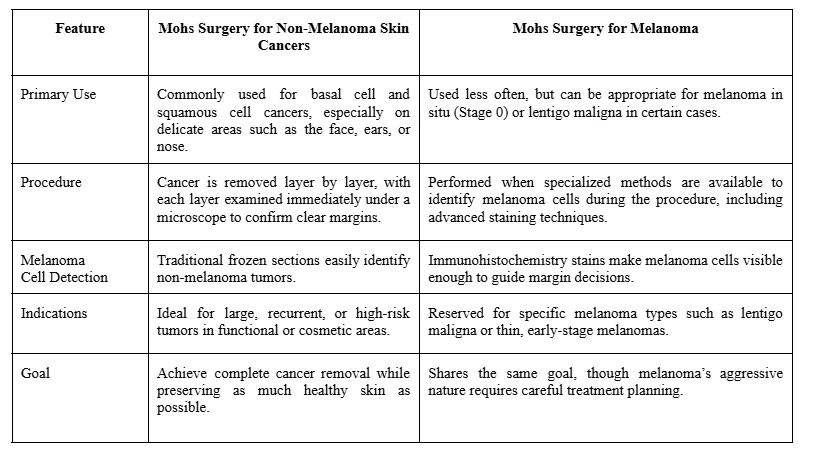
Mohs Surgery for Melanoma vs. Other Skin Cancers
Other Treatment Options for Melanoma Skin Cancer
1. Wide Local Excision
Wide local excision is the primary surgical treatment for most melanomas, suggested after a skin cancer diagnosis in Venice, FL, and other regions. It removes the tumor along with a safety margin of surrounding skin to lower the risk of recurrence. The margin size depends on tumor depth. This approach is effective for localized melanoma and aims to fully eliminate visible cancer.
2. Sentinel Lymph Node Biopsy
A sentinel lymph node biopsy helps determine whether melanoma has spread beyond the original site. Recommended for tumors of certain depths, the procedure identifies and removes the first lymph node(s) likely to contain cancer cells. Results guide staging and decisions about additional treatment, improving overall management of melanoma.
3. Systemic Therapy (Immunotherapy or Targeted Therapy)
For advanced or metastatic melanoma, systemic treatments may be used to destroy cancer cells throughout the body. Immunotherapy boosts the immune system’s ability to recognize and attack melanoma, while targeted therapy focuses on specific genetic mutations. These therapies are often combined with surgery to improve long-term outcomes.
FAQs
How long does Mohs surgery take?
Mohs surgery can last just a few hours, but in some cases, the appointment may extend through most of the day. Timing depends largely on the tumor’s size and depth, which is determined during skin cancer testing in Venice, FL. Larger or more complex tumors usually require additional stages to fully remove all cancer cells.
How successful is Mohs surgery?.+
Mohs micrographic surgery offers the highest cure rates available for basal cell and squamous cell cancers. Cure rates can reach up to 99% for newly diagnosed BCC and around 94% for recurring cases. For SCC, success rates typically range from 95% to 99% for new cancers and around 90% for recurrent ones.
Are there risks associated with Mohs surgery?
The risks from Mohs surgery are generally low. Your surgeon can explain how your own health conditions may affect your procedure. Potential risks include:
- Scarring
- Larger-than-expected wound size
- Slow wound healing
- Bleeding
- Infection
- Temporary or permanent nerve changes
- Tumor regrowth, especially in previously treated or long-standing tumors
How long does it take to heal from Mohs surgery?
Scars from Mohs surgery continue to improve for 12 to 18 months. During this time, you may notice the scar gradually soften and lighten. If the final appearance is not what you hoped for, talk with your surgeon about possible scar-revision options.
What to Discuss With Your Dermatologist
Before choosing a treatment, it’s important to have a thorough conversation with your dermatologist that covers:
- Pathology details: Type, behavior, and aggressiveness of your cancer
- Tumor depth and location: Areas with functional or cosmetic importance may lean toward Mohs
- Previous treatments: Recurrences may call for a more precise method
- Medical conditions and medications: Some health factors can affect healing
- Your goals: Whether you prioritize appearance, recovery time, cost, or long-term outcomes
- Comfort level with surgery: Mohs uses local anesthesia, but it does involve incisions and wound care
Mohs surgery remains a leading option for many skin cancers due to its high cure rates and tissue-sparing approach. Still, it isn’t the right choice for every patient or every diagnosis. The best approach depends on the cancer’s type, size, location, and your personal preferences.
A detailed consultation with a dermatologist at a trusted skin cancer center in Venice, FL, can help you decide on the most effective treatment plan. No matter which path you take, the shared priority is complete cancer removal with the best possible results for your health and appearance.
















Sign in to leave a comment.