Choosing between Montessori vs traditional preschool can feel overwhelming, especially when every preschool promises the best start for your child. Both approaches support learning, but in very different ways. Understanding those differences can help you make a confident decision that suits your child's personality, learning style, and your family's goals.
Many parents focus only on a school's reputation or curriculum when shortlisting options. In reality, the right preschool is the one where your child feels curious, supported, and excited to learn every day. Once you understand how each approach works, the choice becomes much clearer.
What Is Montessori Education?
Montessori education is an approach developed by Dr Maria Montessori over a century ago, built around the idea that children learn best through self-directed exploration rather than being told what to do.
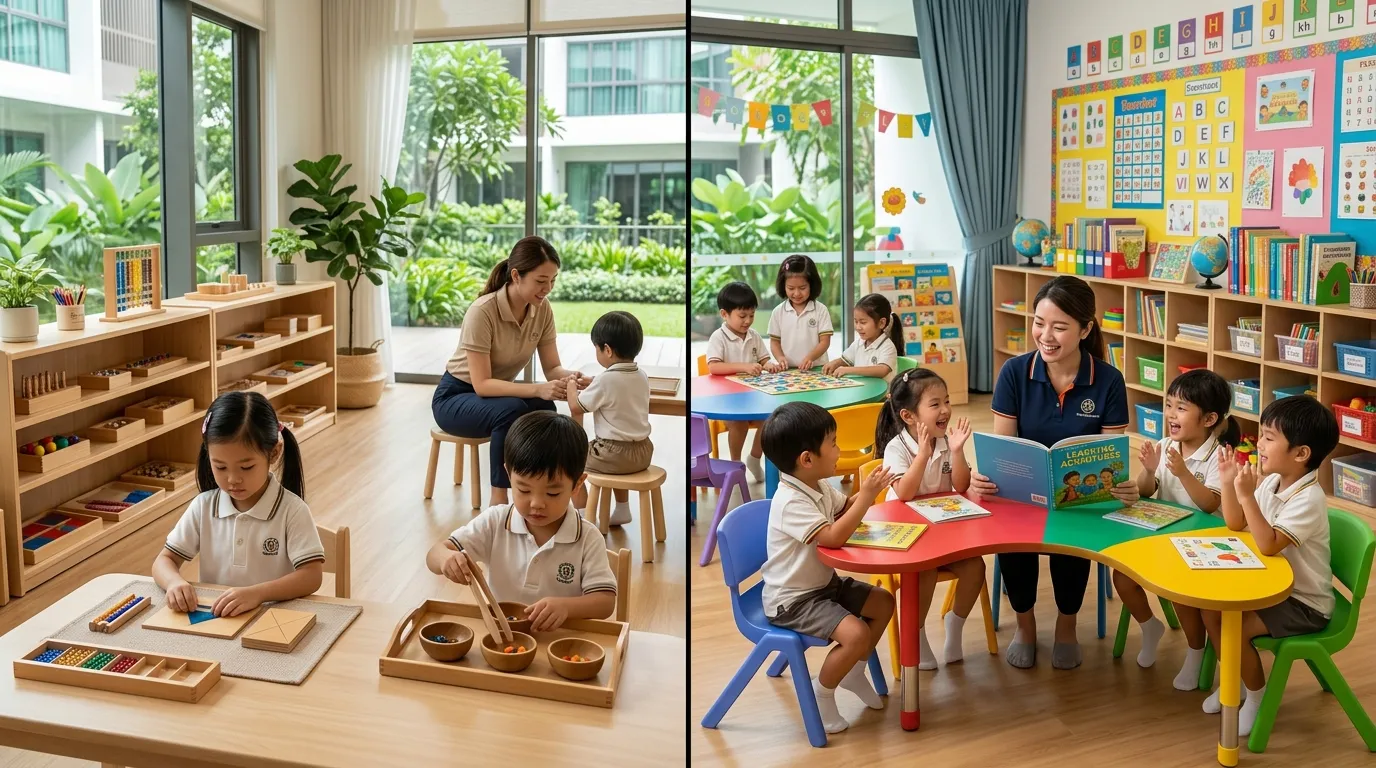
Rather than sitting through lessons, children move freely between activity stations and choose tasks that interest them. Classrooms typically house a mixed-age group, often spanning three years, so younger children learn by watching older ones, and older children reinforce their own understanding by helping the little ones.
You'll also notice hands-on learning materials everywhere: wooden puzzles, pouring jugs, number rods, and sensorial activities designed to sharpen the senses before introducing academic concepts.
What Is a Traditional Preschool?
A traditional preschool follows a more familiar structure: a set timetable, a teacher at the front, and a group of children moving through the day's activities together.
Here, teacher-led instruction guides most of the learning. The educator plans the lesson, the class follows along, and there's a clear, structured curriculum mapped out term by term. Circle time, worksheets, art projects, and story time typically fill the day in a fairly predictable sequence.
This model suits children who respond well to routine and clear direction, and it mirrors the format most primary schools in Singapore will eventually use.
How Does Each Approach Work in Practice?
In Montessori settings, the teacher steps back and lets the prepared environment do much of the teaching. Classrooms are organised with materials arranged by subject and difficulty. A child picks a task, works through it at their own pace, and moves on only once they've genuinely grasped it, not when the clock says it's time.
Teachers, often called "guides," observe closely and step in only when a child needs a nudge. This tends to build independence earlier than many parents expect. Practical life skills, like buttoning a shirt or pouring water without spilling, are treated as seriously as reading and maths, because Dr Montessori believed real-world competence builds genuine confidence.
In traditional settings, the teacher actively leads the room. Teachers plan lessons, deliver them to the whole class, and reinforce them through repetition, group activities, and consistent routines. This structure helps children build the habit of following instructions, sitting through group lessons, and working alongside classmates on a shared task, skills that transfer directly into a primary school classroom.
Montessori vs Traditional Preschool: The Key Differences
| Area | Montessori | Traditional |
|---|---|---|
| Learning pace | Individualised, child sets the pace | Whole class moves together |
| Classroom setup | Mixed-age, child-led | Same-age, teacher-led |
| Teacher's role | Guide and observer | Instructor and planner |
| Materials & activities | Hands-on, sensorial, practical life tasks | Worksheets, crafts, games, structured play |
| Best suited for | Children who thrive with independence and exploration | Children who thrive with routine and clear direction |
Neither approach is the "perfect" choice for every child. The best option supports your child's early development and helps them enjoy learning every day.
Benefits of Montessori Education
Parents drawn to Montessori usually cite a few recurring benefits of Montessori education:
- Stronger independence in children, since kids are trusted to make choices and manage their own tasks from a young age.
- Better focus and concentration, as children work uninterrupted on self-chosen activities rather than being redirected every twenty minutes.
- Natural social-emotional development, thanks to the mixed-age classroom encouraging empathy, patience, and mentorship. This ties closely into building social skills early on, something research consistently links to long-term confidence.
- A genuine love of learning, because the freedom to choose tends to keep curiosity alive rather than snuffing it out with obligation.
A 2017 study published in Frontiers in Psychology (Lillard et al.) found that children in high-fidelity Montessori programmes showed stronger executive function and social skills compared with peers in conventional settings. It's a useful data point, though every child's experience will still vary depending on the specific school and teacher.
What Age Should a Child Start Preschool?
In Singapore, most children start playgroup around 18 months to 2 years, then move into nursery and kindergarten between ages 3 and 4. If you're still unsure where your child fits into this timeline, this Preschool age guide breaks down each stage in more detail.
Montessori settings often accept children from as young as 18 months, since the mixed-age model works well even with toddlers. Traditional preschools more commonly start intake at age 3, once children can follow group instructions more consistently.
There's no universally "correct" age. It depends on your child's readiness for separation, their temperament, and honestly, your own comfort level as a parent.
How to Choose the Right Preschool for Your Child
Choosing the right preschool gets easier once you focus on three things: your child's personality, your family's daily routine, and your long-term priorities for kindergarten readiness. When comparing a Preschool in Singapore, it also helps to consider the teaching approach, classroom environment, location, and daily schedule. For a more detailed, step-by-step breakdown, the Choosing the Best Preschool guide walks you through the full process.
Signs of a Good Preschool, Regardless of Philosophy
Whichever approach you lean towards, certain signs of quality hold everywhere:
- Warm, attentive staff who know each child by name and temperament
- A clean, safe, and well-organised environment
- Clear, regular communication with parents about daily progress
- A healthy balance of academic, social, and physical activities
- Low staff turnover, which usually signals a happy working environment
- For Montessori schools specifically, teachers holding a recognised Montessori diploma
- A reasonable class size and teacher-to-child ratio, whichever model you choose
Final Thoughts
Montessori and traditional preschool aren't competing for the title of "best." They're simply different paths that suit different children. Montessori works well for kids who thrive on independence and self-paced exploration; traditional preschool works well for kids who feel secure with routine and structured, teacher-led learning.
Whichever you choose, consistency, warmth, and a genuine fit between the environment and your child's needs matter most. Academic readiness will follow naturally once a child feels secure and curious, not pressured. So before you decide, book a trial session or classroom visit and watch how your child actually responds to each environment. That reaction will tell you more than any prospectus can.
Once your child moves past the preschool stage, a similar decision awaits at the next level. Our comparison of MOE and private kindergarten follows the same practical, no-hype approach to help you plan.
FAQS
Is Montessori better than traditional preschool?
No single approach is universally "better." Montessori suits children who thrive with independence and self-paced exploration, while traditional preschool suits children who do well with routine and teacher-led structure. The right choice depends on your child's temperament, not on which method ranks higher overall.
What is the main difference between Montessori and traditional preschool?
The main difference is who leads the learning. In Montessori, children choose their own activities and work at their own pace while the teacher observes and guides. In traditional preschool, the teacher plans and leads lessons that the whole class follows together on a set schedule.
Do Montessori kids struggle later in traditional school?
Most research suggests Montessori children adjust well to traditional school settings, often showing strong independence, focus, and problem-solving skills. Some children need a short adjustment period getting used to a fixed timetable and teacher-led instruction, but this is typically brief and not a lasting disadvantage.
What age is best to start Montessori?
Montessori programmes commonly accept children from as young as 18 months, since the mixed-age classroom model works well even with toddlers. There's no single "best" age. It depends on the child's readiness for separation and their comfort with a less structured environment.

























Sign in to leave a comment.