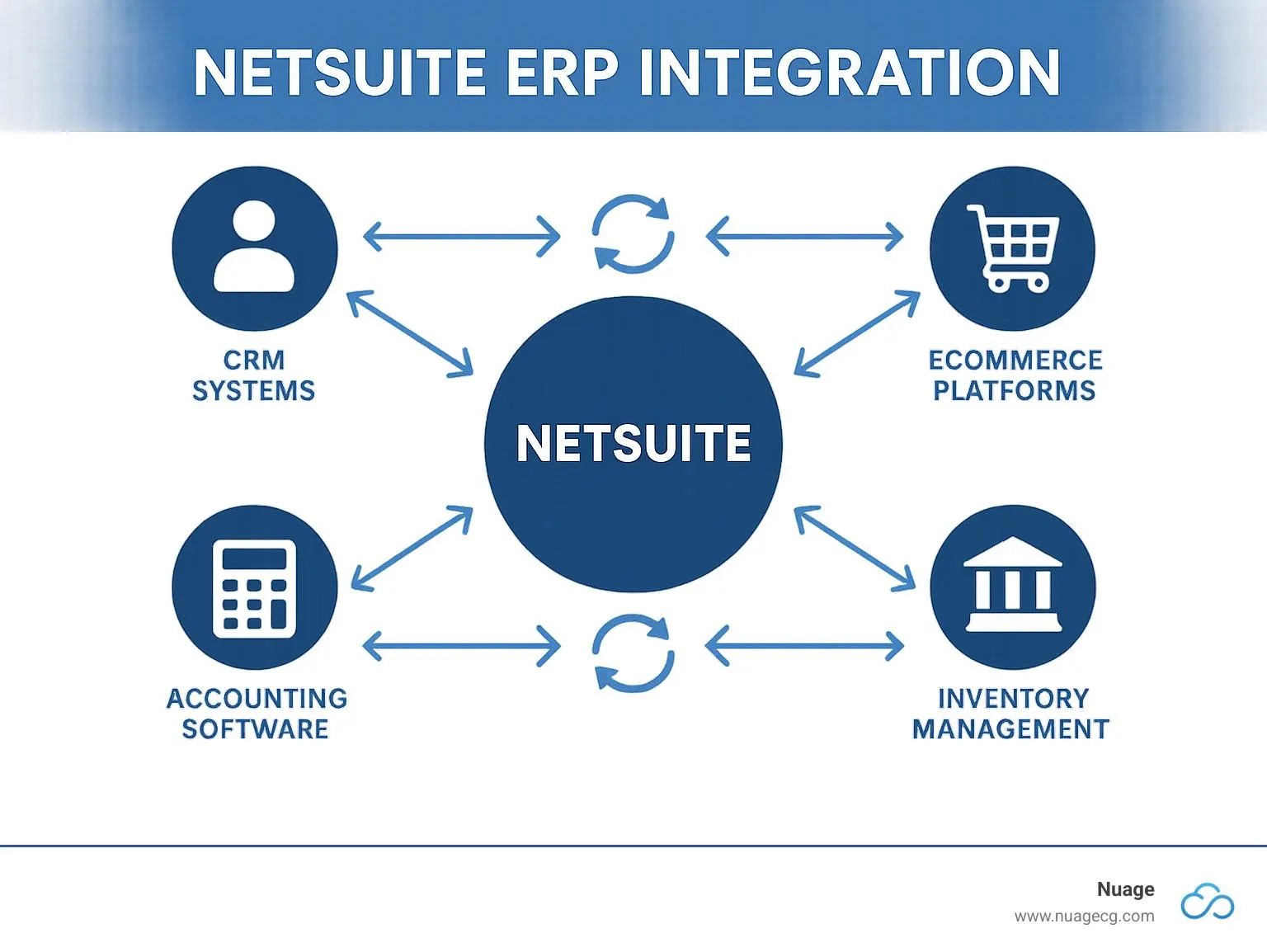

NetSuite is a powerful cloud ERP platform, but businesses rarely use it as a standalone system. Modern companies often need to connect NetSuite with CRM platforms, e-commerce websites, payment gateways, warehouses, logistics providers, and other business applications. A well-planned integration allows information to move automatically between these systems, reducing manual work and improving operational accuracy.
What Is NetSuite Integration?
NetSuite integration is the process of connecting NetSuite with external business applications so that data can be exchanged automatically. Instead of employees entering the same customer, order, payment, or inventory information into multiple systems, an integration keeps the information synchronized.
For example, an e-commerce order can automatically flow into NetSuite for order processing, accounting, inventory management, and fulfillment. Similarly, customer information from a CRM can be synchronized with NetSuite so sales and finance teams can work with consistent data.
Effective netsuite erp integration helps businesses create a connected technology environment while reducing duplicate data entry, reconciliation errors, and delays.
Why Is NetSuite Integration Important?
Businesses generate large amounts of information across different departments and applications. Without integration, employees may rely on spreadsheets, manual data entry, and repetitive reconciliation processes.
A reliable NetSuite integration can provide several benefits:
- Reduces duplicate data entry
- Improves data accuracy
- Provides better inventory visibility
- Automates order and payment processing
- Connects sales and finance data
- Improves reporting and decision-making
- Reduces manual reconciliation
- Supports business growth
When systems share information efficiently, organizations can create a more reliable source of business data and respond faster to operational changes.
Main NetSuite Integration Methods and APIs
NetSuite provides multiple integration options. The right method depends on business requirements, data volume, security needs, and whether information needs to move in real time or on a scheduled basis.
SuiteTalk REST and SOAP
SuiteTalk is NetSuite’s native web services API and supports both REST and SOAP. It can be used for common operations such as creating invoices, updating customer records, and transferring sales orders.
REST is generally suitable for modern integration projects because it works well with contemporary applications and middleware. SOAP continues to be used by many established integrations.
RESTlets
RESTlets are custom endpoints created using SuiteScript. They are useful when standard API functionality does not provide enough flexibility.
A RESTlet can contain custom business rules, validations, calculations, or multi-record operations. This makes it useful for organizations with specialized integration requirements.
SuiteScript
SuiteScript allows developers to create custom logic within NetSuite. It can trigger actions when records are created or updated and can help transform or validate information before it is transferred to another application.
iPaaS and Middleware
Integration platforms such as Celigo, Boomi, and Workato can simplify connections between NetSuite and multiple applications. These platforms commonly provide pre-built connectors, workflow tools, monitoring, and error-handling capabilities.
For companies connecting several systems, middleware can be easier to maintain than multiple independent point-to-point integrations.
Point-to-Point vs. Middleware Integration
A point-to-point integration directly connects two systems. It can be suitable for a simple environment with one or two integrations. However, complexity can increase quickly as more applications are added.
Middleware provides a centralized integration layer between NetSuite and connected applications. This architecture can simplify monitoring, data transformation, authentication, and error handling.
For businesses expecting to connect multiple systems, middleware or an iPaaS approach can provide a more scalable foundation.
Common NetSuite Integration Use Cases
NetSuite can be integrated with many business applications and processes.
CRM Integration: Customer, lead, opportunity, and sales information can be synchronized between NetSuite and CRM platforms.
E-commerce Integration: Online orders, product information, pricing, and inventory can flow between an e-commerce platform and NetSuite.
Payment Integration: Payment transactions and settlements can be connected with NetSuite accounting records, reducing manual reconciliation.
Warehouse and 3PL Integration: Inventory, shipment, fulfillment, and logistics information can be synchronized between NetSuite and warehouse systems.
EDI Integration: Businesses can exchange purchase orders, invoices, shipping information, and other documents with trading partners electronically.
Each integration has different requirements. For example, e-commerce orders may require near-real-time synchronization, while some financial reports may only need scheduled data transfers.
Security Considerations for NetSuite Integration
Security should be considered from the beginning of an integration project. NetSuite supports authentication methods such as Token-Based Authentication and OAuth 2.0.
Organizations should avoid giving integrations unnecessary administrative permissions. Instead, integration-specific roles should be created with only the permissions required for the connection.
Proper authentication, access control, monitoring, and logging can reduce security risks while making it easier to identify integration activity and troubleshoot problems.
How a NetSuite Integration Project Works
A successful integration generally follows a structured process:
Discovery and Requirements: Identify systems, data objects, workflows, and business requirements.
Architecture Selection: Choose APIs, middleware, or custom integration methods.
Security Setup: Configure authentication and appropriate user roles.
Data Mapping: Define how fields and records move between systems.
Development: Build APIs, connectors, scripts, or workflows.
Testing: Test normal transactions as well as refunds, cancellations, missing fields, and other edge cases.
Go-Live: Deploy the integration with monitoring and alerts.
Ongoing Support: Maintain the integration as business requirements and connected applications change.
Choosing the Right NetSuite Integration Partner
Selecting an experienced integration provider can significantly affect the success of the project. Businesses should look for a partner that understands both NetSuite and the systems being connected.
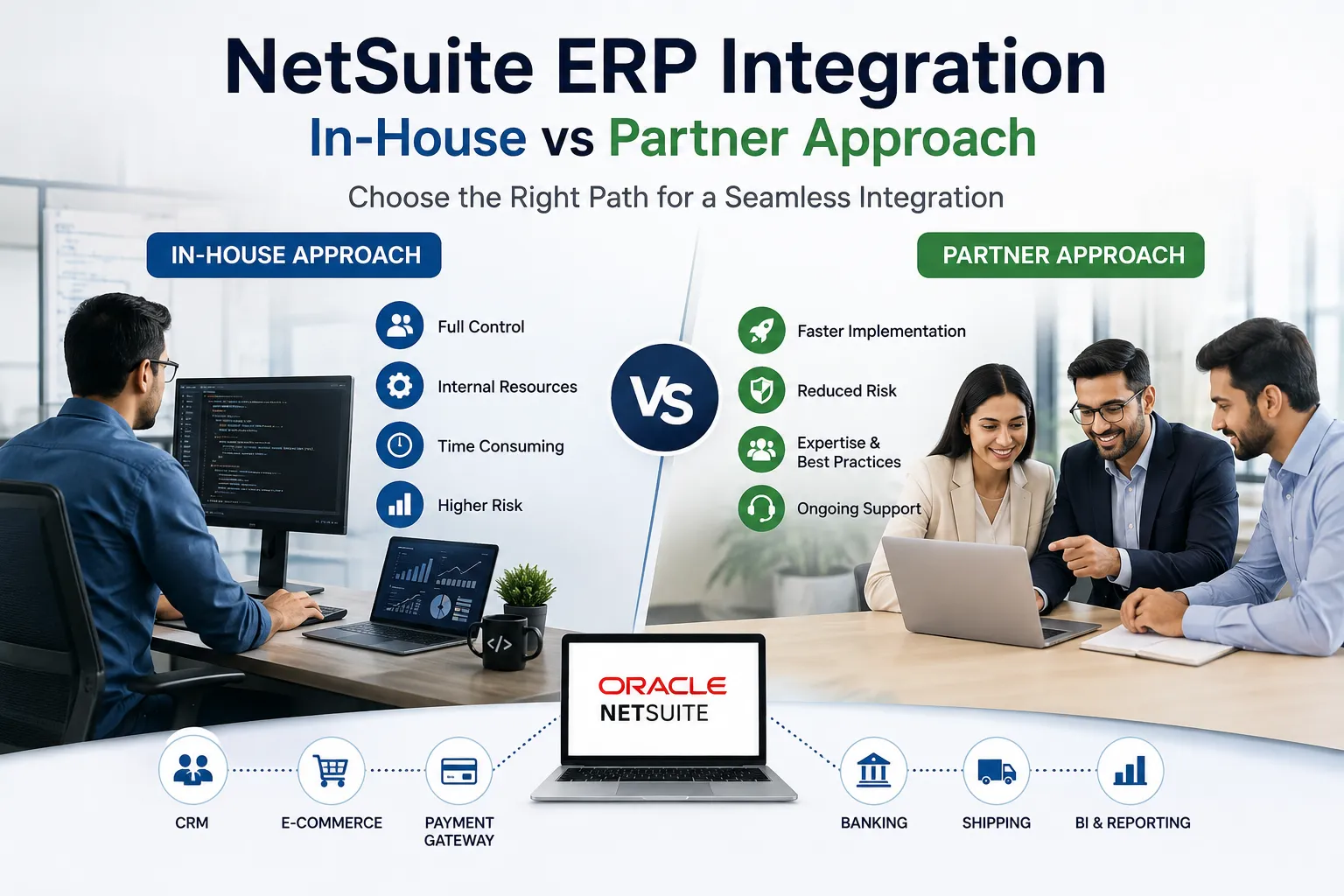
When evaluating netsuite partners in india, consider their technical experience, API knowledge, architecture approach, security practices, testing process, documentation, and post-launch support.
A strong partner should clearly document data flows and mappings before development begins. They should also plan for error handling, monitoring, retries, and future scalability instead of focusing only on getting the initial connection working.
Why LinkedERP for NetSuite Integration?
LinkedERP provides NetSuite integration services for businesses connecting NetSuite with CRM, e-commerce, payment, warehouse, logistics, and other business applications.
Its approach includes architecture planning, API development, SuiteTalk, RESTlets, SuiteScript, middleware and iPaaS solutions, authentication, monitoring, and post-implementation support. The company also emphasizes documented data flows, integration security, and scalable architecture.
Conclusion
NetSuite integration is an important part of building a connected and scalable business environment. Whether a company needs to connect one e-commerce platform or multiple enterprise applications, choosing the right APIs, architecture, security model, and integration strategy is essential.
A well-designed netsuite erp integration can reduce manual processes, improve data accuracy, strengthen visibility, and support better decision-making. Working with experienced netsuite partners in india such as LinkedERP can help businesses design, implement, and maintain integrations that support their current operations while preparing them for future growth.



















Sign in to leave a comment.