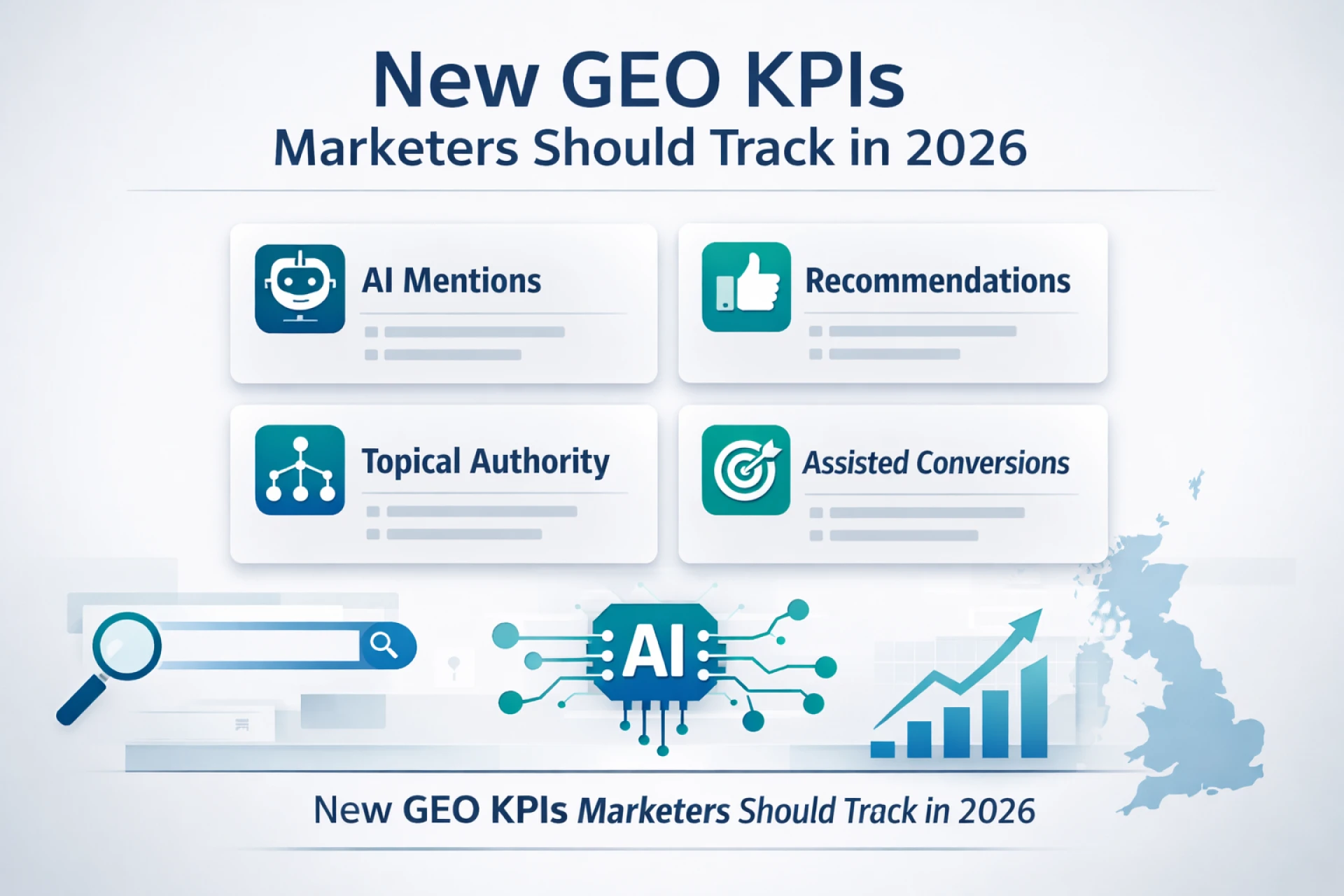

Search is no longer just about rankings, clicks, and blue links. As AI-driven platforms like Google’s AI Overviews, ChatGPT, Perplexity, and other generative engines increasingly answer questions directly, marketers are facing a new challenge: how to measure visibility when users don’t always click?
This is where Generative Engine Optimisation (GEO) changes the conversation. In 2026, success is not defined by how high your page ranks, but by whether AI engines mention, recommend, and trust your brand when generating answers.
Traditional SEO KPIs alone can no longer capture this shift. Marketers now need new GEO-specific KPIs to understand performance, influence, and real business impact.
In this article, we’ll break down the most important GEO KPIs marketers should track in 2026, explained simply, with examples, so you know exactly what to measure and why it matters.
As AI-driven answers become the first point of interaction for users, marketers are being forced to rethink what success truly looks like. Visibility is no longer confined to search result pages, but spread across conversational responses that shape perception before a click ever happens.
Why Traditional SEO KPIs Are No Longer Enough?
For years, marketers relied on familiar metrics like keyword rankings, organic traffic, impressions, and click-through rates. While these still have value, they tell only part of the story in an AI-first search environment.
For example, a user might ask ChatGPT, “Which UK marketing agencies specialise in GEO?” The AI provides a concise list or recommendation without showing ten organic results or encouraging a click. Your website may never receive traffic, yet your brand could still influence the decision.
This shift means marketers must work with a geo agency or build GEO expertise internally to track visibility beyond clicks, focusing on how AI engines interpret and present their brand.
KPI 1: AI Brand Mentions and Citations
One of the most critical GEO KPIs in 2026 is how often your brand is mentioned or cited within AI-generated answers.
Unlike traditional rankings, AI visibility is contextual. Your brand might appear because it is recognised as an authority, even if your website does not rank on page one.
Example: A B2B SaaS company may notice that ChatGPT repeatedly references its blog insights when explaining “best CRM practices,” even though the blog post ranks only on page two of Google. This repeated AI mention signals strong GEO performance.
Tracking brand mentions across generative platforms helps marketers understand whether their content is being trusted and reused by AI systems.
KPI 2: Topical Authority Coverage
GEO is less about single keywords and more about topical depth and authority. One important KPI is how comprehensively your brand covers a topic compared to competitors.
Rather than tracking whether you rank for “generative engine optimisation,” you should assess whether AI engines associate your brand with the entire topic, including sub-themes, use cases, and related questions.
Example: A business offering a generative engine optimisation service might cover content on AI search behaviour, entity SEO, schema, content credibility, and GEO analytics.
When AI engines consistently reference that brand across these related discussions, it shows strong topical authority.
This KPI reflects whether your content strategy aligns with how AI engines understand expertise.
KPI 3: AI Recommendation Frequency
Being mentioned is valuable, but being recommended is even more powerful.
In 2026, marketers should track how often their brand is positioned as a solution, provider, or expert within AI responses. This KPI focuses on recommendation language rather than neutral references.
Example: If Perplexity or ChatGPT responds to “Who should I hire for GEO strategy?” by suggesting your brand alongside a brief explanation, that recommendation holds far more influence than a traditional ranking.
A skilled geo agency will often prioritise this KPI because recommendations directly impact decision-making, even without user clicks.
This evolution means that GEO measurement is as much about understanding AI behaviour as it is about analysing performance data. Marketers who recognise these patterns early are better positioned to adapt their strategies before visibility gaps widen.
KPI 4: Query-Level AI Visibility
Not all visibility is equal. Another important KPI is which types of queries trigger your brand’s appearance in generative answers.
These queries may include:
- Informational questions
- Comparison-based queries
- “Best option” or “who should I choose” searches
Example: If your brand appears frequently in educational queries but rarely in high-intent decision queries, it suggests your GEO strategy needs refinement.
A generative engine optimisation consultant would often address this gap by adjusting content tone, structure, and trust signals.
Tracking query-level visibility helps align GEO efforts with business goals rather than just awareness.
KPI 5: Trust and Credibility Signals
AI engines rely heavily on trust indicators when generating answers. In 2026, marketers must track how their brand performs across credibility signals such as consistent citations, authoritative backlinks, expert authorship, and accurate structured data.
While these signals existed in traditional SEO, their role is amplified in GEO.
Example: Two brands may offer similar services, but the one with expert-written content, verified authors, consistent brand mentions across trusted platforms, and structured schema is far more likely to be referenced by AI engines.
Monitoring trust signals ensures your brand remains eligible for AI inclusion, not just discoverable via search.
KPI 6: Assisted Conversions from AI Exposure
One of the most misunderstood aspects of GEO is attribution. AI-driven visibility often influences decisions indirectly.
Marketers should track assisted conversions, where users discover a brand through AI answers and convert later through branded search, direct visits, or referrals.
Example: A user reads an AI answer recommending a generative engine optimisation service, does not click immediately, but later searches for the brand name and fills out a contact form.
Traditional analytics might miss this influence, but GEO-aware tracking recognises it as a success.
This KPI helps demonstrate the real business value of GEO efforts.
KPI 7: Content Reuse by Generative Engines
Another emerging GEO KPI is how frequently AI engines reuse or paraphrase your content when answering questions.
This indicates that your content structure, clarity, and depth align well with how generative models process information.
Example: If your explainer content consistently appears in AI summaries about GEO best practices, it shows your brand has become a reference point.
A geo agency will often optimise content specifically for this reuse, ensuring it is factual, structured, and context-rich.
KPI 8: Brand Recall and Recognition
Even without clicks, GEO impacts brand recall. In 2026, marketers should measure increases in branded searches, direct traffic, and brand-related enquiries following AI visibility.
Example: After appearing in multiple AI answers about digital strategy, a company may notice a steady rise in searches for its brand name. This indicates that GEO exposure is strengthening brand recognition.
Brand recall is a long-term KPI, but it reflects sustained GEO success.
How Marketers Should Approach GEO Measurement in 2026?
Tracking these KPIs requires a mindset shift. Instead of asking, “How many clicks did we get?”, marketers must ask, “How visible, trusted, and recommended is our brand in AI-generated conversations?”
Working with a geo agency or an experienced generative engine optimisation consultant helps translate these new metrics into an actionable strategy. GEO is not about replacing SEO, but about expanding it to match how users now discover information and make decisions.
Ultimately, GEO KPIs are not just metrics but signals of how well a brand aligns with the way AI engines interpret relevance, authority, and trust. Tracking these indicators consistently allows marketers to future-proof their strategy in an increasingly AI-led search landscape.
Conclusion
In 2026, the brands that win are not just those that rank, but those that AI engines recognise as credible voices worth recommending. New GEO KPIs help marketers measure this invisible but powerful layer of influence.
By tracking AI mentions, topical authority, recommendation frequency, trust signals, and assisted conversions, marketers can finally understand how GEO drives real business outcomes.
As generative search continues to evolve, adopting these KPIs early will be the difference between being quietly replaced by AI answers and being the brand those answers rely on.

Sign in to leave a comment.