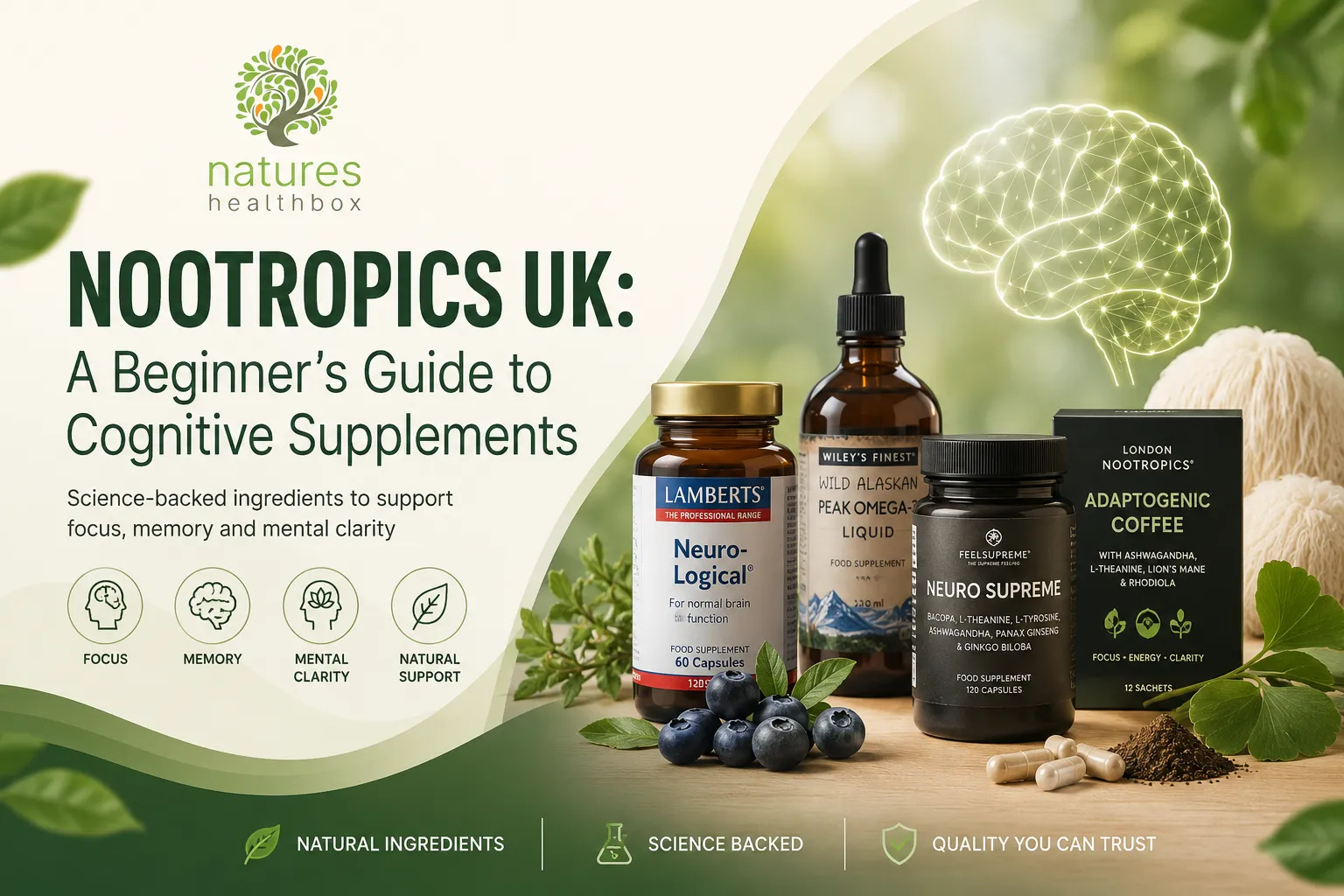

Interest in cognitive enhancement has moved steadily from specialist academic circles into the mainstream wellness sector. In the UK, supplements marketed for concentration, memory and mental performance have become increasingly popular among students, professionals and those seeking to support cognitive health as they age.
At the centre of this growing category are nootropics: compounds that may influence various aspects of brain function, including attention, learning, memory and mental fatigue.
Yet the term is often used rather loosely. Products ranging from mushroom coffees to omega-3 supplements are frequently grouped together under the same label, despite acting through very different biological mechanisms.
For those encountering the category for the first time, understanding the science behind these products is far more useful than following the latest wellness trend. This guide explores the evidence underpinning nootropics UK consumers are most likely to encounter, examines the concept of the cognitive complex, and highlights several noteworthy products available through NaturesHealthBox.
What Are Nootropics?
The term nootropic was first introduced in the 1970s by Romanian psychologist and chemist Corneliu Giurgea. He proposed that a true nootropic should enhance learning and memory while demonstrating a favourable safety profile.
Today, the definition has broadened considerably.
Modern nootropics encompass a diverse range of compounds, including:
- Botanical extracts.
- Adaptogenic herbs.
- Medicinal mushrooms.
- Amino acids.
- Essential fatty acids.
- Vitamins and minerals.
Many ingredients now classified as nootropics do not directly stimulate cognitive function. Instead, they support physiological processes associated with brain health, including neurotransmitter synthesis, neuronal communication, cerebral blood flow and cellular protection against oxidative stress.
Consequently, the contemporary understanding of nootropics has shifted away from the pursuit of enhanced intellectual performance and towards the maintenance of healthy cognitive function.
How Do Nootropics Influence Cognitive Function?
The human brain accounts for approximately 2% of total body weight while consuming around 20% of the body's energy. Its function depends upon a complex interplay between metabolic activity, vascular supply, neurotransmitter regulation and cellular signalling.
Different nootropic ingredients may exert their effects through different pathways, including:
- Supporting neurotransmitter production.
- Modulating the body's response to physiological stress.
- Maintaining neuronal membrane integrity.
- Supporting healthy cerebral circulation.
- Protecting cells against oxidative damage.
Because cognitive function is influenced by numerous biological systems, many supplements combine multiple ingredients to create a broader spectrum of activity. These formulations are often described as a cognitive complex.
Lion's Mane: The Mushroom That Has Transformed the Nootropics Market
Few ingredients have attracted as much attention in recent years as Lion's Mane mushroom (Hericium erinaceus).
Traditionally used within East Asian herbal practice, Lion's Mane has become a prominent ingredient within the modern nootropics market because of its potential relationship with nerve growth factor synthesis and neuronal health.
While research remains ongoing, the ingredient has become particularly popular among individuals seeking support for concentration, mental clarity and productivity.
Those interested in incorporating medicinal mushrooms into their daily routine may wish to consider London Nootropics Adaptogenic Coffee with Lion's Mane and Rhodiola.
Unlike conventional coffee products, this formulation combines caffeine with adaptogenic and mushroom-derived ingredients, creating a more functionally oriented approach to cognitive support.
Bacopa Monnieri: An Ayurvedic Approach to Memory Support
Bacopa Monnieri occupies an important position within traditional Ayurvedic medicine, where it has been used for centuries to support intellectual function.
Contemporary research has examined Bacopa's potential relationship with memory formation, information processing and learning. Although the evidence continues to develop, Bacopa remains one of the most extensively investigated botanical ingredients within the nootropics category.
One example available through Natures HealthBox is Feel Supreme Neuro Supreme, which combines Bacopa with several other well-established cognitive ingredients, including:
- L-theanine.
- L-tyrosine.
- Ashwagandha.
- Panax ginseng.
- Ginkgo biloba.
This type of formulation reflects an increasingly common strategy within brain supplements UK consumers are purchasing: combining multiple ingredients to target several aspects of cognitive function simultaneously.
Ginkgo Biloba and Cerebral Circulation
Derived from one of the oldest surviving tree species, Ginkgo biloba has been studied extensively for its potential influence on circulation and cognitive function.
Unlike ingredients that primarily influence neurotransmitter activity, Ginkgo has traditionally been associated with supporting healthy blood flow, including circulation to the brain.
As a result, it frequently appears in formulations designed to support memory and cognitive performance.
Its continued inclusion in modern supplements demonstrates the enduring relevance of traditional botanical medicine within contemporary nutritional science.
Omega-3 Fatty Acids and Brain Health
Not all nootropics originate from botanical sources.
Omega-3 fatty acids, particularly docosahexaenoic acid (DHA), are among the most thoroughly researched nutrients associated with neurological health.
DHA forms a structural component of neuronal cell membranes and contributes to normal brain function throughout the lifespan.
For this reason, omega-3 supplementation should not be overlooked when discussing brain supplements UK consumers should consider.
Products such as Wiley's Finest Peak Omega-3 Liquid provide a convenient method of increasing dietary omega-3 intake and may represent an appropriate starting point for individuals who prefer an evidence-based, nutritional approach to cognitive support.
What Is a Cognitive Complex?
The phrase cognitive complex refers to a supplement that combines multiple ingredients into a single formulation designed to support various aspects of brain function.
The rationale is straightforward.
Cognitive performance cannot be reduced to a single biological pathway. Memory, concentration, attention and mental energy are influenced by numerous physiological systems.
Consequently, many formulations combine ingredients that contribute to:
- Neurotransmitter synthesis.
- Cellular energy production.
- Stress adaptation.
- Antioxidant defence.
- Cerebral circulation.
Feel Supreme Neuro Supreme
This broad-spectrum formulation incorporates amino acids, adaptogens and botanical extracts, creating a comprehensive supplement intended to support focus, memory and concentration.
AGAN NOUS Advanced Memory Support
This supplement combines two ingredients:
- MEMOPHENOL, a grape and wild blueberry extract rich in polyphenols.
- COGNIVIA, a dual-extract sage formulation.
The combination has been specifically developed to support memory and cognitive performance.
Lamberts Neuro-Logical
This supplement adopts a nutritional approach to brain health by combining multiple nutrients within a single formulation designed to support normal neurological function.
Are Adaptogens Nootropics?
The relationship between adaptogens and nootropics is not always straightforward.
Adaptogens are traditionally defined as substances that help the body adapt to physical and psychological stress. Since chronic stress is associated with impaired concentration and cognitive performance, many adaptogens have become incorporated into nootropic formulations.
Common examples include:
- Ashwagandha.
- Rhodiola.
- Cordyceps.
- Siberian ginseng.
This overlap explains why products such as London Nootropics Adaptogenic Coffee with Ashwagandha and L-Theanine have become increasingly popular among consumers seeking alternatives to conventional stimulants.
How Should Beginners Approach Nootropics?
The expanding range of products available can make selecting an appropriate supplement challenging.
Several principles may help simplify the decision-making process.
Identify a specific objective.
Are you seeking support for memory, concentration, mental clarity or stress management?
Prioritise transparency.
Look for products that clearly disclose their ingredients and dosages.
Avoid introducing multiple supplements simultaneously.
Beginning with a single product allows for a more meaningful assessment of its suitability.
View supplements as an adjunct rather than a substitute.
Adequate sleep, physical activity, nutritional quality and stress management remain the most significant determinants of cognitive health.
The Future of Nootropics in the UK
The growing popularity of nootropics UK consumers are embracing reflects a broader shift within health and wellness: an increasing interest in proactive approaches to long-term wellbeing.
Rather than focusing exclusively on physical health, consumers are now paying greater attention to cognitive resilience, mental performance and healthy ageing.
As research continues to evolve, the distinction between traditional herbal medicine, nutritional science and cognitive supplementation is likely to become increasingly blurred.
For those beginning their exploration of nootropics, the most sensible approach remains a measured one: prioritise evidence, select reputable formulations and establish realistic expectations.
The goal should not be cognitive optimisation at any cost, but rather the support and preservation of one of the body's most complex and remarkable systems.
Disclaimer: Food supplements should not be used as a substitute for a varied and balanced diet or a healthy lifestyle. If you are pregnant, breastfeeding, taking medication or have an underlying medical condition, seek professional advice before introducing a new supplement.

























Sign in to leave a comment.