
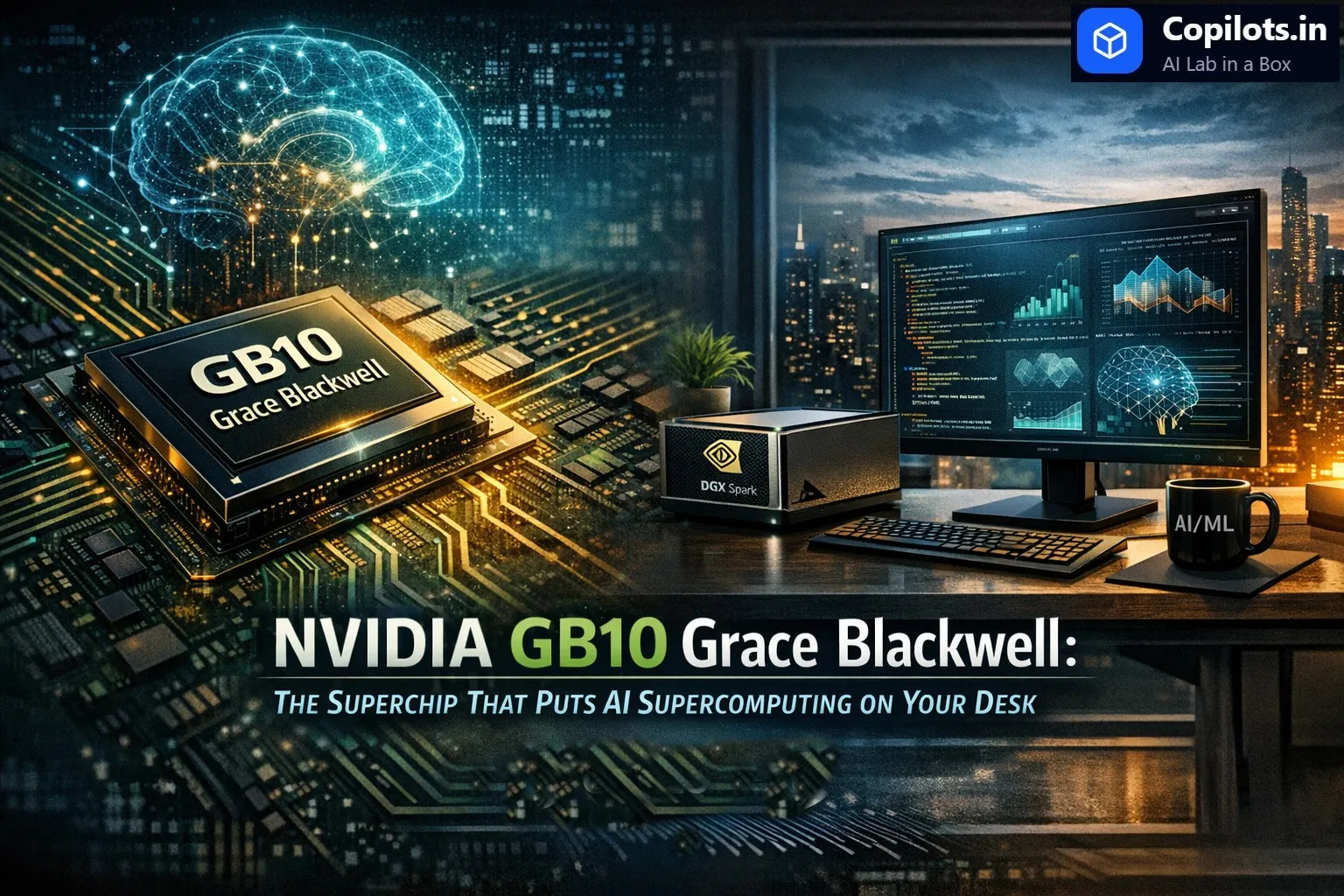
There's a certain moment in tech when something shifts — not a gradual nudge, but a real break from what came before. The NVIDIA GB10 Grace Blackwell Superchip is one of those moments. It's a chip designed not just for data centers or research labs, but for the desk of a developer, a researcher, a startup team that needs serious AI compute without renting it by the hour from a cloud provider.
If you've been watching the AI hardware space, you already know NVIDIA has been pushing compute density further than most thought possible. The GB10 is the latest expression of that ambition — and it's built to run large language models locally, in real time.
What is the NVIDIA GB10 Grace Blackwell Superchip?
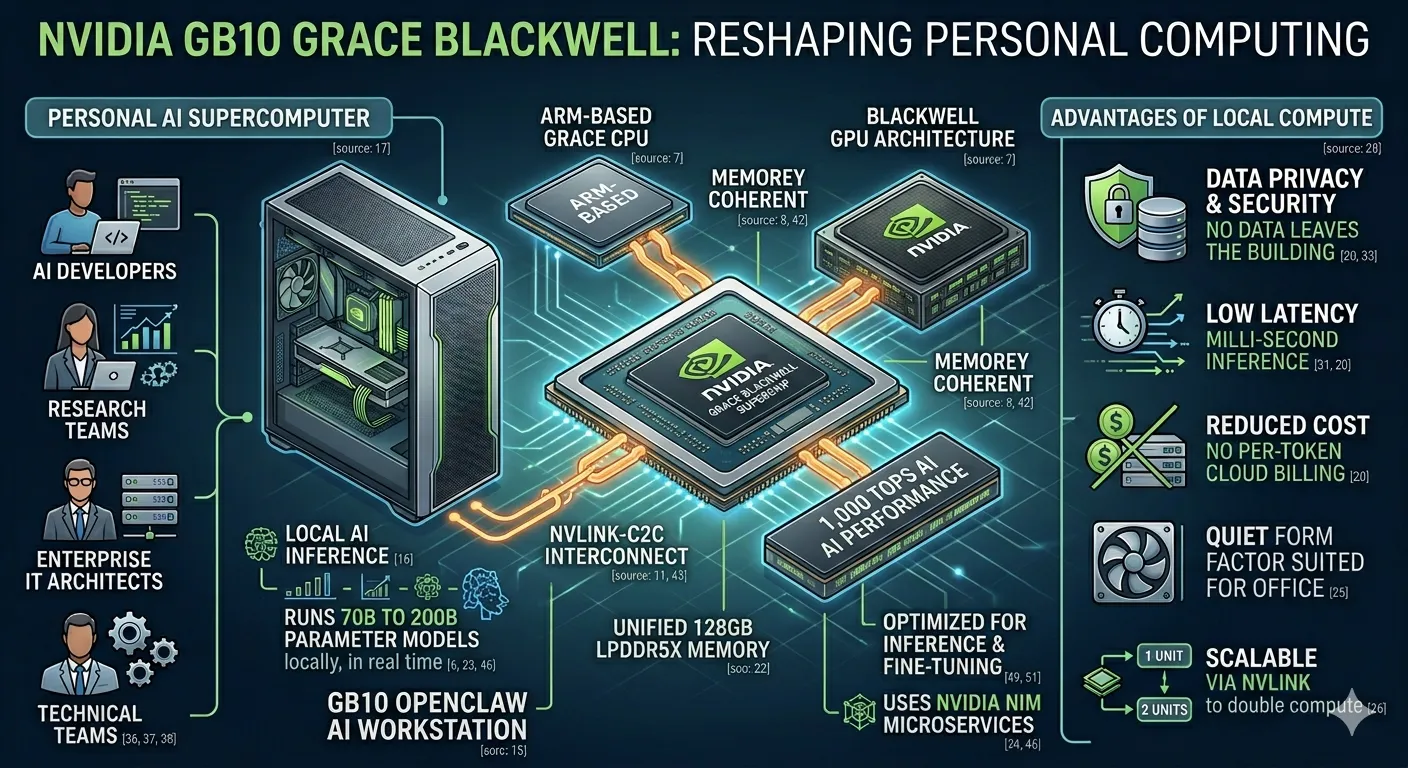
The NVIDIA GB10 Grace Blackwell is a seriously compact, high-performance superchip that takes the best of NVIDIA's Blackwell GPU architecture and pairs it with the ARM-based Grace CPU. What you get is a unified platform that's memory-coherent - basically meaning that the CPU and GPU can talk to each other super efficiently - and it's capable of delivering up to 1,000 tops (Tera Operations Per Second) of AI performance - enough to run a massive AI model with 200 billion parameters on a single desktop.
And let me tell you, that's no small feat. Running AI workloads at that scale usually requires a whole rack of enterprise grade GPUs or loads of cloud infrastructure. But the GB10, well, that just packs that kind of performance into a form factor that you can easily slot into a workstation. The way it does this is with a super-fast NVLink-C2C interconnect between the CPU and GPU. This eliminates the usual bottleneck you get when these two components are talking to each other over 'normal' PCI.
The result is that shared memory - data that's stored in one place and accessible by both processors at the same time - eliminates the back-and-forth copying of data that usually holds these systems back. And this is a game-changer for AI inference workloads. Memory bandwidth is usually the thing that determines how fast a model actually runs - and the GB10 is set to smash through those limitations.
GB10 Openclaw AI Workstation: The Personal AI Supercomputer
The GB10 Openclaw AI Workstation is one of the very first commercial systems to be built around the GB10 Grace Blackwell Superchip. This thing is - you guessed it - purpose-built for local AI, and it's designed for developers, AI researchers and enterprise teams. And what it represents is a whole new category of machine: the personal AI supercomputer.
At its core, the GB10 Openclaw is about bringing cloud-scale inference to on-premises hardware. For teams dealing with sensitive data — healthcare, legal, finance — that's a significant advantage. Running models locally means no data leaves the building, no latency from network round-trips, and no per-token cloud billing that compounds into real costs over time.
Some of what makes the Openclaw workstation stand out:
- Integrated Grace CPU + Blackwell GPU with unified 128GB of LPDDR5X memory shared across both
- Support for running 70B to 200B parameter models without quantization compromises
- Designed for NVIDIA NIM microservices and popular inference frameworks like TensorRT-LLM
- Compact, quiet form factor suited for an office or lab environment
- Scalable — two units can be connected via NVLink to double the compute for larger deployments
For a team building internal AI tools, fine-tuning open-source models, or just experimenting with large-scale inference without cloud dependency, this kind of system removes a lot of the friction that typically slows that work down.
Why Local AI Compute Is Getting More Attention
The shift toward on-device and on-premises AI isn't just about cost — though cost is real. Cloud GPU prices for high-end inference can run several dollars per hour, and for teams doing sustained development work, that adds up fast.
There's also the latency question. Real-time applications — conversational AI, code generation tools, interactive simulations — all benefit from inference that happens in milliseconds, not across a network. The GB10 Grace Blackwell is fast enough to make that practical for models that previously required cloud infrastructure to run responsibly.
And then there's the regulatory angle. In industries with strict data residency requirements, having a machine that handles AI workloads completely on-site isn't a nice-to-have. It's often the only workable path forward.
Who Should Be Paying Attention to the GB10?
Honestly, a few different audiences. AI developers building and testing models at scale. Research teams that need repeatable, low-latency inference for experimentation. Enterprise IT architects evaluating whether on-prem AI infrastructure makes more sense than perpetual cloud spend. And honestly, any technically sophisticated team that's tired of working around the limitations of smaller, consumer-grade AI hardware.
The GB10 Grace Blackwell isn't positioned as a consumer product. It's aimed at people doing serious work — and for that audience, it delivers compute that would have seemed implausible on a desktop platform just two years ago.
Frequently Asked Questions
What makes the NVIDIA GB10 Grace Blackwell so different from all the other NVIDIA AI chips?
The GB10 Grace Blackwell is where they finally put the Blackwell GPU and Grace CPU together on the same platform - and in doing so they've also made these two big memory stores share the same pool of memory. Up until now the memory for both the CPU and the GPU just lived in their own separate worlds, not really talking to each other much - but the GB10 uses a thing called NVLink-C2C to bring them into line with each other. This means latency goes down and you get a serious boost in throughput for tasks that involve running AI on pre-trained models.
Can the GB10 Openclaw AI Workstation handle large language models that are stored locally?
Yeah, it can. The Openclaw is basically designed to handle models of up to 200 billion parameters on its own, and it comes with support for the popular inference frameworks and NVIDIA's NIM microservices. This makes it super practical for teams who need to run enterprise-scale AI but can't rely on cloud infrastructure.
Is the GB10 Grace Blackwell the right choice for training AI models from scratch?
The truth is, the GB10 is primarily optimised for running pre-trained models (inference) rather than actually training them up from the start. If you're talking about training big large-scale models you're probably going to be better off with a data centre GPU like one of the H100 or B200 models. On the other hand, the GB10 actually turns out to be pretty good at handling fine-tuning tasks - and even smaller-scale training projects - thanks to its good memory bandwidth and compute density.




























Sign in to leave a comment.