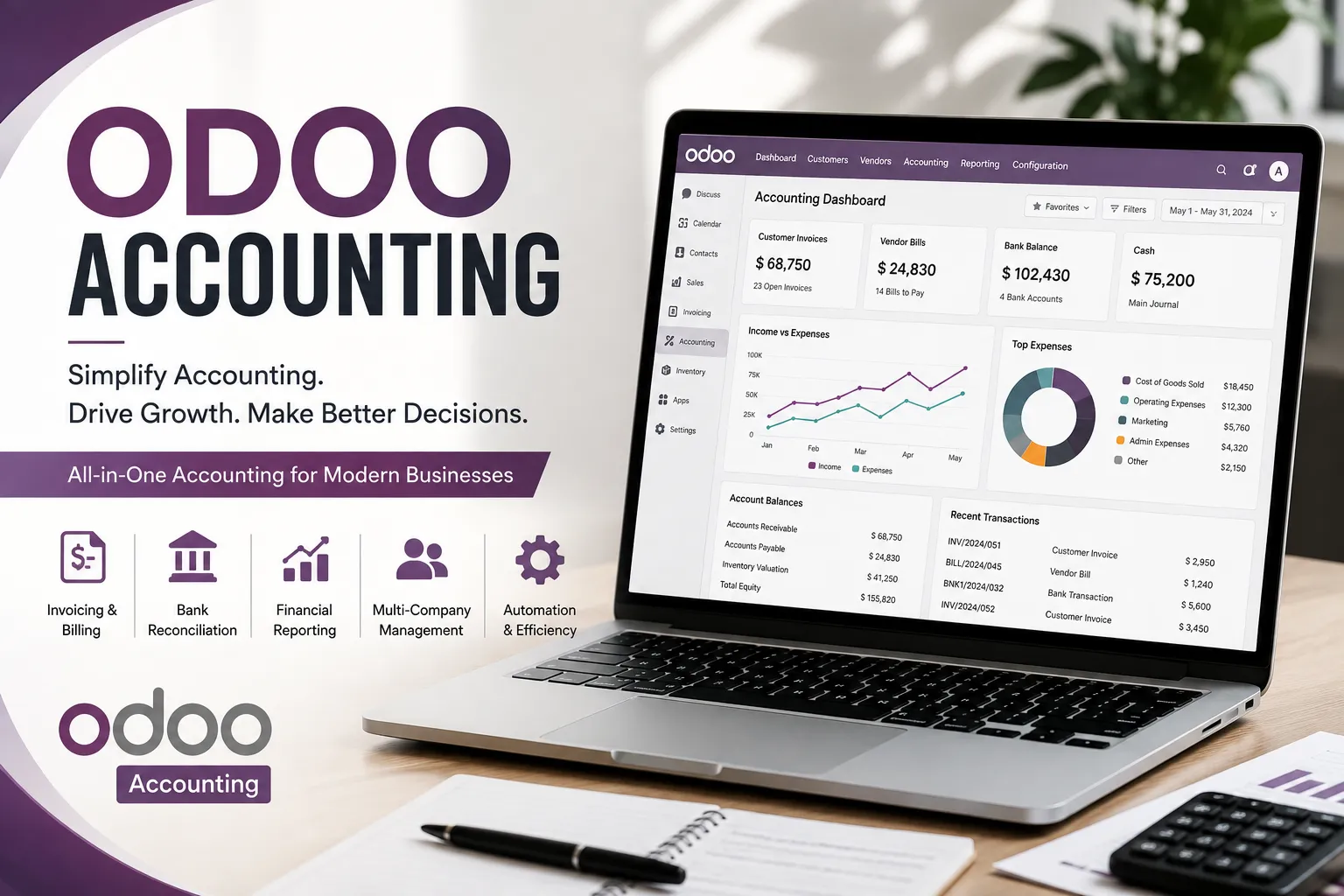

Managing business finances becomes increasingly complicated as a company grows. More customers, vendors, transactions, employees, inventory, sales channels, and business entities can quickly make accounting difficult to manage with disconnected tools and spreadsheets.
This is where an integrated ERP platform such as Odoo can make a difference.
Odoo combines accounting with other core business functions, allowing companies to connect financial information with sales, purchasing, inventory, expenses, invoicing, and other operational activities.
However, simply having Odoo in place does not guarantee accurate financial reporting or efficient accounting. Businesses also need well-designed accounting workflows, proper configuration, regular reconciliations, and reliable financial controls.
Understanding how Odoo accounting works and how businesses can use it effectively can help companies get more value from their ERP investment.
What Is Odoo Accounting?
Odoo Accounting is the financial management component of the Odoo ERP platform. It helps businesses manage accounting and financial activities within an integrated business environment.
Depending on the company's requirements and configuration, Odoo can support processes such as:
- General ledger management
- Accounts payable
- Accounts receivable
- Customer invoicing
- Vendor bills
- Bank reconciliation
- Expense management
- Financial reporting
- Tax management
- Payment processing
- Budget management
- Multi-company accounting
One of the main advantages of Odoo accounting is its connection with other Odoo applications.
For example, a sales order can be connected to invoicing, while purchasing and inventory activities can flow into the company's broader financial processes. This reduces the need to repeatedly move information between unrelated systems.
Why Growing Businesses Need Better Accounting Systems
A basic accounting system may be sufficient when a company has a limited number of transactions and a simple operating model.
As the business grows, however, accounting becomes more demanding.
An ecommerce company might manage multiple sales channels, payment processors, inventory locations, refunds, and returns. A service-based business may need to manage projects, expenses, invoices, and recurring customers. A growing company may also have multiple entities or locations.
Without an integrated system, finance teams may spend significant time collecting information from different sources.
This can result in:
- Duplicate data entry
- Inconsistent financial information
- Delayed reconciliations
- Slow month-end closing
- Limited visibility into cash flow
- Reporting difficulties
- Increased risk of accounting errors
Odoo can help address these challenges by bringing financial and operational information into a connected ERP environment.
Key Benefits of Odoo Accounting
1. Centralized Financial Data
One of the biggest benefits of an ERP-based accounting system is centralization.
Instead of maintaining financial information across spreadsheets and separate applications, businesses can manage accounting information within Odoo.
This can give finance teams a more consistent view of transactions, receivables, payables, expenses, and other financial activities.
Centralized data can also make it easier for business owners and managers to access information when making financial decisions.
2. Better Integration With Business Operations
Accounting does not operate independently from the rest of a business.
Sales generate revenue. Purchases create expenses and inventory movements. Employee expenses affect financial statements. Inventory changes can affect the cost structure of an ecommerce or retail business.
Odoo connects these activities through its integrated ERP architecture.
This means financial teams can work with information generated by other parts of the business instead of manually collecting data from multiple platforms.
3. Streamlined Invoicing and Billing
Creating and managing invoices can become time-consuming when businesses rely heavily on manual processes.
Odoo can help businesses manage customer invoices, vendor bills, payments, and related accounting activities from a centralized system.
For businesses with recurring transactions or high invoice volumes, reducing manual steps can improve efficiency and allow accounting professionals to focus on more valuable work.
4. Easier Bank Reconciliation
Bank reconciliation is one of the most important recurring accounting processes.
Businesses need to compare recorded transactions with bank activity to identify discrepancies and ensure that financial records are accurate.
Odoo provides tools that can support bank reconciliation and help finance teams match transactions more efficiently.
However, automation should still be supported by appropriate review procedures. Automated matching is useful, but unusual transactions and exceptions still require human judgment.
5. Improved Financial Reporting
Reliable financial reports help business owners understand how their company is performing.
Odoo accounting can support financial reporting around areas such as:
- Revenue
- Expenses
- Profit and loss
- Assets and liabilities
- Accounts receivable
- Accounts payable
- Cash position
- Taxes
- Customer and vendor activity
The value of these reports depends on the accuracy and structure of the underlying accounting data.
A well-maintained Odoo environment can therefore provide management with more timely financial information for decision-making.
Odoo Accounting for Ecommerce Businesses
Ecommerce companies often have accounting requirements that become complicated as transaction volumes increase.
An online business may sell products through its own website, marketplaces, wholesale channels, and other sales platforms. It may also deal with payment processing fees, shipping costs, refunds, returns, inventory adjustments, and multiple warehouses.
Odoo can connect several of these operational processes with accounting.
For example, sales activity can connect with invoicing, while inventory operations can provide information relevant to financial reporting and cost management.
This integrated approach can help ecommerce businesses reduce dependence on disconnected spreadsheets and improve visibility across financial and operational processes.
Odoo Accounting for Growing and Multi-Company Businesses
Growth can introduce another layer of accounting complexity.
Businesses may expand into new locations, create subsidiaries, or begin operating multiple companies. Managing financial information across these structures can become challenging if every entity operates independently.
Odoo supports multi-company environments, allowing businesses to manage different company structures within the broader ERP environment.
The exact setup depends on factors such as the company's legal structure, reporting requirements, currencies, tax obligations, and accounting policies.
Proper configuration is therefore important when implementing Odoo for a growing organization.
Why Odoo Configuration Matters
Odoo is flexible, but flexibility also means businesses need to make thoughtful decisions about how the system should be configured.
For example, companies may need to determine:
- How the chart of accounts should be structured
- How products should be mapped to financial accounts
- How taxes should be configured
- How customer and vendor transactions should be recorded
- How inventory transactions affect accounting
- How payment methods should be reconciled
- Which financial reports management requires
- Which users should have access to specific accounting functions
Poor configuration can create problems even when the ERP itself is technically working as expected.
For this reason, accounting knowledge is just as important as software knowledge.
Odoo Accounting Services: When Businesses May Need Support
Not every business needs outside accounting assistance. However, professional support can be useful during an Odoo implementation, accounting migration, business expansion, or when the internal finance team is dealing with a growing workload.
Companies may consider Odoo accounting services when they need assistance with bookkeeping, reconciliations, financial reporting, accounting processes, or maintaining accurate financial records within Odoo.
External accounting support can be particularly useful for growing businesses that have a lean internal finance team but increasingly complex accounting requirements.
The objective should not simply be to outsource accounting tasks. The bigger goal is to establish reliable processes that provide management with accurate and timely financial information.
How Businesses Can Get More From Odoo Accounting
Implementing Odoo is only the starting point. Businesses should also establish processes that help maintain financial accuracy and efficiency.
Establish Consistent Accounting Workflows
Recurring accounting processes should be documented and standardized.
This may include invoicing, bill processing, bank reconciliation, expense review, account reconciliation, and month-end close procedures.
Standardized workflows make it easier to identify errors and maintain consistency as the business grows.
Automate Repetitive Tasks
Automation can reduce the amount of time finance teams spend on repetitive administrative activities.
However, automation should be implemented selectively. Businesses should maintain appropriate review and approval procedures for transactions that require financial judgment.
Maintain Accurate Financial Records
ERP software cannot compensate for inaccurate underlying data.
Businesses should regularly review account balances, reconcile financial accounts, investigate unusual transactions, and correct errors promptly.
Review the Chart of Accounts
The chart of accounts should provide enough detail for useful financial reporting without becoming unnecessarily complicated.
As the company changes, its accounting structure may also need to evolve.
Monitor Key Financial Metrics
Businesses should determine which financial metrics are most important to their operations.
Depending on the business model, these might include revenue, gross margin, operating expenses, accounts receivable, cash flow, inventory costs, or profitability by product or business unit.
The purpose of an ERP is not simply to store financial information but to make that information useful for decision-making.
Odoo Accounting vs. Traditional Accounting Tools
Traditional accounting software can work well for businesses with relatively straightforward financial requirements.
However, companies that need stronger connections between accounting and operational processes may benefit from an ERP approach.
Odoo can connect accounting with areas such as:
- Sales
- Purchasing
- Inventory
- CRM
- Expenses
- Projects
- Manufacturing
- E-commerce
This integrated structure can reduce the need to maintain separate systems for every business function.
That does not mean Odoo is automatically the right choice for every organization. Businesses should evaluate their transaction volume, workflows, industry requirements, budget, integrations, and future growth plans before selecting an ERP.
Final Thoughts
Odoo accounting can provide growing businesses with a centralized way to manage financial information while connecting accounting with broader business operations.
Its value goes beyond recording transactions. When properly configured and maintained, Odoo can help businesses streamline invoicing, improve reconciliation processes, strengthen financial reporting, and create more scalable accounting workflows.
However, technology alone is not enough.
Accurate accounting requires appropriate processes, financial controls, regular reconciliations, and knowledgeable oversight. Businesses that combine Odoo's ERP capabilities with sound accounting practices can create a stronger financial foundation for growth.
For companies evaluating Odoo or already using the platform, the focus should be on building an accounting environment that is accurate, efficient, and capable of supporting the organization's changing needs.





























Sign in to leave a comment.