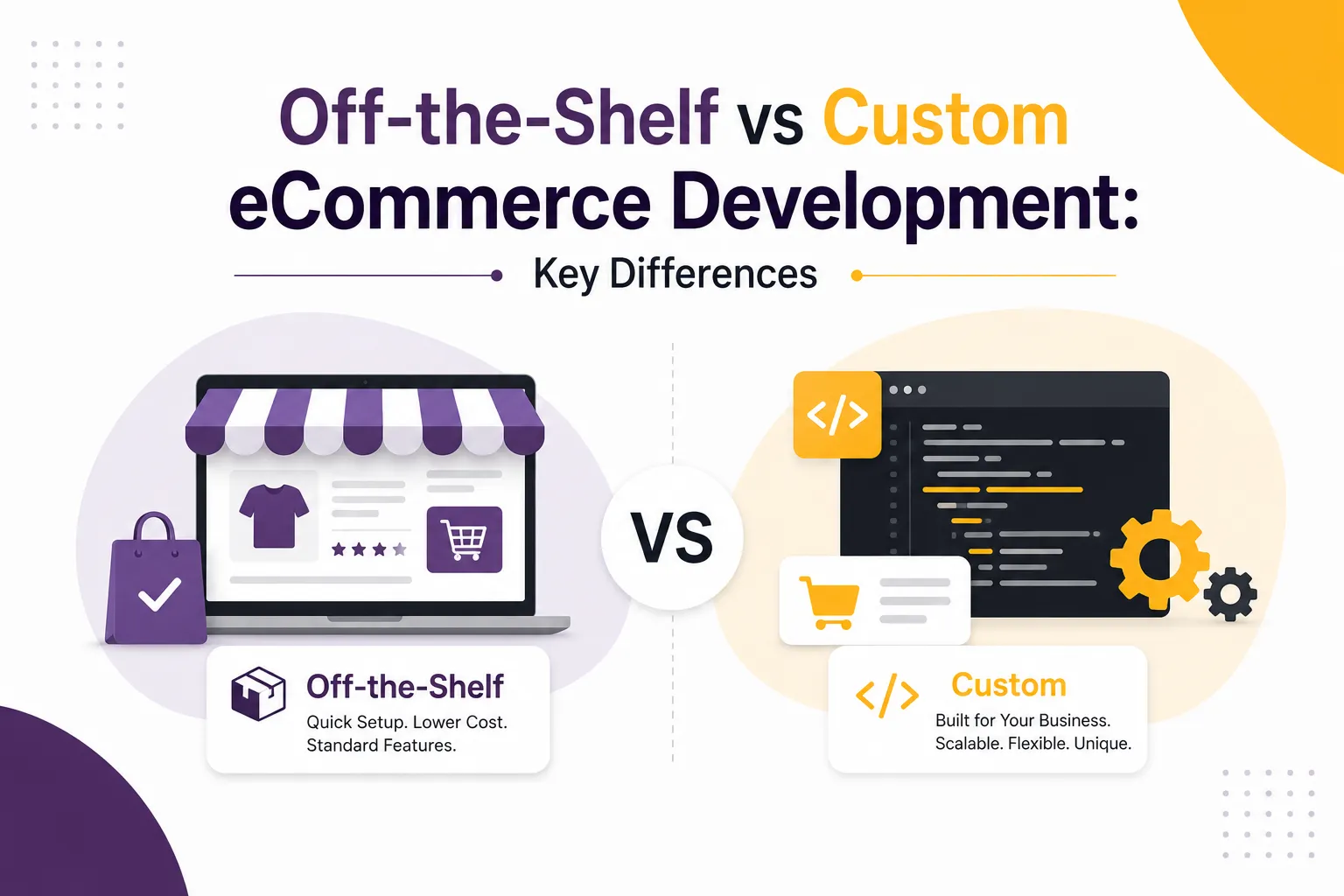

Choosing an ecommerce platform isn't really a question of "which option is better." Both off-the-shelf app development and custom ecommerce development can work well — plenty of successful stores run on each. The real question is whether the platform can support the way your business operates today, and how it plans to operate two or three years from now.
An off-the-shelf platform gives you a faster starting point. Custom eCommerce Development gives you more control over how the store actually works. The gap between the two only starts to matter once your catalog, integrations, customer types, or order workflows get more complicated than the platform was built to handle.
Speed vs. Control
Off-the-shelf platforms exist for businesses that want to start selling without a long development cycle. You pick a platform, configure the store, connect payment and shipping, and you're live.
That speed is a genuine advantage, and for a lot of stores it's the right call.
Custom development runs on a different clock. Requirements get defined, architecture gets planned, interfaces get designed, and the application gets built and tested before anything launches. It takes longer — but what comes out the other end is built around your specific business processes, not the other way around.
The choice is easy when the priority is getting live fast. It gets harder when your existing workflow doesn't fit the standard platform's assumptions.
Standard Features vs. Business-Specific Workflows
Most ecommerce businesses need the same core functions: product management, checkout, payments, customer accounts, order processing, shipping. Off-the-shelf platforms handle all of this well — this isn't where they struggle.
The problems show up around the edges.
Take a B2B company with customer-specific pricing, multi-level approvals, negotiated catalogs, purchase limits, and different payment terms per account. You can bolt on apps and extensions to approximate this, but every exception you add stacks complexity on top of a system that wasn't designed for it. Custom ecommerce development lets those rules live in the application's core logic instead of a pile of disconnected add-ons trying to talk to each other.
Integration Is Where the Difference Gets Real
A modern store rarely operates alone. It may need to talk to an ERP, CRM, warehouse management system, payment gateway, accounting platform, marketplace, and internal analytics tools — all at once, all in sync.
Off-the-shelf platforms cover the popular integrations well. If your stack is fairly standard, that's genuinely enough.
Custom development earns its cost when your integrations are business-critical or unusual enough that off-the-shelf connectors don't map cleanly. APIs and data flows get built around the systems your company already runs — not the other way around.
Galaxy Weblinks' Off-the-Shelf vs Custom eCommerce Development guide goes deeper into exactly this tradeoff — including where integration flexibility and long-term architectural control tend to outweigh the faster off-the-shelf setup, and what that shift usually costs in practice.
Upfront Cost vs. Total Cost
This is where most comparisons get too simple.
Off-the-shelf software costs less to launch — that part's true. What it doesn't advertise up front is the ongoing stack of subscriptions, premium themes, paid apps, transaction fees, integration tools, and per-user charges that accumulate month over month. None of these show up on the initial invoice, but they show up on every invoice after.
Custom development front-loads the cost: design, development, testing, infrastructure, deployment. It's a bigger number on day one.
Run both forward three years, though, and the comparison can flip. A store paying for six extensions and a handful of workarounds every month can end up spending more over time than the "expensive" custom build — the initial invoice was never the real number. The right comparison is total cost of ownership, not launch price.
Scalability Isn't Just About Traffic
When people talk about ecommerce scalability, they default to thinking about traffic — can the platform handle a surge on Black Friday. That's the easy part. Most platforms, off-the-shelf or custom, handle traffic fine.
The harder scaling problem is operational complexity. Adding a second warehouse with its own fulfillment rules. Expanding into a market with different tax logic and currency handling. Introducing a wholesale customer group alongside your retail one. A platform that comfortably serves 10,000 visitors a day can still hit a wall here — not because it can't handle the load, but because its architecture wasn't built to express rules that specific.
Custom ecommerce development lets the underlying architecture evolve alongside these requirements as they show up. Off-the-shelf platforms can absolutely scale too, but you're scaling within whatever the platform's customization ceiling allows — and that ceiling is real, even if you don't hit it on day one.
The Middle Option Most Businesses Actually Land On
Off-the-shelf and custom aren't the only two choices, and treating them as a binary undersells how most growing businesses actually solve this.
The more common path: start on an established platform, and build custom only where your business genuinely differs from the standard pattern — a custom pricing engine, a specific fulfillment workflow, one deep integration that matters more than the rest. You get the platform's speed and maintenance for the 80% that's standard, and custom development for the 20% that isn't. You don't need to build an entire commerce platform from zero to get real control over the parts that matter.
Who Should Choose What?
Off-the-shelf app development makes sense when your products, checkout, fulfillment, and integrations follow common ecommerce patterns, launch speed matters more than deep customization, and you'd rather the platform provider handle the maintenance burden.
Custom eCommerce Development makes sense when unique pricing, ordering, fulfillment, or integration workflows are core to how you compete — not edge cases — or when the number of plugins and workarounds propping up your current setup has become its own maintenance problem.
A hybrid approach makes sense when most of your operation is standard but one or two workflows are genuinely non-negotiable for your business.
The Better Question to Ask
Instead of "should we choose custom or off-the-shelf," ask: which parts of our ecommerce operation are standard, and which parts are where we actually compete?
Keep the standard parts on a proven platform — there's no reason to rebuild checkout from scratch. Put custom development where your workflows, integrations, or customer experience need more control than the platform can give you.
That's a better way to make this decision than comparing feature lists. The right architecture for Off-the-Shelf vs Custom eCommerce Development isn't the one with the most features — it's the one that matches how your business actually sells, fulfills, and grows. For a deeper breakdown of costs, architecture, and ROI on the custom side of that decision, Galaxy Weblinks' Off-the-Shelf vs Custom eCommerce Development guide is worth the full read.



























Sign in to leave a comment.