Offshore .NET Developers vs In-House Developers: Cost & Benefits

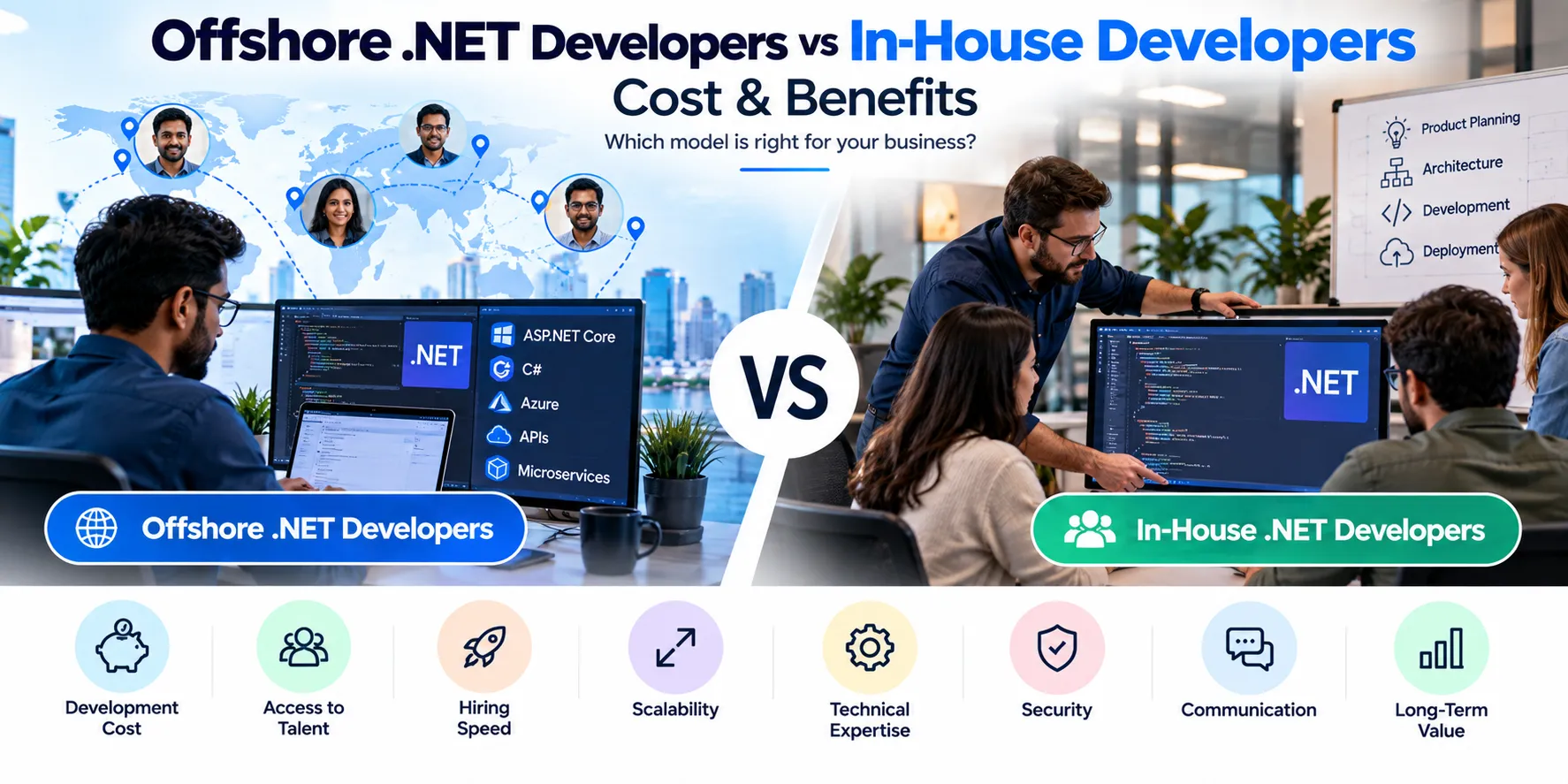
Choosing between offshore .NET developers and in-house developers is an important decision for businesses building, modernizing, or maintaining software applications. The choice affects not only development costs but also hiring speed, technical expertise, scalability, communication, project control, and long-term maintenance.
For companies working with Microsoft technologies, the decision becomes even more relevant as applications increasingly involve ASP.NET Core, Azure, APIs, microservices, cloud-native architecture, AI integrations, and enterprise systems.
An in-house team can provide close collaboration and direct organizational control. Offshore development, meanwhile, can provide access to specialized talent, flexible team sizes, and potentially lower development costs.
So, which model is better?
The answer depends on the project, budget, timeline, technical requirements, and long-term business strategy.
This guide compares offshore .NET developers vs. in-house developers across cost, benefits, productivity, communication, scalability, security, and hiring models.
Offshore .NET Developers vs. In-House: Quick Comparison
| Factor | Offshore .NET Developers | In-House .NET Developers |
|---|---|---|
| Initial hiring cost | Generally lower | Generally higher |
| Access to talent | Global | Local talent pool |
| Hiring speed | Often faster | Can take longer |
| Scalability | High | Moderate |
| Infrastructure | Usually provided by vendor | Company responsibility |
| Employee benefits | Usually not direct | Company responsibility |
| Management control | Shared | Direct |
| Time-zone flexibility | Depends on provider | Usually easier collaboration |
| Long-term ownership | Depends on engagement | Strong |
| Best for | Flexible development & scaling | Core internal engineering |
What Are Offshore .NET Developers?
Offshore .NET developers are software professionals located outside the company's primary operating country who work remotely on .NET development projects.
For example, a U.S.-based company may work with .NET developers located in India, Eastern Europe, Latin America, or another global technology hub.
Offshore developers can work on:
- ASP.NET applications
- .NET Core development
- Enterprise software
- SaaS platforms
- APIs
- Microservices
- Azure applications
- Legacy .NET migration
- Database integration
- E-commerce platforms
- AI-powered applications
- Third-party integrations
Companies can work with individual developers, dedicated teams, or an outsourced development partner.
What Are In-House .NET Developers?
In-house .NET developers are employees hired directly by the company.
They typically work as part of the organization's internal engineering department and participate directly in:
- Product planning
- Architecture decisions
- Sprint planning
- Code reviews
- Development
- QA collaboration
- Deployment
- Maintenance
- Technical strategy
For companies where software is a core part of the business, maintaining an internal engineering team can provide significant strategic advantages.
Offshore .NET Developers: Key Benefits
1. Lower Development Costs
Cost is one of the biggest reasons companies consider offshore development.
Hiring an in-house developer involves more than salary. Businesses may also need to account for:
- Recruitment
- Employee benefits
- Payroll taxes
- Insurance
- Office infrastructure
- Equipment
- Training
- Software licenses
- Paid leave
- Recruitment fees
With an offshore development partner, many of these expenses are incorporated into the development engagement.
This can make offshore development particularly attractive to startups, SaaS businesses, and companies working with fixed technology budgets.
However, businesses shouldn't compare offshore rates with salaries alone. The correct comparison is total cost of ownership.
2. Access to a Larger Talent Pool
Hiring locally limits a business to developers who are available in its geographic market.
Offshore development opens access to a global talent pool.
This can make it easier to find specialists in areas such as:
- .NET Core
- ASP.NET
- C#
- Microsoft Azure
- SQL Server
- Entity Framework
- REST APIs
- Microservices
- DevOps
- AI integration
This becomes especially valuable when a project requires a specific technical skill that is difficult to find locally.
3. Faster Team Scaling
Suppose a company suddenly needs:
- 2 .NET developers
- 1 QA engineer
- 1 UI developer
- 1 DevOps engineer
Building this team internally could take weeks or months.
An offshore provider may already have developers available and can scale the team based on project requirements.
This flexibility is one of the biggest advantages of outsourcing.
4. Access to Specialized Expertise
A good offshore development partner may have experience across multiple industries and technology stacks.
Instead of hiring a permanent specialist for one project, businesses can access expertise when needed.
For example, a company migrating a legacy application to ASP.NET Core and Azure may need cloud migration expertise for several months.
After the migration is complete, maintaining a full-time cloud specialist may no longer be necessary.
An offshore model can provide more flexibility.
5. Faster Project Initiation
Recruiting, interviewing, negotiating, onboarding, and training employees can delay software projects.
A specialized development provider can often begin with an existing team structure.
This can help businesses move from:
Project Requirements → Developer Allocation → Development
more quickly.
Benefits of In-House .NET Developers
Offshore development isn't automatically better.
In-house developers have several important advantages.
1. Greater Direct Control
With an internal team, management has direct control over:
- Work priorities
- Development processes
- Communication
- Architecture
- Security policies
- Performance expectations
- Product direction
For highly strategic software products, this level of control can be valuable.
2. Better Product Knowledge
An in-house developer working on the same product for years can develop deep knowledge of:
- Business logic
- Customer behavior
- Internal processes
- Technical architecture
- Legacy code
- Product roadmap
That institutional knowledge can become an important competitive advantage.
Offshore teams can develop similar knowledge, but it requires strong documentation, communication, and long-term collaboration.
3. Easier Real-Time Collaboration
When developers, product managers, designers, QA engineers, and executives work in the same organization and time zone, communication can be simpler.
Daily meetings, brainstorming sessions, architecture discussions, and emergency troubleshooting can happen immediately.
This is particularly useful for projects with constantly changing requirements.
4. Stronger Long-Term Ownership
Internal developers are directly invested in the company's product and technology roadmap.
They can contribute beyond individual projects by participating in:
- Technology strategy
- Architecture planning
- Innovation
- Hiring
- Mentoring
- Internal standards
- Long-term technical decisions
For technology companies where software is the primary product, this ownership can be highly valuable.
Offshore vs. In-House .NET Developer Costs
The cost difference isn't simply:
Offshore = Cheap
and
In-house = Expensive.
Businesses need to evaluate the entire financial model.
In-house costs may include:
- Base salary
- Benefits
- Recruitment
- Payroll
- Equipment
- Office space
- Training
- Paid leave
- Insurance
- Bonuses
- HR administration
- Employee retention
Offshore costs may include:
- Developer or team fees
- Project management
- Communication overhead
- Vendor management
- Security requirements
- Knowledge-transfer costs
- Infrastructure requirements
The final cost depends heavily on the location, developer seniority, engagement model, technology requirements, and project complexity.
When Should You Choose Offshore .NET Developers?
Offshore development can make sense when:
You need to reduce development costs
Companies with limited budgets can access global talent without establishing a large local engineering department.
You need developers quickly
If a product launch is approaching, offshore teams can sometimes provide faster access to available developers.
You need temporary expertise
For migrations, integrations, modernization, or specific technical projects, outsourcing can provide specialized skills without permanent hiring.
You need to scale rapidly
Businesses experiencing rapid growth can increase or decrease development capacity according to demand.
You don't want to build a large internal QA and development department
An offshore partner can potentially provide development, QA, DevOps, and project management capabilities under one engagement.
When Should You Choose In-House .NET Developers?
An internal team may be preferable when:
- Software is the company's primary competitive advantage
- Product requirements change constantly
- Highly sensitive intellectual property is involved
- Long-term architecture ownership is essential
- Close collaboration is required every day
- The company has the budget to maintain a permanent engineering team
For example, a technology company building a proprietary platform that defines its entire business may benefit significantly from maintaining core engineering expertise internally.
A Hybrid Model Can Be the Best Option
Businesses don't necessarily have to choose between 100% offshore and 100% in-house.
A hybrid development model can combine both.
For example:
Internal team
- CTO
- Product manager
- Solution architect
- Senior developers
Offshore team
- .NET developers
- QA engineers
- UI developers
- DevOps engineers
- Automation specialists
The internal team maintains product ownership and architecture while the offshore team provides additional development capacity.
This model can provide a strong balance between control and scalability.
Hire Dedicated .NET Developers Instead of Building a Full Team
For businesses that want more control than traditional project outsourcing provides, a dedicated developer model can be an effective alternative.
When you Hire Dedicated .NET Developers, the developers work specifically on your project for an agreed period rather than being shared across unrelated projects.
A dedicated team can include:
- Senior .NET developers
- ASP.NET Core developers
- Full-stack .NET developers
- Azure developers
- Backend developers
- QA engineers
- DevOps engineers
This approach provides greater continuity while maintaining the flexibility of an offshore development model.
What to Look for When Hiring Offshore .NET Developers
Cost shouldn't be the only selection criterion.
Before choosing an offshore developer or development company, evaluate:
Technical Expertise
Check experience with:
- C#
- .NET
- ASP.NET Core
- Entity Framework
- SQL Server
- REST APIs
- Microservices
- Azure
- Docker
- CI/CD
Communication
Ask about:
- Working hours
- Time-zone overlap
- Communication tools
- Reporting
- Sprint meetings
- Escalation processes
Security
For sensitive applications, evaluate:
- Access controls
- Secure development practices
- NDA procedures
- Code ownership
- Data protection
- Infrastructure security
Development Process
Understand whether the team follows:
- Agile
- Scrum
- DevOps
- Code reviews
- Automated testing
- CI/CD
- Documentation standards
Portfolio and Experience
Look for experience with projects similar to yours.
A provider experienced in simple websites may not be the right choice for a complex enterprise .NET platform.
Common Mistakes When Choosing Offshore Developers
Choosing Based Only on Price
The cheapest developer isn't necessarily the most cost-effective.
Poor-quality code can result in:
- More bugs
- Higher maintenance costs
- Security vulnerabilities
- Delayed releases
- Technical debt
Evaluate value rather than hourly price alone.
Not Defining Requirements
Before development begins, establish:
- Project scope
- Technology stack
- Deliverables
- Timeline
- Communication process
- Quality standards
- Ownership
- Support requirements
Ignoring Time-Zone Differences
Time-zone differences can either be an advantage or a problem.
A properly managed offshore team can provide extended development coverage, but companies should establish overlapping working hours for important meetings and issue resolution.
Offshore vs. In-House: Which Is Better?
There is no universal answer.
Offshore .NET developers are generally better when you prioritize:
Cost efficiency + scalability + global talent + faster team expansion
In-house .NET developers are generally better when you prioritize:
Control + institutional knowledge + product ownership + continuous collaboration
A hybrid model is often ideal when you need:
Internal product ownership + external development capacity
The right choice should be based on the project's strategic importance, budget, complexity, timeline, and long-term maintenance requirements.
Why Consider Tabdelta for .NET Development?
For companies that want to access offshore development expertise without completely giving up control, Tabdelta Solutions offers dedicated .NET development engagement models.
Businesses can Hire Dedicated .NET Developers for ongoing projects or build teams around specific requirements, including .NET development, ASP.NET Core, APIs, cloud applications, enterprise software, and modernization projects.
A dedicated engagement can be particularly useful when a company needs additional engineering capacity but doesn't want the cost and administrative overhead of recruiting an entire in-house team.
The key is to establish clear communication, development standards, code ownership, security practices, and project objectives from the beginning.
Final Verdict
The decision between offshore .NET developers and in-house developers should not be based purely on hourly development rates.
In-house teams provide control, product knowledge, and long-term ownership. Offshore teams can provide access to global talent, lower operational overhead, faster scaling, and specialized technical expertise.
For many businesses, the best solution is somewhere between the two.
A hybrid or dedicated development model can allow companies to retain internal control over product strategy while using offshore developers to expand engineering capacity.
If your business needs additional .NET expertise without committing to the full cost of an internal engineering department, choosing to Hire Dedicated .NET Developers can provide a practical middle ground between traditional outsourcing and permanent hiring.
Ultimately, the best model is the one that delivers the right combination of technical expertise, development speed, quality, communication, scalability, and total cost of ownership for your specific business.
Frequently Asked Questions
1. Are offshore .NET developers cheaper than in-house developers?
They can be more cost-efficient because businesses may avoid several costs associated with direct employment, including recruitment, benefits, office infrastructure, and payroll administration. However, total cost depends on project scope and developer expertise.
2. Should a startup hire offshore .NET developers?
For many startups, offshore development can provide access to experienced developers without the cost of establishing a large internal team.
3. What is the difference between offshore and dedicated .NET developers?
Offshore describes the developer's geographic location relative to the client. Dedicated describes the engagement model. A company can Hire Dedicated .NET Developers who are located offshore and work exclusively on its project.
4. Can offshore .NET developers work with an in-house team?
Yes. A hybrid model can combine internal product and architecture teams with offshore .NET developers, QA engineers, and other specialists.
5. What skills should a .NET developer have?
Depending on the project, relevant skills may include C#, .NET, ASP.NET Core, SQL Server, Entity Framework, REST APIs, Azure, microservices, Docker, CI/CD, and cloud development.
6. Is offshore development secure?
It can be secure when the provider follows appropriate security practices, access controls, confidentiality agreements, secure coding standards, and data-protection procedures.
7. When should I hire dedicated .NET developers?
A dedicated team is particularly useful for long-term development, product modernization, SaaS development, enterprise applications, ongoing maintenance, and projects requiring continuous developer involvement.
8. Is a hybrid .NET development model better than fully offshore development?
It can be. A hybrid approach allows the company to retain strategic ownership internally while using offshore resources to increase development capacity and control costs.









Sign in to leave a comment.