
Introduction
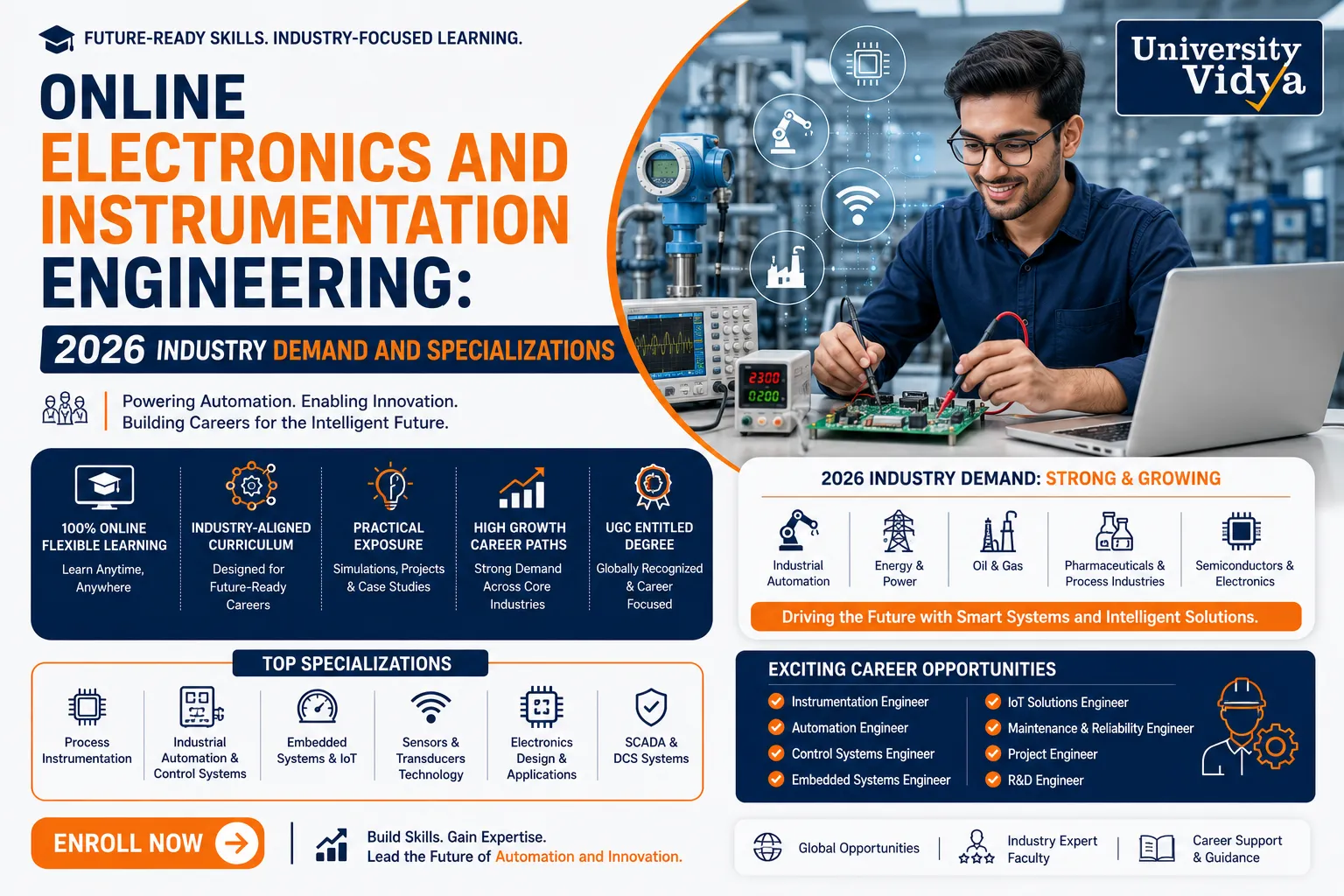
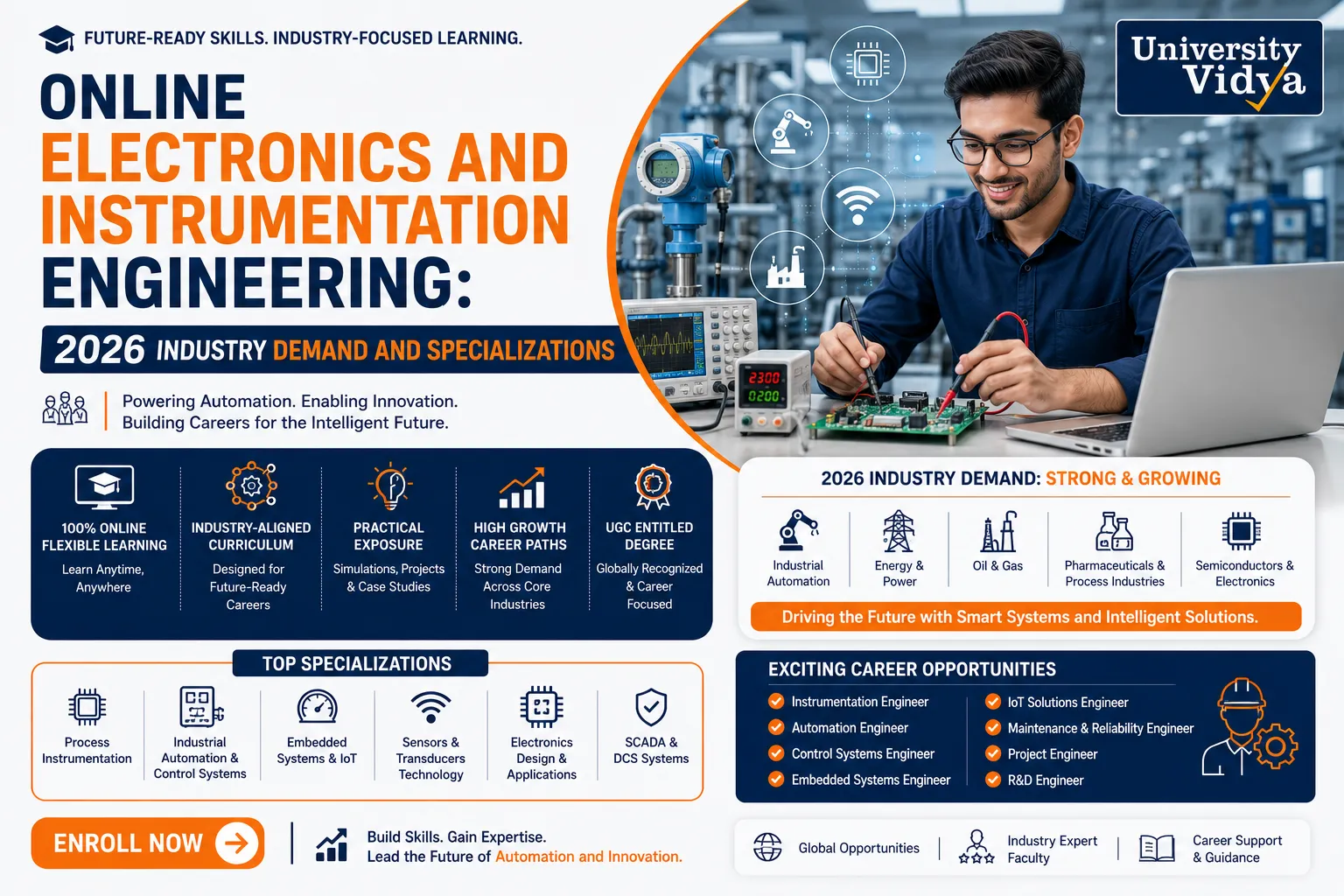
Behind every automated factory, every oil refinery, every pharmaceutical plant, and every power generation unit in India there are instruments measuring, monitoring, and controlling critical processes in real time. The engineers who design, calibrate, and maintain these systems belong to a discipline that most people have never heard of but every major industry depends on: Electronics and Instrumentation Engineering. In 2026, as India's manufacturing, energy, and process industries scale up under National Manufacturing Policy targets, the demand for EIE professionals is surging and the Online Electronics and Instrumentation Engineering Course is making this specialist career accessible without a full-time college commitment. This blog covers everything you need to know.
What Is Electronics and Instrumentation Engineering?
EIE Electronics and Instrumentation Engineering is a four-year B.Tech discipline that combines electronics engineering fundamentals with the science and technology of measurement, sensing, control, and automation systems.
Where ECE focuses on communication networks and semiconductors, and EEE focuses on power systems and drives EIE focuses on the instrumentation layer: the sensors, transmitters, controllers, and actuators that measure and regulate temperature, pressure, flow, level, and composition in industrial processes.
In practice, an EIE engineer understands:
- How to select and calibrate industrial sensors (thermocouples, RTDs, pressure transmitters, flow meters)
- How to design and programme PLC and DCS-based control systems
- How to integrate SCADA systems for remote process monitoring
- How to apply process control theory to industrial loops
- How to maintain and troubleshoot field instruments in hazardous environments
This combination of electronics knowledge and process control expertise is what makes EIE engineers uniquely valuable in industries where measurement accuracy and process reliability are mission-critical.
EIE vs ECE Online Understanding the Difference
One of the most searched comparisons is EIE vs ECE online and it is worth addressing clearly before discussing programs.
ECE (Electronics and Communication Engineering):
- Focuses on communication systems, semiconductor devices, signal processing, and wireless networks
- Career concentration: Telecom, VLSI, embedded systems, defense electronics, consumer electronics
- Broader employment base across IT, telecom, and electronics manufacturing
EIE (Electronics and Instrumentation Engineering):
- Focuses on industrial measurement, process control, automation, and sensor technology
- Career concentration: Oil and gas, petrochemicals, power plants, pharmaceuticals, water treatment, food processing
- More specialised but higher average pay in process industries and PSUs
EIE vs ECE is essentially a choice between two different industrial worlds ECE is about how signals and information are communicated; EIE is about how physical processes are measured and controlled. If your interest lies in factories, refineries, and industrial automation rather than communication networks and chips EIE is the right branch.
Who Should Pursue an Online EIE Course?
The EIE online India pathway is most valuable for:
- Class 12 PCM students interested in industrial automation and process control careers
- ITI certificate holders in instrument mechanic or electrician trades wanting a formal engineering degree
- Polytechnic diploma holders in Instrumentation Engineering or Electronics targeting lateral B.Tech entry
- Working instrument technicians and field engineers in oil and gas, power, or chemical industries without a formal B.Tech
- Government engineers in PSUs like ONGC, BPCL, HPCL, NTPC, or GAIL who need a degree for grade revision
- Process control engineers in pharmaceutical or food processing industries wanting academic credentials
- Engineers transitioning from electrical or electronics roles into industrial automation and process industries
Online EIE Scope Where EIE Engineers Work in 2026
The online EIE scope is concentrated in India's process-intensive industries sectors where precision measurement and reliable control are non-negotiable:
Oil, Gas, and Petrochemicals This is the largest and highest-paying employer of EIE professionals in India. ONGC, HPCL, BPCL, IOC, Cairn, and private refineries all employ EIE engineers for instrument calibration, field device maintenance, control room operations, and instrumentation project engineering. Offshore oil rigs, onshore refineries, and LNG terminals require permanent EIE engineering teams.
Power Generation Thermal, Nuclear, and Hydro Coal-based and combined cycle power plants rely on instrumentation for boiler drum level control, turbine speed regulation, steam pressure management, and combustion optimisation. NTPC, Adani Power, Tata Power, and state electricity generation companies are major employers. Nuclear power plants operated by NPCIL employ specialist instrumentation engineers for reactor control systems.
Pharmaceutical and Life Sciences Manufacturing India's pharmaceutical industry the world's largest generic drug producer requires EIE engineers for process validation, environmental monitoring, GMP-compliant control systems, and regulatory documentation. Roles in pharma instrumentation engineering are among the most compliance-intensive and well-compensated.
Water and Wastewater Treatment Municipal water supply projects, industrial effluent treatment plants, and desalination projects under the Jal Jeevan Mission require instrumentation for flow measurement, pH monitoring, chemical dosing control, and filtration system automation.
Chemical and Fertiliser Plants Large chemical and fertiliser manufacturers such as GNFC, GSFC, RCF, and NFL employ EIE engineers for reactor instrumentation, safety instrumented systems (SIS), and distributed control system (DCS) operations.
Food and Beverage Manufacturing Temperature control, fill level monitoring, bottling automation, and quality assurance instrumentation in food and beverage plants require EIE professionals with knowledge of hygienic instrument standards.
Smart Manufacturing and Industry 4.0 The convergence of IoT, AI, and industrial automation under Industry 4.0 is creating new demand for EIE engineers who can bridge traditional field instrumentation with digital data platforms, predictive maintenance systems, and smart sensor networks.
Salary Outlook:
- Fresh B.Tech EIE graduate: ₹3 LPA to ₹6 LPA
- With 3 to 5 years experience in oil and gas or pharmaceuticals: ₹7 LPA to ₹15 LPA
- Senior instrumentation engineer or project engineer in PSU: ₹12 LPA to ₹22 LPA
- Specialist DCS/SIS engineer in refinery or LNG terminal: ₹18 LPA to ₹35 LPA
Online B.Tech EIE Eligibility Requirements
Standard eligibility for online B.Tech EIE hybrid programs:
- Education: Class 12 with Physics, Chemistry, and Mathematics from a recognised board
- Minimum marks: 45% to 55% in PCM aggregate (varies by institution)
- Entrance requirement: JEE Main scores at AICTE-approved institutions; institutional entrance tests at others; direct merit admission at select programs
- Lateral entry: 3-year polytechnic diploma holders in Instrumentation Engineering, Electronics, or Electrical can enter directly into Year 2 a three-year path to the B.Tech degree
- ITI holders: Instrument Mechanic ITI certificate holders may qualify through bridge courses at select institutions
- Age limit: 17 to 23 years for fresh applicants; most hybrid and distance programs carry no upper age limit
Online EIE Syllabus Four-Year Curriculum Structure
A standard online electronics and instrumentation engineering course curriculum covers:
Year 1 Engineering Foundation
- Engineering Mathematics (Calculus, Differential Equations, Probability)
- Basic Electronics and Electrical Engineering
- Engineering Physics and Materials Science
- Programming Fundamentals (C, Python)
- Engineering Drawing and Communication Skills
Year 2 Core EIE Fundamentals
- Electronic Devices and Circuits (Op-Amps, Transistors, Diodes)
- Signals and Systems
- Sensors and Transducers (Thermocouples, RTDs, Pressure Sensors, Flow Meters)
- Digital Electronics and Microcontroller Fundamentals
- Network Theory and Measurements
Year 3 Advanced Instrumentation and Control
- Process Control Systems (PID Controllers, Cascade Control, Feedforward)
- Industrial Instrumentation (Transmitters, I/P Converters, Smart Instruments)
- Programmable Logic Controllers (PLC Programming and Applications)
- Control Systems Engineering (Bode Plot, Root Locus, Nyquist Criteria)
- Data Acquisition and Signal Conditioning
Year 4 Automation, Systems, and Specialisation
- Distributed Control Systems (DCS) Architecture and Programming
- SCADA Systems and Industrial IoT
- Safety Instrumented Systems (SIS) and Functional Safety (IEC 61511)
- Industrial Robotics and Automation
- Major Project or Industry Dissertation
- Electives (Biomedical Instrumentation, Environmental Monitoring, Smart Sensors)
M.Tech EIE Specialisations Available Online and Distance
For working EIE professionals with an existing B.Tech, M.Tech specialisations available in online or hybrid format include:
Process Control and Automation Covers advanced PID design, model predictive control (MPC), distributed control systems, real-time systems, and process optimisation. Most in-demand M.Tech specialisation for oil and gas and chemical plant engineers.
Industrial Instrumentation and Measurement Covers advanced sensor technology, measurement uncertainty analysis, calibration methodologies, smart instrumentation, and fieldbus technology (HART, FOUNDATION Fieldbus, Profibus). Relevant for instrument engineers targeting metrological and calibration leadership roles.
Embedded Systems and IoT for Industry Covers industrial IoT architecture, edge computing, OPC UA protocol, MQTT-based industrial data platforms, and digital twin technology. Bridges traditional instrumentation with Industry 4.0 digital systems.
Biomedical Instrumentation Covers physiological measurement systems, medical imaging instrumentation, patient monitoring electronics, and medical device regulatory frameworks. Available at select institutions; relevant for engineers targeting healthcare technology careers.
Control Systems and Robotics Covers advanced control theory, adaptive control, robotic manipulator dynamics, vision-guided robotics, and autonomous systems. Applicable to engineers in smart manufacturing, pharmaceutical robotics, and automation companies.
Power Plant Instrumentation Covers boiler and turbine instrumentation, nuclear reactor control instrumentation, power plant DCS integration, and condition monitoring systems. Relevant for engineers in NTPC, NPCIL, and state electricity generation companies.
Instrumentation Engineering Online Universities Where to Study
When choosing instrumentation engineering online universities, verify both AICTE and UGC-DEB approval for EIE specifically:
For B.Tech EIE (Hybrid Online Mode):
- BITS Pilani WILP Work-integrated engineering programs; strong credibility; ECE/EEE-adjacent programs relevant to EIE professionals
- Manipal University Online Engineering programs including instrumentation branches; UGC-DEB approved
- Amity University Online B.Tech programs in electronics-related branches; NAAC A+ accredited; national coverage
- IGNOU School of Engineering B.Tech technology programs; most affordable; PSU and government recognition
- LPU Online B.Tech engineering programs; wide exam centre network; active student community
For M.Tech EIE Specialisations (Distance/Hybrid):
- IIT Roorkee Part-Time M.Tech Instrumentation Engineering; sponsored category; strong credibility in oil and gas sector
- BITS Pilani WILP M.Tech in process and instrumentation disciplines; no GATE required
- NIT Part-Time Programs Instrumentation and Control Engineering at select NITs; GATE-based; periodic campus sessions
- Manipal University Online M.Tech specialisations relevant to instrumentation professionals
- Annamalai University Established distance programs in instrumentation; strong South India acceptance
Important verification step: EIE is a less common branch for online delivery than CSE or IT. Always verify that the specific institution has UGC-DEB and AICTE approval for EIE not just a general engineering approval.
Key Certifications for EIE Professionals
Software and System Certifications:
- Siemens TIA Portal PLC Programming Industry-standard PLC platform; widely used in Indian manufacturing
- Rockwell Automation PLC (Allen Bradley) RS Logix and Studio 5000; widely used in pharmaceutical and FMCG manufacturing
- Yokogawa DCS Engineer Certification CENTUM VP DCS platform; used in refineries and chemical plants
- ABB DCS Certification (System 800xA) Used in power plants, oil and gas, and water treatment
Safety and Compliance Certifications:
- IEC 61511 Functional Safety for Process Industry (TÜV Rheinland) Essential for SIS/Safety Instrumented System roles in oil and gas
- CFSE (Certified Functional Safety Expert) exida certification; globally recognised in process safety
- ISO 9001 Lead Auditor Quality management systems applicable to instrumentation departments
Measurement and Calibration Certifications:
- NABL Accredited Calibration Technician National Accreditation Board for Testing and Calibration Laboratories
- HART Communication Foundation Certified HART protocol for smart field instruments
- Fieldbus Foundation Certified FOUNDATION Fieldbus protocol; used in advanced refinery instrumentation
Professional Memberships:
- ISA (International Society of Automation) India section; most relevant professional body globally for instrumentation engineers
- Institution of Engineers India (IEI) Corporate Membership pathway for EIE graduates
- IETE Institution of Electronics and Telecommunication Engineers; relevant for EIE professionals
Online EIE for Working Professionals Practical Strategies
For working instrumentation engineers, several factors make the hybrid online EIE program more manageable than it might initially appear:
Workplace as a Living Lab An instrumentation engineer working in a refinery or power plant is surrounded by the physical equipment covered in their B.Tech or M.Tech curriculum pressure transmitters, flow controllers, PLC panels, and DCS consoles. Document your workplace activities systematically. Many programs allow experienced professionals to submit structured site work reports in lieu of certain contact lab sessions.
Simulation Tools Reduce Contact Session Dependency Tools like Factory I/O for PLC simulation, MATLAB Simulink for control system design, and Process Simulate for process control modelling allow most EIE theory and applied concepts to be practiced at home before contact sessions significantly reducing the time required at physical centres.
Functional Safety Certification as a Parallel Investment The IEC 61511 functional safety certification (TÜV Rheinland or exida pathway) is one of the highest-value professional credentials an EIE engineer can hold. Pursuing it alongside an M.Tech significantly amplifies career outcomes in the oil and gas and petrochemical sectors.
Target GATE Alongside Your Degree GATE IN (Instrumentation Engineering) is one of the less competitive GATE papers compared to CSE or EE making it relatively more accessible for working professionals. A qualifying GATE IN score opens PSU recruitment at ONGC, BPCL, HPCL, and NTPC, as well as IIT and NIT M.Tech admissions in instrumentation and control engineering.
How University Vidya Helps EIE Professionals Navigate Their Options
EIE is one of the less commonly covered branches in online education guides making it harder for instrumentation professionals to find accurate, verified information about programs, approvals, and admission pathways.
University Vidya is a trusted education platform where EIE professionals and aspiring students across India can explore online instrumentation and electronics engineering programs, verify UGC-DEB and AICTE approvals for EIE specifically, compare M.Tech specialisation options, understand lateral entry pathways, and get personalised admission support all without the research complexity of navigating individual university portals.
Whether you are an instrument technician in ONGC targeting lateral B.Tech entry, a working process control engineer seeking M.Tech in Process Automation, or a pharmaceutical instrumentation specialist wanting a formal postgraduate credential University Vidya connects you with the right program efficiently.
Conclusion
Online electronics and instrumentation engineering in 2026 may be a lesser-known pathway compared to CSE or ECE but it serves some of the most essential and highest-paying engineering roles in India's industrial economy. Refineries, pharmaceutical plants, power stations, and chemical complexes will always need engineers who can measure accurately, control reliably, and automate intelligently. The online EIE scope continues to expand as India's process industries grow and as Industry 4.0 integration adds digital complexity to traditional instrumentation roles. For every instrument engineer working without the degree to match their expertise a recognised hybrid or distance B.Tech or M.Tech is the practical, career-defining next step.
Ready to formalise your instrumentation engineering expertise with a recognised degree? Explore AICTE and UGC-DEB approved online EIE programs, compare B.Tech and M.Tech options, understand lateral entry pathways, and get personalised admission guidance all in one place.






























Sign in to leave a comment.