
Why the OPRA Exam Syllabus Is the Most Important Step in Your Pharmacy Registration
Journey
An opinion and analysis piece for internationally trained pharmacists navigating the Australian registration pathway
Let me say something that might sound obvious but is consistently ignored by the majority of OPRA candidates.
The syllabus is not a formality. It is not the boring administrative document you glance at before jumping straight into your textbooks. It is not the thing you download, save to a folder, and never open again.
The OPRA exam syllabus is the single most strategically important document in your entire registration journey, and how seriously you treat it in the first week of your preparation will determine whether you pass on your first attempt or find yourself booking a second sitting.
I've seen both outcomes up close. The difference between them is almost always the same thing: whether the candidate truly understood what the syllabus was telling them before they started studying.
The Shift Nobody Warned You About
If you trained as a pharmacist outside of Australia, your entire pharmacy education was built around a different system. Different guidelines, different formularies, different regulatory frameworks, different clinical priorities.
That's not a criticism, it's just reality. And it's the reality that OPRA is specifically designed to address.
The exam isn't asking whether you're a competent pharmacist by the standards of wherever you trained. It's asking whether you're ready to practise safely and effectively within the Australian healthcare system, with Australian patients, Australian prescribers, Australian clinical guidelines, and Australian pharmacy law.
This is a fundamentally different question. And the OPRA exam syllabus is the document that defines exactly what that question looks like in practice.
When you read the syllabus properly, not skim it, actually read it, you start to understand that OPRA is not a pharmacology test with some clinical bits thrown in. It is a clinical readiness assessment that requires pharmacological knowledge as its foundation. That's a meaningful distinction. It changes how you study, what you prioritise, and how you approach every practice question you do.
What the Syllabus Is Actually Telling You
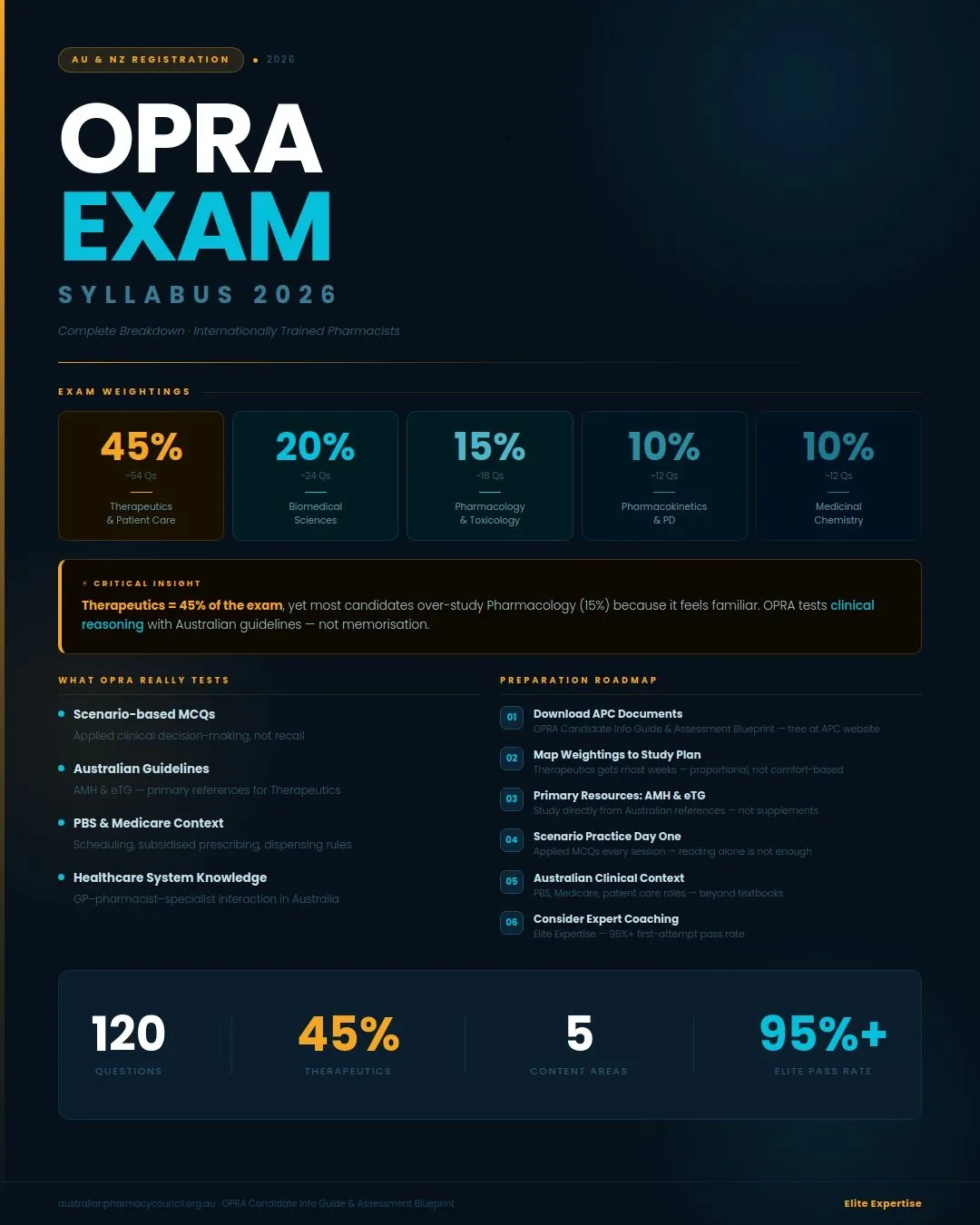
The OPRA exam syllabus covers five content areas. Here they are with their official weightings:
| Content area | weightage | Approximate questions |
| Therapeutics & Patient Care | 45% | ~54 questions |
| Biomedical Sciences | 20% | ~24 questions |
| Pharmacology & Toxicology | 15% | ~18 questions |
| Pharmacokinetics & Pharmacodynamics | 10% | ~12 questions |
| Medicinal Chemistry & Biopharmaceutics | 10% | ~12 questions |
Now look at that table and tell me, who won the exam or lost?
Therapeutics & Patient Care. 45%. Nearly half the exam. 54 of your 120 questions.
And yet when I look at how most internationally trained pharmacists approach their preparation, the majority of study time goes into pharmacology and biomedical sciences, areas that together account for 35% of the exam, simply because those feel more familiar and more comfortable to study.
This is the core strategic error that the syllabus, if read carefully, explicitly warns you against. The weightings are not arbitrary. They reflect exactly what the Australian Pharmacy Council has determined matters most for safe and competent pharmacy practice in Australia. When the APC puts 45% of the exam into therapeutics and patient care, they are telling you something important about what kind of pharmacist the Australian healthcare system needs.
Why Therapeutics Is Different From What You Think
Here's where I want to offer an honest opinion rather than just information.
Most candidates, when they see "Therapeutics & Patient Care," think of it as an extension of pharmacology, drug names, indications, side effects, interactions. They approach it as content to memorise. And they wonder why the questions feel harder than expected.
Therapeutics in the OPRA context is not a content area. It is a clinical reasoning area.
The questions don't ask you to state that metformin is first-line in type 2 diabetes. They give you a patient with type 2 diabetes, stage 3 chronic kidney disease, a recent HbA1c of 9.2%, and a current medication list — and they ask you what the appropriate pharmacological management is now, and what monitoring parameters you would apply.
That's a completely different cognitive task. It requires you to synthesise multiple pieces of information, apply Australian clinical guidelines (specifically, Therapeutic Guidelines and the Australian Medicines Handbook), and arrive at a clinically defensible decision — all within the time pressure of a 120-question exam.
This is why candidates who study OPRA the way they studied for their overseas pharmacy degree often struggle. And it's why understanding what the syllabus is actually asking you to demonstrate — before you open a single textbook — changes everything about how you prepare.
The OPRA Syllabus in the Context of Your Registration Journey
Let's zoom out for a moment, because I think there's a bigger point worth making here.
Your Australian pharmacy registration journey has several stages. There's the eligibility assessment, the English language requirements, the OPRA application, the exam itself, and then the post-OPRA registration process through Ahpra. Each stage matters.
But the OPRA exam is the stage where the most candidates get stuck — and where getting stuck has the most significant consequences. A failed attempt means months of waiting for the next sitting. It means additional cost. It means delayed registration, delayed employment, delayed everything.
The OPRA exam syllabus is the tool that, if used properly, makes a first-attempt pass significantly more likely. It tells you exactly what's tested, in what proportions, at what level of depth. It removes the guesswork that causes candidates to over-prepare in the wrong areas and under-prepare in the areas that actually matter.
From a registration journey perspective, mastering the syllabus before mastering the content is not just good exam strategy. It is the single highest-leverage thing you can do at the start of your preparation.
What the Syllabus Doesn't Tell You — And Why That Gap Matters
Here's where I want to be direct about something.
The OPRA exam syllabus tells you what is tested. It does not tell you how to study it, which Australian resources to use, how to approach adaptive MCQ questions under time pressure, or where internationally trained pharmacists most commonly lose marks.
That gap — between knowing the syllabus and being able to perform against it on exam day — is real. And it's the gap that separates candidates who pass comfortably from candidates who narrowly miss or fail outright.
Filling that gap requires a few things:
The right clinical references
The Australian Medicines Handbook and Therapeutic Guidelines are not optional supplements. They are the primary language of the OPRA therapeutics section. If you're studying therapeutics from a general pharmacology textbook or your home country's formulary, you are preparing for a slightly different exam than the one you'll actually sit.
Applied scenario practice from day one
The exam is scenario-based. Your preparation should be scenario-based. Reading content and then doing a few questions at the end of a chapter is not sufficient preparation for an adaptive MCQ exam that tests clinical reasoning. Scenario practice needs to be built into every study session, not tagged on at the end.
Understanding the Australian clinical context
This is the part that self-study alone genuinely struggles to deliver. The Australian healthcare system, how GPs, pharmacists, and specialists interact, how medications are scheduled and dispensed, how clinical decisions are made within Medicare and PBS frameworks, has nuances that aren't captured in any single textbook. This is the contextual knowledge that makes the difference between reading an AMH entry and truly understanding what it means for patient care in Australia.
Structured expert guidance
This is why programs like Elite Expertise, led by Arief Mohammad and Harika Bheemavarapu — exist and why their candidates consistently achieve pass rates above 95%. It's not because they have access to secret content that isn't in the syllabus. It's because they teach candidates how to think through OPRA questions the way the exam actually rewards — within the Australian clinical context, at the right depth, with the right applied reasoning skills.
The syllabus is the foundation. Expert guidance is what builds on top of it effectively.
A Direct Opinion on How Most Candidates Approach This
I'll be straight here because I think this needs saying clearly.
The majority of OPRA candidates approach the exam the way they approached their undergraduate pharmacy exams. They look for content to memorise. They search for the most comprehensive set of notes they can find. They download PDFs from Telegram channels without verifying the source. They study what feels familiar rather than what the exam weights most heavily. And then they're surprised when the exam feels harder and more applied than they expected.
OPRA is not an undergraduate exam. It is a professional readiness assessment for people who already have pharmacy degrees and registration. It is designed to test whether you can function as a pharmacist in a specific, real-world healthcare environment — not whether you can recall information under pressure.
The candidates who perform best are not necessarily the ones who studied the most hours. They are the ones who understood what the exam was asking, built their preparation around the syllabus weightings, practised applied clinical reasoning consistently, and used Australian-specific clinical resources throughout.
The syllabus is the starting point for all of that. Not the boring administrative document you read once and forget. The strategic foundation of your entire preparation.
Practical Steps to Take Right Now
If you're in the early stages of your OPRA preparation, here is exactly what I'd suggest doing this week:
- Download the official APC documents — the OPRA Candidate Information Guide and the OPRA Assessment Blueprint, both free on the Australian Pharmacy Council website
- Map the weightings against your current knowledge — for each of the five content areas, honestly assess where you're strong and where you have gaps
- Get access to AMH and eTG — these are your primary therapeutics references, not supplementary ones
- Build a proportional study plan — Therapeutics & Patient Care gets the most weeks, not pharmacology
- Commit to scenario-based practice from week one — not just content review
- Consider structured coaching — particularly for the therapeutics section and Australian clinical context, where self-study has the clearest limitations
Final Thought
The OPRA exam syllabus is, in many ways, a test of how seriously you take your own preparation.
Candidates who read it carefully, build their study plan around its weightings, and use it as an active reference throughout their preparation tend to pass. Candidates who treat it as a formality and study based on instinct and familiarity tend to struggle — not because they aren't capable, but because they prepared for the wrong exam.
You've worked hard to get to the point of sitting OPRA. Your overseas degree, your home country registration, your English proficiency — all of that got you to the starting line. The syllabus is what tells you how to run the race.
Treat it accordingly.
Frequently Asked Questions
What is the significance of the OPRA exam syllabus for pharmacy registration in Australia?
The OPRA exam syllabus is crucial as it outlines the content areas and their weightings for the exam, helping candidates understand what is most important to study. Treating the syllabus as a foundational document rather than a formality can significantly impact a candidate's chances of passing on the first attempt.
How should internationally trained pharmacists approach studying for the OPRA exam?
Candidates should focus on the syllabus's weightings, prioritizing therapeutics and patient care, which comprise 45% of the exam. It is essential to engage in scenario-based practice and utilize Australian-specific resources to understand the clinical context rather than relying solely on familiar pharmacology content.
Why do many candidates struggle with the OPRA exam despite having a pharmacy degree?
Many candidates approach the OPRA exam as they did their undergraduate studies, focusing on rote memorization rather than understanding clinical reasoning and application. This can lead to difficulties with the exam's scenario-based questions, which require a synthesis of information and application of Australian clinical guidelines.
What are the main content areas covered in the OPRA exam syllabus?
The OPRA exam syllabus includes five main content areas: Therapeutics & Patient Care (45%), Biomedical Sciences (20%), Pharmacology & Toxicology (15%), Pharmacokinetics & Pharmacodynamics (10%), and Medicinal Chemistry & Biopharmaceutics (10%). Understanding these areas and their respective weightings is key to effective exam preparation.
How can candidates fill the gap between knowing the syllabus and performing well on the exam?
Candidates can bridge this gap by using appropriate clinical references like the Australian Medicines Handbook and Therapeutic Guidelines, practicing scenario-based questions, and seeking structured guidance. This approach helps them apply their knowledge effectively in the Australian healthcare context, which is critical for success.
What resources should candidates rely on when preparing for the OPRA exam?
Candidates should prioritize the Australian Medicines Handbook and Therapeutic Guidelines as primary resources for studying therapeutics. Additionally, engaging with structured coaching programs can provide the necessary context and guidance for navigating the exam's requirements effectively.
What common mistakes do candidates make when preparing for the OPRA exam?
A common mistake is focusing too heavily on pharmacology and biomedical sciences, which do not reflect the exam's primary focus on therapeutics and patient care. Additionally, many candidates tend to study content that feels familiar rather than what is actually tested, which can lead to inadequate preparation.




























Sign in to leave a comment.