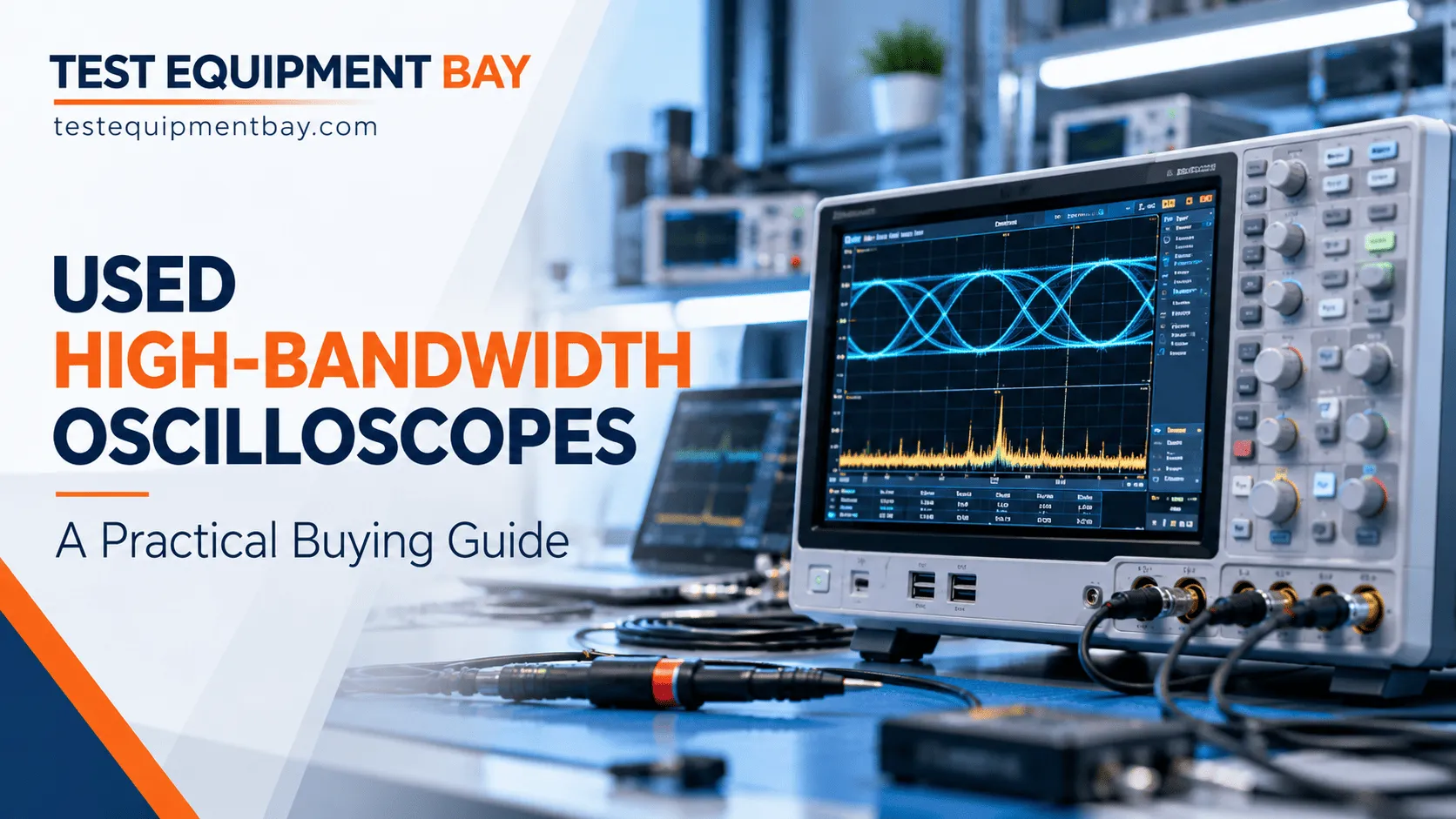

Oscilloscope Bandwidth and Sample Rate: What Engineers Should Know
Choosing an oscilloscope requires more than comparing prices or selecting the instrument with the highest specifications. Engineers need to understand how bandwidth, sample rate, memory depth and channel configuration affect the measurements they perform.
These factors become particularly important when troubleshooting high-speed digital circuits, investigating signal integrity, or validating electronic designs.
Why Does Oscilloscope Bandwidth Matter?
Bandwidth describes an oscilloscope's frequency response and its ability to reproduce signal components accurately. An instrument with insufficient bandwidth can display rounded edges or underestimate signal amplitude.
The appropriate bandwidth depends on the signal's frequency content, rise time and required measurement accuracy. Engineers working with fast digital transitions may need significantly more bandwidth than those performing basic low-frequency measurements.
Selecting excessive bandwidth can also increase equipment costs without providing meaningful benefits for the intended application.
Sample Rate and Memory Depth
Sample rate determines how frequently an oscilloscope captures signal data. A suitable sample rate helps preserve waveform details, while sufficient memory depth allows engineers to record longer periods without sacrificing the sampling resolution required for analysis.
Buyers should check whether the quoted sample rate applies to one channel or is shared across multiple channels. They should also consider whether the instrument supports the triggering and analysis features required for their work.
Choosing a Used High-Bandwidth Oscilloscope
A pre-owned oscilloscope may offer a practical way to access advanced measurement capabilities while controlling equipment expenditure. However, the model name alone does not establish whether an instrument is suitable.
Before purchasing, verify the exact configuration, installed software options, channel functionality, calibration history and included probes. Also consider warranty coverage, return conditions and the availability of replacement accessories.
For a more detailed checklist covering model selection, inspection and total ownership costs, read the used high-bandwidth oscilloscope buying guide.
Make the Decision Based on Your Application
The best oscilloscope is the one that meets your measurement requirements without unnecessary expense. Define the signals you need to capture, establish the minimum specifications, and compare the full cost of each instrument before making a decision.
A structured evaluation can help engineers select equipment that fits their laboratory workflow and long-term testing needs.
























Sign in to leave a comment.